Army boosts incentives in battle for new recruits
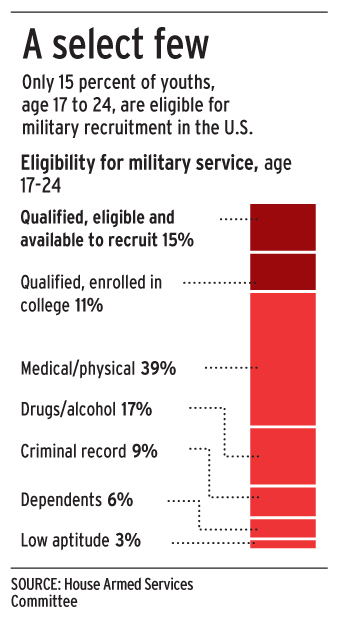
Graphic shows percentage of individuals eligible and ineligible for military service; two sizes; 1c x 3 inches; 46.5 mm x 76.2 mm; 1c x 3 1/2 inches; 46.5 mm x 88.9 mm
Washington ? Tyka Pettey wanted to go to a university. And she needed a car.
The Army is making both possible for the 21-year-old. She joined the Army Reserve in late July and leaves in about a week for boot camp to start her new life as a soldier. She’s getting a $20,000 signing bonus and is eligible for college money.
“You’re really taking a major step from your civilian life : but I just decided to go for it,” said Pettey, of Philadelphia.
The incentives could get even better for recruits under an Army proposal that military leaders say is needed to fill wartime ranks.
Under the plan, men and women who enlist could pick from a “buffet” of incentives, including up to $45,000 tax-free that they accrue during their career to help buy a home or build a business. Other options would include money for college and to pay off student loans.
An Associated Press review of the increasingly aggressive recruiting offerings found the Army is dangling more sign-up rewards – and loosening rules on age and weight limits, education and drug and criminal records.
It’s all part of an Army effort to fill its ranks even as the percentage of young people who say they plan to join the military has hit a historic low – 16 percent by the Pentagon’s own surveying – in the fifth year of the Iraq war.
In June, the Army failed to meet its recruitment target for the second month in a row, although it apparently met its goal to recruit 9,750 troops in July and is on target for 80,000 for the year that ends Sept. 30. The service spent nearly $1 billion last year on recruiting bonuses and ads.
Defense Secretary Robert Gates wants to increase the size of the active-duty Army by 65,000 to a total of 547,000 within five years. In part, that’s to ease the wartime strain on the Army, which is the largest branch of the military.
“Recruiting next year and beyond will remain challenging and will : require additional innovative approaches,” said Lt. Col. Michael Rochelle, the Pentagon’s deputy chief of staff for personnel. He asked lawmakers last week on Capitol Hill for money to pay for the new program.
Beyond the Iraq war, the military says other factors have affected its ability to recruit. More high school graduates are going to college, and the economy is strong, providing lots of civilian jobs.
National

Unhealthy air quality in California city as huge warehouse fire burns for 3rd day
Judge orders Trump administration to restore National Park changes at sites that ‘disparaged’ US
Teens’ reading and math scores have stagnated, US test results show
WASHINGTON (AP) — Younger students have regained ground academically after the pandemic's disruptions while older ...
Lawyers for man accused of killing Charlie Kirk try to block death penalty

Trump’s name poised to come off Kennedy Center