Iraqis find unlikely unifying force
Baghdad ? By early Friday night, families here were hunkered around their televisions, nervously awaiting the election results that would come hours later. In the northern Iraqi town of Irbil, thousands packed into a shopping mall courtyard and stood before a massive screen, shouting for the victory of their candidate: “Shada! Shada!”
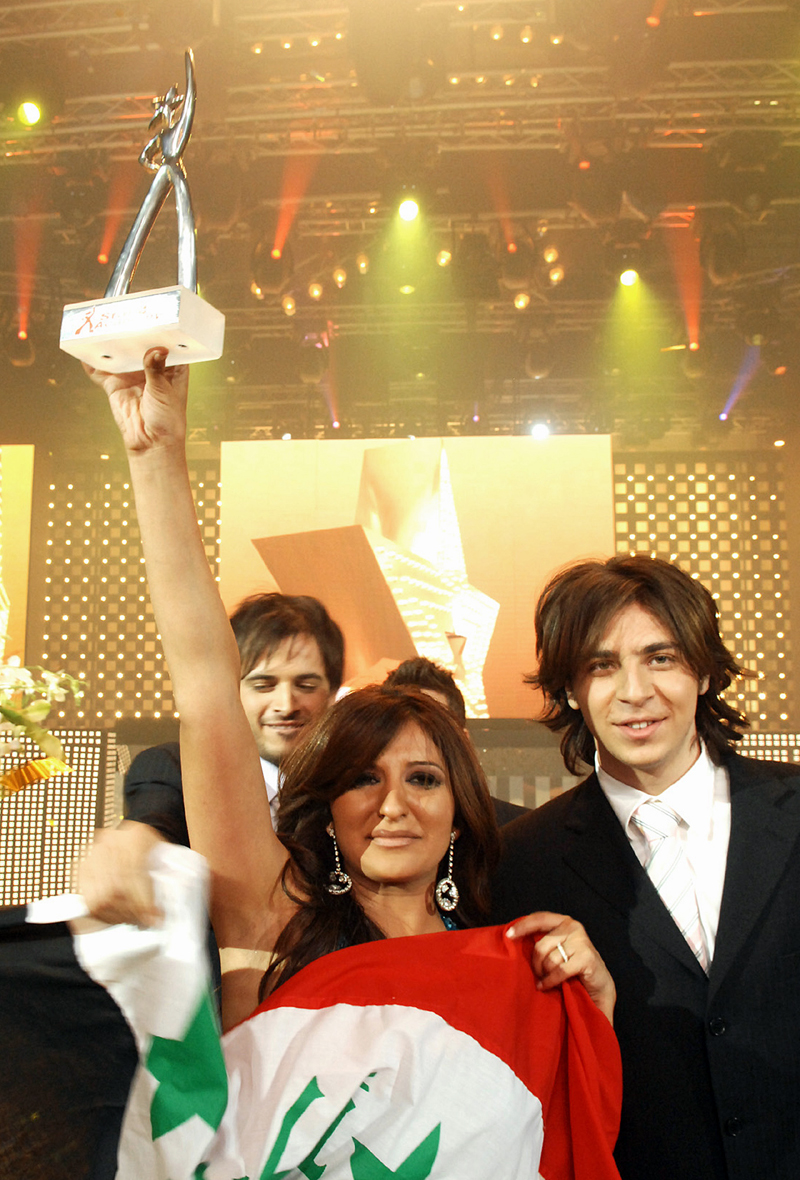
Iraqi singer Shada Hassoun, wrapped with her national flag, holds the trophy as she celebrates her win of a pan-Arab singing contest on Lebanese LBC satellite television in Beirut, Lebanon, Friday. The 26-year-old Iraqi woman has captivated fellow countrymen for weeks, giving them a respite from the violence plaguing their nation. Her triumph was met with volleys of celebratory gunfire in Baghdad.
The chestnut-maned object of their obsession was Shada Hassoun, Iraq’s contestant on the fourth season of the Lebanese show “Star Academy,” the “American Idol” of the Arab world. She had made Friday’s finals, and a public vote, sent via cellphone, would decide her fate. And so Iraqis everywhere were in a Shada frenzy this week – causing many to observe that, win or lose, Hassoun, 26, who professes to love jet-skiing and Antonio Banderas, had managed to engender a sense of national cohesion that has eluded Iraq for years.
“Sunnis and Shiites will unite with your victory!” read one text message, sent by a viewer, that scrolled across the screen Friday during a pre-show on Iraq’s al-Sharqiya satellite channel. “You are the one who unites all of Iraq, from the North to the South, from the Tigris to the Euphrates!”
Hassoun might seem an unlikely ambassador for Iraq because she’s never been to the country. Born in Casablanca, Morocco, she lays claim to Iraqi nationality through her father, a native-born member of the Shimary tribe of southern Iraq. Some say the distance may also have aided her rise as a unity candidate: No one knows for sure whether she’s Sunni or Shiite, so both sects have claimed her. And living abroad is forgivable these days in Iraq, which many residents have fled as violence has worsened.
But what really counted, fans said, is that the beautiful, Paris-educated Hassoun embraced bombed-out, struggling Iraq. Iraq, in turn, embraced her.
“We heard she lived in Morocco and has never been in Iraq. And she loves her country so much. Imagine how great her love would be if she lived here!” said Ahmed Kadhiim, 32, a day laborer sipping a Diet Pepsi in a small market in central Baghdad on Friday. Around him was a small crowd of boys and men, who estimated that among them, they had cast at least 500 votes for Hassoun this week.
Iraqis have been gripped by Hassoun’s travails on “Star Academy.” She bickered with other contestants, got poor reviews after forgetting her lyrics and fretted constantly that her nose is too pointy. Last week, she lay on a bed, crying that her countrymen were too busy and besieged by war to take the time to vote for her.
And they have rejoiced at her victories: She was selected as one of nine contestants to go on the “Star Academy” world tour. She was voted best “pal” by her colleagues and offered her choice of a trip to Spain or a nose job. (She chose the nose job when told she could postpone it until after the contest, so as not to affect her voice.) A week ago, she garnered 54.8 percent of the global vote, which sent her into the finals and jubilant Iraqis into the streets.
“She’s the queen,” said a breathless Emad Nuhad, 18, among the crowd at the Baghdad market Friday.
Not everyone was obsessed.
“Of course not,” said Ali al-Dabbagh, a spokesman for Iraqi Prime Minister Nouri al-Maliki, when asked if the country’s top leader was a “Star Academy” watcher.
With violence a constant threat, there is little else to do but stay home and watch television. Hassoun’s spangly dresses and sensual dancing symbolize a freedom now unknown in Iraq. Plus, there is her sultry alto voice.
But there was also something more profound, said Samir Stiphan, 62, as he sat in his Baghdad art gallery smoking cigarettes. He had been subjected to the show by his sister, he said, but was no fan; in his opinion, Hassoun was too Western, and his interest was politics.
“If the country didn’t have problems and we had a normal life, no one would vote for her,” he said, exhaling a puff of smoke. “The feeling that we have deep inside our hearts is that someone is trying to make us lose our Iraqi identity. That makes us hold onto anything that makes us feel we are Iraqis and we are united.”
National
Lawyers for man accused of killing Charlie Kirk try to block death penalty

Trump’s name poised to come off Kennedy Center

Suspect in Texas shooting had fired at police days earlier, officials say

Man pleads guilty to killing a top Minnesota Democrat and her husband
New tornadoes outside Chicago as severe storms pummel the Midwest