

Scans reveal Mona Lisa secrets
Paris ? Maybe they should call it the “Mama Lisa.”
Researchers studying 3-D images of the “Mona Lisa” say she was probably either pregnant or had just given birth when she sat for Leonardo da Vinci’s 16th century masterpiece. The clue was something she wore.
Scans turned up evidence of a fine, gauzy veil around Mona Lisa’s shoulders – a garment women of the Italian Renaissance wore when they were expecting, a leading French museum researcher, Michel Menu, said this week.
As the painting aged, the veil darkened. The thick, dark varnish on the work made it difficult even to know what color her dress is – it has been described as everything from black to brown to green. A piece of fabric draped over Mona Lisa’s shoulder sometimes was interpreted as a shawl or scarf.
But images obtained from infrared reflectography tell a different story. The veil – called a guarnello – is transparent, and it looks similar to a gauzy garment in Sandro Botticelli’s “Portrait of a Lady,” depicting a pregnant woman with her hand over her stomach.
Tradition holds that the “Mona Lisa” is a painting of Lisa Gherardini, wife of Florentine merchant Francesco del Giocondo, and that Leonardo started painting it in 1503. In France, the painting, on display at the Louvre Museum, is referred to as La Joconde – the French version of her married name. The name Mona Lisa is the equivalent of “Madam Lisa.”
The veil “would confirm art historians’ hypothesis that Giocondo asked for a painting of his wife to celebrate the birth of his second son,” said Menu, chief of the research department at the French Museums’ Center for Research and Restoration, which has its offices in the Louvre.
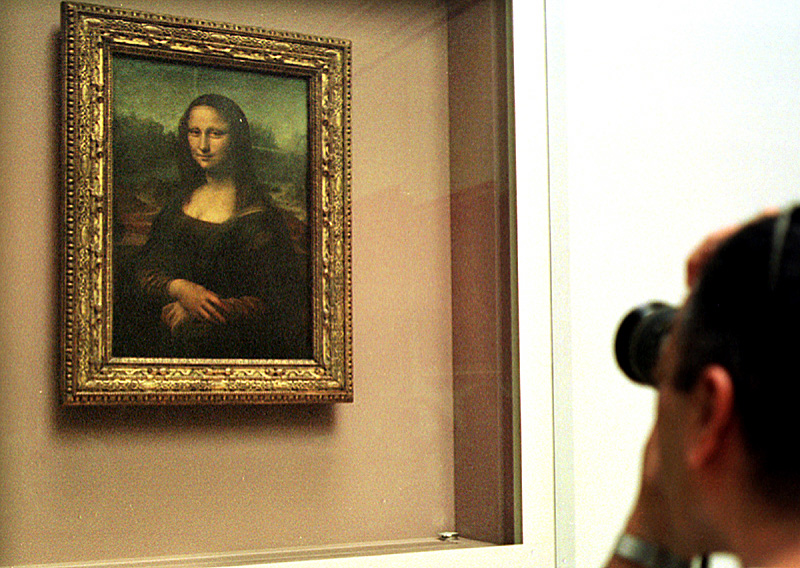
Mona Lisa, the woman depicted in Leonardo da Vinci's 16th century masterpiece, was either pregnant or had recently given birth when she sat for the painting, a French art expert said. The iconic painting is shown here behind a protective glass at the Louvre in Paris.
The scans also make clear that Mona Lisa does not have her hair down, as it appears. Most of her tresses are pinned back into a chignon and covered with a veil, Menu said. The analyses of hairstyle and clothes were made by Bruno Mottin, curator of the research department at the center.
Various high-grade scans were taken during three sessions in October 2004, on days when the Louvre was closed, sometimes overnight.
The scans have been collected in a book, “Mona Lisa: Inside the Painting,” published this month by Harry N. Abrams Inc. Menu and Mottin wrote the book with another leading French researcher, Jean-Pierre Mohen.
Teams from the National Research Council of Canada analyzed the painting with three-dimensional digitization through laser scanner technology. The scans revealed depth resolution so detailed it was possible to see differences in the height around the paint surface cracks and in the thickness of the varnish.
“We know how the painting is painted with very thin layers,” Mottin said Wednesday in Ottawa, Canada. “That’s one of the things we couldn’t see by the naked eye, and that Canadian technology brought us.”
The data show warping in the poplar panel Leonardo used as his canvas, but the painting is in relatively good shape.
Arts and Entertainment

Photos: Lawrence begins World Cup festivities with downtown block party
Watkins Museum to open special exhibit detailing how Douglas County celebrated America’s Bicentennial

Go, See, Do: Kaw River Roots Festival, markets and more

Soccer gear honoring Lawrence history’s all-star team is now on sale as part of city’s public art exhibition
Nominations, call for artists open for Lawrence’s 2026 Phoenix Awards