Rita damage remains a year later
West Orange, Texas ? Sam Henry swept dead pigs off Highway 87 two days after Hurricane Rita tossed them there. Then his job turned really unpleasant.
He pulled double shifts for the Texas Department of Transportation, hauling trash and patching roads cleaved by uprooted trees. The long days worsened Henry’s ailing knees but hastened the repair of vital infrastructure.
In some parts along the Texas-Louisiana border, it seems as if there never was a Category 3 hurricane that pummeled the region one year ago today.
The story on Henry’s street is different.
In his neighborhood, a cluster of families working jobs like construction and maintenance, rebuilding the rural swath of southeast Texas has come at the expense of their own homes. Many are among the few still living in FEMA trailers that flank their tarp-covered houses, which remain neglected following long workdays.
“You can’t work seven days a week forever,” said home renovator Sheila LeLeaux, who lives near Henry and has a monthlong backlog of clients waiting for her to gut their houses.
Rita landed in Sabine Pass on Sept. 24, 2005, packing 120 mph winds that flattened the coastal hamlet before splaying into East Texas and lashing western parts of Louisiana. At least nine were killed after the storm roared ashore, and thousands of homes in the mostly poor and densely wooded path of the storm were destroyed.
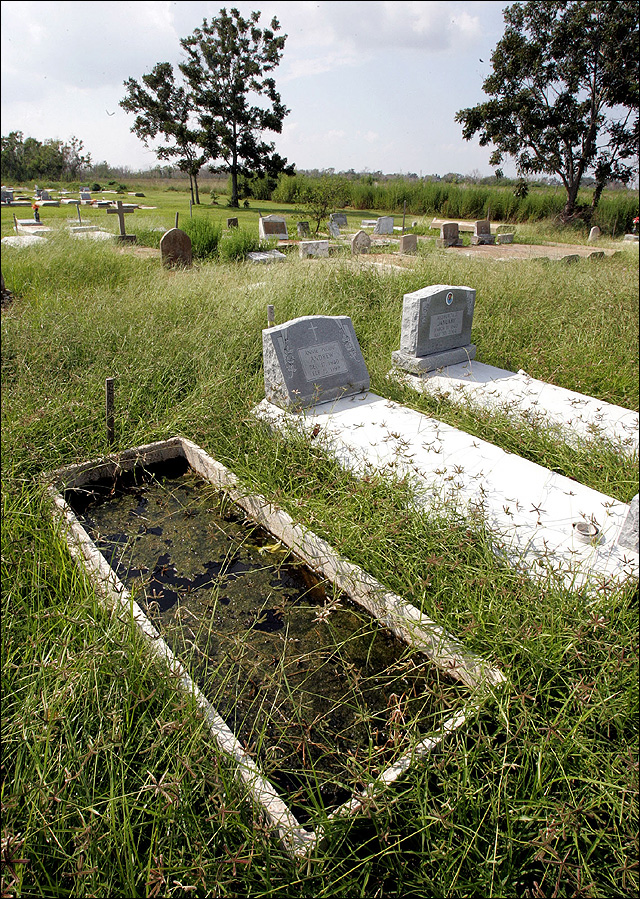
A year after Hurricane Rita, this grave sits empty and filled with stagnant water Sept. 15 at Ebenezer Baptist Cemetery in Cameron, La. The vault and casket of this grave were yanked from the ground by churning floodwater from Hurricane Rita.
The Southeast Texas Regional Planning Commission estimates Rita residential damages at $2 billion – far less than the tens of billions in damages borne by Hurricane Katrina, but still a hefty price tag to area officials.
Already this year, LeLeaux and her husband have six times the number of home renovation jobs the couple contracts in a normal year.
LeLeaux, 41, hangs drywall and rips out floors for about 10 hours, seven days a week. Her toenails are freshly painted bright pink but she’s embarrassed that she has no time to touch up the gray roots in her hair. Nor does she have a spare hour to clean her house or wash the pile of laundry on her kitchen floor – she now pays her mother $50 to do that.
Henry’s FEMA trailer is parked next to a simple square house rendered uninhabitable since Rita buckled the walls and pushed the frame from the slab.
Orange County Judge Carl Thibodeaux, who’s still waiting for his county’s slice of the $74.5 million in federal aid awarded to the state in December, paints a brighter picture. To be sure, the county has come a long way since spending the first month without power and policing gas station lines that formed three hours before pumps were turned on.
The county still sorely lacks hourly wage workers because most low-rent apartment complexes remain uninhabitable. But repaired homes in West Orange outnumber the damaged ones, and Thibodeaux believes the county needs only about another year before the last blue tarp is peeled from a roof.
Thibodeaux believes that some whose homes still require dramatic overhauls are the same residents who failed to keep up their properties before Rita.
“The storm has just magnified this,” he said.
National
Teens’ reading and math scores have stagnated, US test results show
WASHINGTON (AP) — Younger students have regained ground academically after the pandemic's disruptions while older ...

Lawyers for man accused of killing Charlie Kirk try to block death penalty

Trump’s name poised to come off Kennedy Center

Suspect in Texas shooting had fired at police days earlier, officials say

Man pleads guilty to killing a top Minnesota Democrat and her husband