Bush arrives at U.N. with policy problems at home, abroad
New York ? President Bush faced disagreement Monday over how to confront Iran’s nuclear ambitions and skepticism about his approach to Iraq and the Middle East as world leaders gathered for the U.N. General Assembly meeting.
Still, Bush was upbeat, focusing on his push for democratic change and first lady Laura Bush’s call for governments to embrace literacy programs to improve lives.
“We don’t believe freedom belongs only to the United States of America,” Bush said at the White House Conference on Global Literacy hosted by his wife. “We believe that liberty is universal in its applications. We also believe strongly that as the world becomes more free, we’ll see peace.”
Bush arrived in New York to attend the 61st session of the world body with policy problems at home and abroad that have narrowed his room to maneuver on the international stage.
The U.S.-led war in Iraq is in its fourth year with no end to bloody sectarian violence in sight. International support is dwindling for imposing sanctions against Iran for defying U.N. demands that it halt certain nuclear work. The repressive Taliban regime toppled in Afghanistan is showing new signs of resilience. The Israeli-Palestinian conflict continues and Lebanon’s government has, so far, proved too weak to rein in the Islamic militant group Hezbollah.
At home, Bush’s approval rating, while experiencing a recent uptick, stands at just 40 percent. Americans are growing weary of the war. The White House is in a showdown with Senate Republicans over the interrogation and trying of terror suspects. And elections that will determine which party controls Congress are seven weeks away.
The president’s so-called freedom agenda is the theme of his speech to the U.N. General Assembly today. He will focus on democratic reforms in Iraq, Afghanistan and Lebanon and elsewhere in the Middle East. He’ll seek to quell skepticism about U.S. motives in the Middle East by working to avoid the impression that he wants to see a U.S.-style democracy imposed on any nation.
In his speech, Bush is expected to say that while military and law enforcement actions are needed to curb terrorism, the ultimate weapons are freedom and opportunity. He is to note two type of states in the Middle East – those with an absence of freedom and weak ones with fragile democracies, such as Iraq and Lebanon.
“I think the president sees this … as a struggle between the forces of extremism and the forces of moderation in the Middle East,” national security adviser Stephen Hadley said, previewing Bush’s speech. “And it’s really a crucial time.”
The president also is expected to firmly denounce Iran and Syria, two nations that Bush says are working to thwart freedom in the region. Iranian President Mahmoud Ahmadinejad also planned to be at the United Nations, but Bush had no intention of talking with him.
National
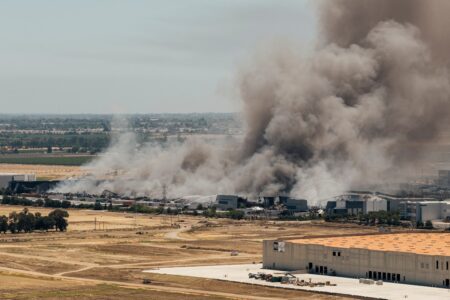
Unhealthy air quality in California city as huge warehouse fire burns for 3rd day
Judge orders Trump administration to restore National Park changes at sites that ‘disparaged’ US
Teens’ reading and math scores have stagnated, US test results show
WASHINGTON (AP) — Younger students have regained ground academically after the pandemic's disruptions while older ...
Lawyers for man accused of killing Charlie Kirk try to block death penalty
Trump’s name poised to come off Kennedy Center