Suppressing violence in capital is top U.S. priority, general says
Troops have moved from Anbar province to help secure Baghdad
Washington ? U.S. officials say they have not written off Iraq’s troubled Anbar province – the country’s largest, and one of its most violent – but neither are they sending more U.S. troops there to battle the insurgents.
In fact, they have shifted some troops from Anbar to Baghdad this summer, not because security conditions are improving in the western province but because they are deteriorating even more in the capital area. The Pentagon told Congress two weeks ago that Baghdad has some of the makings of an all-out civil war.
Anbar suddenly drew attention at the highest levels of the Pentagon this week with the disclosure in news reports of a remarkably pessimistic, secret assessment by the intelligence chief for Marines operating in Anbar. The assessment by Col. Pete Devlin said, in essence, that U.S. and Iraqi forces have battled to a stalemate with the insurgents in Anbar, and that economic and political breakthroughs are urgently needed.
Speaking to reporters Friday at the Pentagon from his headquarters in Baghdad, Lt. Gen. Peter Chiarelli, who oversees U.S. military operations throughout Iraq, said he agrees with Devlin’s conclusions – but apparently not with Devlin’s view that the situation cannot be rescued without an infusion of more U.S. troops.
“That’s Pete’s opinion,” Chiarelli said when a reporter noted that Devlin called for adding thousands more troops.
When placed in the broader context of what’s happening elsewhere in Iraq – namely the threat of civil war in Baghdad – U.S. commanders generally agree that Baghdad has to be a higher priority than Anbar, Chiarelli indicated. Therefore, the effort in Anbar should be seen as supporting, or secondary to, the Baghdad effort.
“That’s what we’re doing right now, and we’re going to continue to do that until we get the conditions in Baghdad where they need to be,” Chiarelli said.
The future of Anbar is in doubt, but Chiarelli strongly denied that U.S. officials consider it a lost cause.
“We are not, and I repeat we are not, looking to walk away from that province,” he said.
In a telephone interview Tuesday, the top U.S. commander in Anbar, Marine Maj. Gen. Richard Zilmer, said U.S.-led forces were “stifling” the insurgency there but are not strong enough to defeat it. He said his main mission is not to defeat the insurgency but to train Iraqi soldiers and police.
“Now, if that mission statement changes – if there is a larger role seen for coalition forces out here to win that insurgency fight – then that is going to change the metrics of what we need out here” in terms of U.S. troop levels, Zilmer said.
Asked about that comment, Chiarelli said no one should doubt that the U.S. goal in Anbar is to prevail against the insurgents.
“It is our job to win, but winning is a combination of not only what U.S. forces do on the ground, but our Iraqi counterparts,” Chiarelli said, adding that the government in Baghdad needs to follow through on promises to provide more resources for Anbar to revive the economy and get jobs for young men who are otherwise attracted to joining the insurgents, who offer higher pay than either the Iraqi army or police.
Barham Saleh, the deputy Iraqi prime minister, said Thursday during a Pentagon visit that he met recently with the governor of Anbar and promised to release “a lot of funds” to improve security and the economy.
“It’s not just a matter of security operations,” Saleh said. “People need to see reconstruction and they need jobs being made and so on.”
National
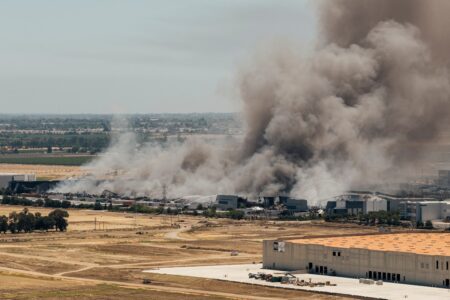
Unhealthy air quality in California city as huge warehouse fire burns for 3rd day
Judge orders Trump administration to restore National Park changes at sites that ‘disparaged’ US
Teens’ reading and math scores have stagnated, US test results show
WASHINGTON (AP) — Younger students have regained ground academically after the pandemic's disruptions while older ...
Lawyers for man accused of killing Charlie Kirk try to block death penalty
Trump’s name poised to come off Kennedy Center