

Work begins on space station addition
Houston ? Two spacewalking astronauts Tuesday began installing the first big addition to the international space station in more than 3 1/2 years, and NASA pronounced the outing a success, even though a small bolt floated off and got lost.
“I felt today like this is what NASA is supposed to do,” lead space station flight director John McCullough. “This is what we’re here to do.”
Wearing bulky suits and gloves, the two Atlantis astronauts ventured outside to begin attaching a new 17 1/2-ton box-like truss section that the space shuttle delivered this week. The job involved connecting 17 wires or tubes and tightening or loosening 167 bolts.
Astronaut Joe Tanner was working with a 1 1/2-inch bolt with an attached spring when the washer holding it in fell off. The bolt and spring floated over the head of astronaut Heidemarie Stefanyshyn-Piper and skittered across the truss.
While the washer went out into space harmlessly, Tanner worried the bolt and spring could get into the wiring and tubing of the truss and cause problems.
“I just hope that bolt is on its way to Mother Earth right now and not on its way” to a crucial joint, Tanner said.
Even though NASA didn’t have any video showing the bolt missing the mechanism, officials said they are certain that the bolt flew off into space harmlessly.
“It’s pretty trivial,” McCullough said. “It didn’t go inside.”
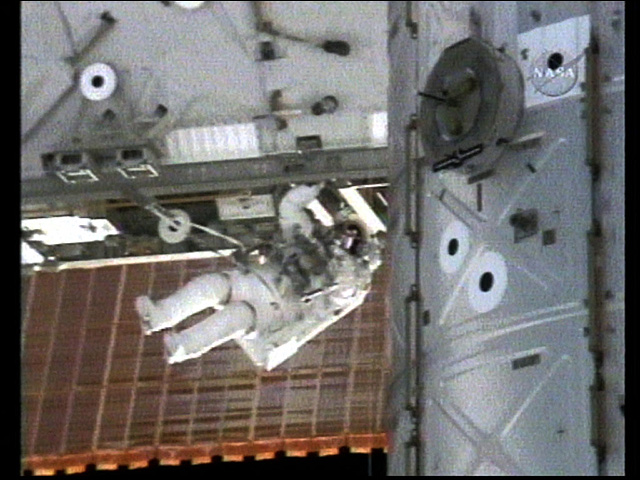
Mission Specialist Joe Tanner works during a spacewalk to install power and data cables on an addition to the international space station, in this image from NASA television. Two more spacewalks to complete construction are planned.
Space debris can be dangerous if it punctures space station walls or spacesuits and can jam crucial mechanisms. However, spacewalkers have a long history of losing things in space. In July, Discovery spacewalkers lost a 14-inch spatula that floated away.
Two more spacewalks will be conducted during the 11-day mission to finish hooking up the new addition to the half-built space station. Construction had been on hold since the Columbia disaster in 2003.
The 45-foot, $372 million addition includes two electricity-generating solar arrays that will be unfurled on Thursday. It will provide more power to the international space station in preparation for European, Russian and Japanese modules to be added in the next few years.
National

Suspect in Texas shooting had fired at police days earlier, officials say
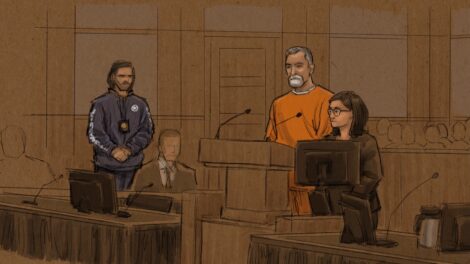
Man pleads guilty to killing a top Minnesota Democrat and her husband
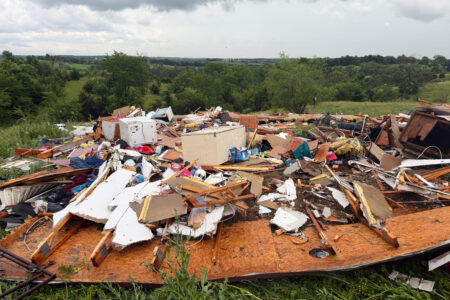
New tornadoes outside Chicago as severe storms pummel the Midwest

Feds won’t seek death penalty in plea deal with man accused of killing top Minnesota Democrat
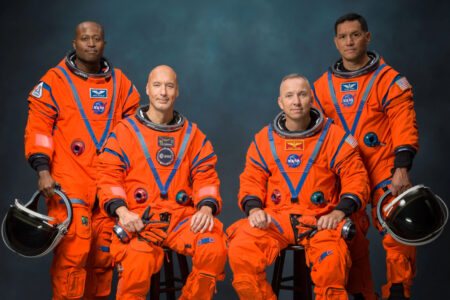
NASA unveils astronauts to test tech for future moon landing
Social Security’ fund faces shortfall one year earlier than expected
WASHINGTON (AP) — Social Security 's retirement trust fund is projected to face a funding shortfall in 2032, a ...