Survey: Americans more religious than thought
More Americans are active in religious groups than previously thought, and many others without ties to congregations still believe in God or a higher power, according to a broad survey of faith in America.
The survey was conducted by the Baylor University Sociology Department and the Baylor Institute for Studies of Religion as the first in a series on the spiritual life of Americans.
Researchers found that only 10.8 percent of Americans have no ties to a congregation, denomination or faith group. Previous surveys had put that figure at 14 percent, overlooking about 10 million people involved in some form of organized religion, the Baylor report said.
Baylor researchers found that one-third of Americans are evangelical Protestant, just under one-quarter are mainline Protestant, one-fifth are Roman Catholic and 5 percent are black Protestant. Jews comprise 2.5 percent of the population, while 5 percent of Americans belong to other faiths.
The rest are not fully secular, researchers said. More than 60 percent of the unaffiliated say they believe in God or a higher power, and nearly one-third say they pray at least occasionally. Eleven percent believe Jesus is the son of God.
Among the more religiously observant Christians, the term “evangelical” is unpopular, according to the study. Nearly 70 percent of evangelical and black Protestants say “Bible-believing” better describes their views. Nearly as many liked the term “born-again.”
Asked whether God favored the United States, only one-fifth of respondents said they agreed. Evangelical Protestants were the most likely to agree, with 26 percent saying they think God favors the country.
Researchers also examined Americans’ conception of God and found the greatest share – about 31 percent – think of God as “authoritarian,” deeply involved in people’s lives and world events, angry and capable of punishing the unfaithful. Nearly one-quarter consider God a “distant” force that set the laws of nature in motion, but is not active in the world. About the same percentage view God as “benevolent,” active in their daily lives, but less willing to condemn or punish.
And about 16 percent consider God “critical,” an observer who views the state of the world unfavorably and will mete out punishment in another life.
The survey of 1,721 respondents has a margin of error of plus or minus 4 percentage points.
National
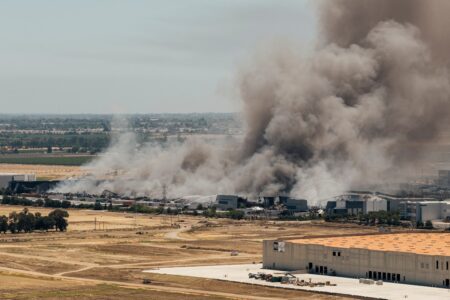
Unhealthy air quality in California city as huge warehouse fire burns for 3rd day
Judge orders Trump administration to restore National Park changes at sites that ‘disparaged’ US
Teens’ reading and math scores have stagnated, US test results show
WASHINGTON (AP) — Younger students have regained ground academically after the pandemic's disruptions while older ...
Lawyers for man accused of killing Charlie Kirk try to block death penalty
Trump’s name poised to come off Kennedy Center