Surge in American killings gives October grim distinction
Month could be deadliest since siege of Fallujah
Baghdad, Iraq ? Eleven more U.S. troops were slain in combat, the military said Wednesday, putting October on track to be the deadliest month for U.S. forces since the siege of Fallujah nearly two years ago.
The military says the sharp increase in U.S. casualties – 70 so far this month – is tied to Ramadan and a security crackdown that has left American forces more vulnerable to attack in Baghdad and its suburbs. Muslim tenets hold that fighting a foreign occupation force during Islam’s holy month puts a believer especially close to God.
As the death toll climbed for both U.S. forces and Iraqi civilians, who are being killed at a rate of 43 a day, the country’s Shiite-dominated government remained under intense U.S. pressure to shut down Shiite militias.
There have been growing signs in recent days of mounting strain between Washington and the wobbly government of Prime Minister Nouri al-Maliki, who felt compelled during a conversation with President Bush this week to seek his assurances that the Americans were not going to dump him.
Foreign Minister Hoshyar Zebari on Wednesday blamed American officials who ran Iraq before its own government took nominal control for bringing the country to the present state of chaos.
“Had our friends listened to us, we would not be where we are today,” Zebari said in an interview with The Associated Press.
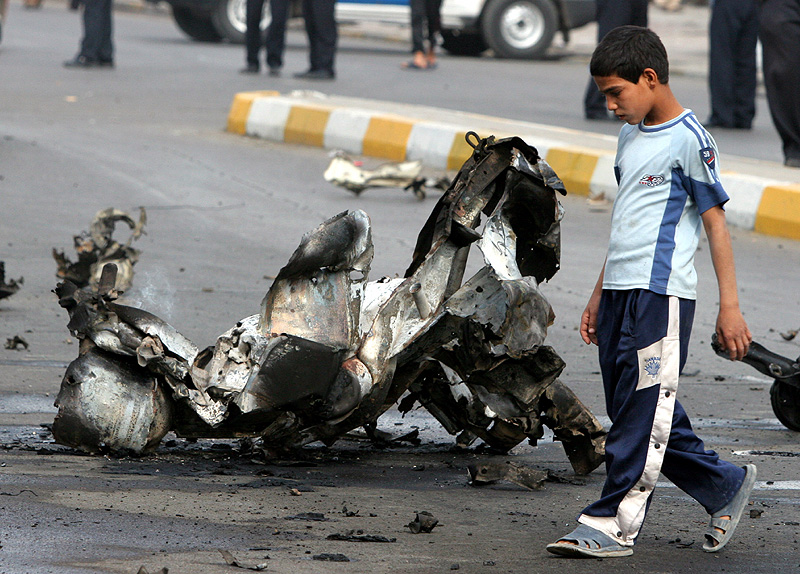
AN Iraqi boy walks past car bomb wreckage in Baghdad. A parked car exploded Wednesday in Baghdad's central Alwiya district, wounding seven bystanders. Across the country, 11 U.S. soldiers were killed Tuesday and Wednesday, bringing October's toll to about 70.
Asked which friends he was referring to, Zebari said:
“The Americans, the Coalition (Provisional Authority), the British. OK? Because they didn’t listen to us. The did exactly what they wanted to do. … Had they listened to us, we would have been someplace else (by now), really.”
It was an unusually harsh statement from Zebari, a Kurd, whose ethnic group owes much to the U.S. intervention in Iraq and for its virtual autonomy in the north of the country.
Despite the climbing death toll, the U.S. military claims it is making progress in taming runaway violence in the capital as it engages insurgents, militias and sectarian death squads, rounds up suspects and uncovers weapons caches and masses of stockpiled explosives.
October is now on track to be the deadliest month for American forces in Iraq since November 2004, when military offenses primarily in the then-insurgent stronghold of Fallujah, 40 miles west of Baghdad, left 137 troops dead, 126 of them in combat.
National
Unhealthy air quality in California city as huge warehouse fire burns for 3rd day
Judge orders Trump administration to restore National Park changes at sites that ‘disparaged’ US
Teens’ reading and math scores have stagnated, US test results show
WASHINGTON (AP) — Younger students have regained ground academically after the pandemic's disruptions while older ...
Lawyers for man accused of killing Charlie Kirk try to block death penalty
Trump’s name poised to come off Kennedy Center