Lengthy discussion doesn’t lead to decision on chef’s request
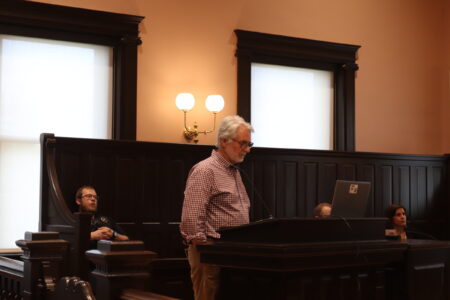
An east Lawrence chef who wants to operate an upscale private restaurant out of his home was turned away by city commissioners Tuesday night.
City commissioners at their weekly meeting declined to approve a request by Robert Krause to rezone his home at 917 Del. to allow for a by-reservation-only restaurant that would serve gourmet food to no more than 30 people per night.
Instead, a majority of city commissioners said they liked his unique restaurant idea but instructed Krause to go through a different, multimonth approval process that will require him to appeal to the Lawrence-Douglas County Planning Commission, Historic Resources Commission and, ultimately, the City Commission.
Krause, though, may have a different recipe: take his business to a different city.
“We’re basically out of money, so it is a financial issue for us at this point,” Krause said after the meeting.
Krause said he and his wife, Molly, would have to make a decision within the next few days about whether to try to continue to win approval for the project in Lawrence or follow up on previous opportunities to open the business in a different community.
The first domino?
The issue, which sparked more than three hours of debate at the City Commission meeting, ended up being about more than a request from a restaurant operator.
Krause’s rezoning request caused the East Lawrence Neighborhood Assn. board of directors to raise concerns that residential property in the neighborhood was facing increasing pressure to become commercial.
“We feel like this would be a domino going down,” said K.T. Walsh, secretary of the neighborhood association’s board of directors. “It is almost a religion in East Lawrence to hold onto residential zoning because it is getting eaten up on every side.”
A majority of commissioners ultimately agreed. Commissioners Boog Highberger, Mike Rundle and David Schauner all said they could not support rezoning the property to a commercial use.
But a majority of commissioners did say they would look favorably on granting the business idea a special use permit. A special use permit would make it more difficult for the commercial use to continue if the Krauses sold the property.
The problem is that the city’s Development Code does not allow restaurants to receive special use permits. The solution, commissioners decided, is to rewrite that section of the development code. That would require public hearings at both the Planning Commission and City Commission levels.
Presuming that the new code language wins approval, Krause could then apply for one of the new special use permits. That application would require him to go through public hearings at the Planning Commission, Historic Resources Commission and City Commission.
Unique addition
Krause currently operates a catering business out of his 1870s home and previously operated the private dining restaurant from about 2001 to 2005 until city inspectors determined that the restaurant violated the city’s zoning code.
People speaking in support of the project outnumbered those speaking against it at Tuesday night’s meeting. Many said Krause’s restaurant would be such a unique addition to Lawrence that it should be allowed.
“This business is the complete opposite of suburban sprawl,” said Michael Morley, an East Lawrence property owner. “They use local produce, local vendors whenever they can. This is the type of business we should be supporting.”
The issue also brought up questions about the city’s new zoning code that was adopted in July. Planning commissioners had recommended the city approve the rezoning but place strict conditions that would limit the property to use as a single-family home or a private restaurant that operated on a by-reservation-only status. Such conditional zoning was not allowed under the city’s previous zoning code, but city attorneys said it is allowed under the new code.
Representatives from the League of Women Voters, though, said they questioned whether a court would uphold such conditional zoning. Some city commissioners expressed concern because the concept never has been tested in a Kansas court.
City Government
Developer seeks incentive from City of Lawrence to build 131 units of housing near Wakarusa and Queens

Lawrence city leaders will consider whether to keep Community Building open, make 2 other rec centers free to access
A STAR Bond application raises questions for city leaders about Costco and housing west of the SLT
Soccer gear honoring Lawrence history’s all-star team is now on sale as part of city’s public art exhibition
To honor public servants, Lawrence’s July 4 celebration will have a whole gallery of their photos on display; submissions open now