Bush signs bill on detainee interrogation
Washington ? President Bush said he was saving lives with a stroke of his pen Tuesday, signing a law authorizing tough interrogation and prosecution of terror suspects.
The legislation gives legal protection to CIA agents who have used harsh techniques to force alleged terrorists to describe their plans, their al-Qaida leaders and other information that Bush said has helped prevent attacks on the U.S. It also opens the door for terror prosecutions before military commissions, without some of the rights defendants usually are guaranteed under U.S. law.
“It is a rare occasion when a president can sign a bill he knows will save American lives,” Bush said. “I have that privilege this morning.”
The Supreme Court ruled in June that trying detainees in military tribunals violated U.S. and international law, so Bush urged Congress to change the law during a Sept. 6 speech in the White House East Room attended by families of the Sept. 11, 2001, victims. He also insisted that the law authorize CIA agents to use tough – yet unspecified – methods to interrogate suspected terrorists.
Six weeks later, after a highly publicized dispute with key Republicans on the terms of the bill, Bush signed the new law “in memory of the victims of September 11th.”
“With the bill I’m about to sign, the men our intelligence officials believe orchestrated the murder of nearly 3,000 innocent people will face justice,” Bush said in a White House ceremony.
Imprisoned at Guantanamo Bay, Cuba, and awaiting trial are Khalid Sheikh Mohammed, the accused mastermind of the 9/11 attacks; Ramzi Binalshibh, an alleged would-be 9/11 hijacker; and Abu Zubaydah, who was believed to be a link between Osama bin Laden and many al-Qaida cells.
The Pentagon expects to begin pretrial motions early next year and to begin the actual trials in the summer.
Civil libertarians and leading Democrats decried the law as a violation of American values. The American Civil Liberties Union said it was “one of the worst civil liberties measures ever enacted in American history.” Democratic Sen. Russ Feingold of Wisconsin said: “We will look back on this day as a stain on our nation’s history.”
“It allows the government to seize individuals on American soil and detain them indefinitely with no opportunity to challenge their detention in court,” Feingold said. “And the new law would permit an individual to be convicted on the basis of coerced testimony and even allow someone convicted under these rules to be put to death.”
The legislation, which sets the rules for court proceedings, applies to those selected by the military for prosecution and leaves mostly unaffected the majority of the 14,000 prisoners in U.S. custody, most of whom are in Iraq. It does apply to 14 suspects who were secretly questioned by the CIA overseas and recently moved to the U.S. detention center at Guantanamo Bay.
The swift implementation of the law is a rare bit of good news for Bush as casualties mount in Iraq in daily violence. Lawmakers are increasingly calling for a change of strategy, and political anxieties are jeopardizing Republican chances of hanging onto control of Congress.
Bush has been criticizing Democrats who voted against the law, called the Military Commissions Act of 2006, during campaign appearances across the country. He has suggested that votes against the law show that Democrats would not protect the country from another terrorist attack.
Bush noted that the law came amid dispute.
“Over the past few months, the debate over this bill has been heated, and the questions raised can seem complex,” he said. “Yet, with the distance of history, the questions will be narrowed and few: Did this generation of Americans take the threat seriously? And did we do what it takes to defeat that threat?”
A coalition of religious groups staged a protest against the bill outside the White House, shouting “Bush is the terrorist” and “Torture is a crime.” About 15 of the protesters, standing in a light rain, refused orders to move. Police arrested them one by one.
National

Lawyers for man accused of killing Charlie Kirk try to block death penalty
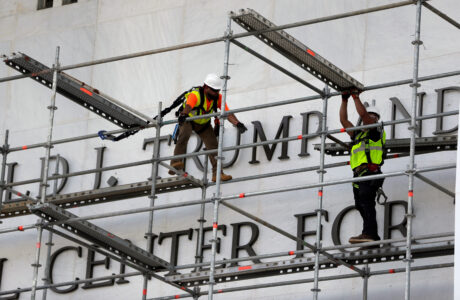
Trump’s name poised to come off Kennedy Center

Suspect in Texas shooting had fired at police days earlier, officials say
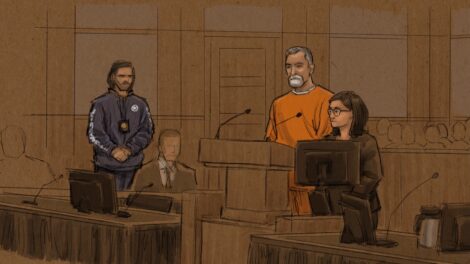
Man pleads guilty to killing a top Minnesota Democrat and her husband

New tornadoes outside Chicago as severe storms pummel the Midwest