Wisconsin may be first state to defeat gay marriage ban
Milwaukee ? When it comes to statewide votes on gay marriage, the score so far is 20-0 in favor of keeping it a one-man, one-woman institution.
If there’s a chance to break the streak on Nov. 7, it might be in Wisconsin, where activists believe that support from unions, college students and church leaders – coupled with hoped-for conservative apathy – could enable them to finally overcome the string of losses.
Among the hopeful are Debbie Knepke and Candice Hackbarth, devoted partners for nine years who are raising a 3-year-old daughter and 7-month-old son in Milwaukee. They have joined some 8,000 other volunteers in a bid to defeat a proposed state constitutional amendment that would ban same-sex marriage and civil unions.
“It makes us mad that the Christian conservatives are so against us,” said Knepke, 41. “If they came into our house, they’d find we’re no different from anybody else. We’re every single thing they consider good parents to be.”
Eight states will vote on ban-gay-marriage amendments in November, following 20 that previously approved such measures. Passage is considered certain in Idaho, South Carolina, South Dakota and Tennessee, but gay-rights strategists believe their side is at least competitive in Arizona, Colorado, Virginia and Wisconsin.
Supporters of banning gay marriage remain confident of victory, but optimism also is high in the ranks of Fair Wisconsin, a coalition fighting the proposed amendment since it surfaced in the Legislature in 2004. Large labor unions, many religious leaders and top Democratic officials – including Gov. Jim Doyle – have spoken out against the measure.
“This could be the state where we beat this thing,” said Fair Wisconsin campaign chief Mike Tate. “I’m not saying it’s easy, but we’ve got the right ingredients on the table.”
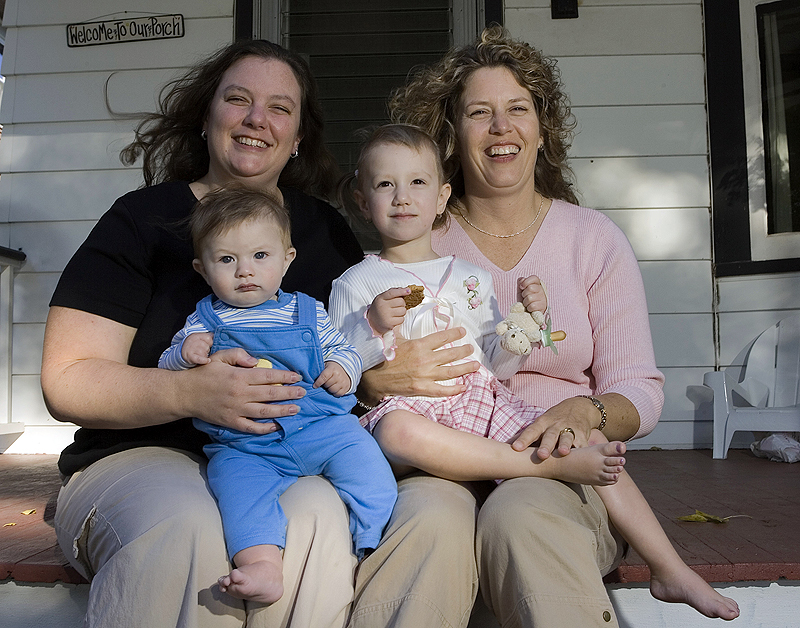
Candice Hackbarth, left, and Debbie Knepke sit on the porch of their Milwaukee home with their children, 7-month-old Nolan Hackbarth and 3-year-old Sienna Hackbarth. The couple and others in Wisconsin hope the state becomes the first to reject a statewide ban on gay marriage during the Nov. 7 election.
Tate believes the gay marriage issue – which helped motivate conservative voters in 2004 – is no longer fueling the same urgency, possibly diminishing conservative turnout. One reason is recent court rulings in New York and Washington state against same-sex unions, leaving Massachusetts as the only state allowing gay marriage.
The head of the rival campaign, Julaine Appling of Vote Yes For Marriage, said her side may wind up being outspent and out-advertised, but she believes Fair Wisconsin’s confidence is misplaced.
“It’s a gross misunderstanding of the people of Wisconsin,” she said. “They are good, solid stock. They understand that marriage is a good public institution – it’s appropriate to protect it as the union of a man and a woman exclusively.”
There have been no major opinion polls since mid-August, when a survey showed Appling’s “Yes” side with 48 percent support, compared with 40 percent against the amendment. Tate says the gap is narrowing as undecided voters tilt against the measure; Appling believes the final result will be in line with Michigan and Ohio, where similar measures prevailed with roughly 60 percent support in 2004.
One of Appling’s allies, Marquette University political scientist Christopher Wolfe, believes the amendment will pass, but perhaps narrowly.
“It’s certainly a lot closer than the people favoring the amendment would like,” said Wolfe, who observed that even at his Roman Catholic school many students oppose the ban.
Tate, at 27 a veteran of numerous campaigns, thinks campuses statewide will provide vital support for his side.
“This is a motivating issue for young people, whether they’re gay or not,” he said.
While Milwaukee and the state capital, Madison, tend to veer leftward, the rest of the state generally is more conservative. But opinions are deeply divided.
Debbie Knepke finds it hard to be dispassionate. Because the children she helps raise, Sienna and Nolan, were borne by Hackbarth, Knepke has no legal standing as a parent and fears passage of the amendment would dim her chances of ever gaining such recognition.
“It’s the living in fear of what might happen,” she said, fighting back tears. “I can’t imagine, if something happened to Candy, that I would not have my children.”
National

Unhealthy air quality in California city as huge warehouse fire burns for 3rd day

Judge orders Trump administration to restore National Park changes at sites that ‘disparaged’ US
Teens’ reading and math scores have stagnated, US test results show
WASHINGTON (AP) — Younger students have regained ground academically after the pandemic's disruptions while older ...
Lawyers for man accused of killing Charlie Kirk try to block death penalty

Trump’s name poised to come off Kennedy Center