Sweet & sour
Young author probes his personal life in critically praised 'Goodbye Lemon'
New York ? Critics assume that Adam Davies’ debut novel, “The Frog King,” is autobiographical. Protagonist Harry Driscoll, like Davies, is a young single guy living in New York, working for a publishing company and generally making a mess of his life.
But really, Davies says, only superficial details link him to that character.
His new novel, “Goodbye Lemon,” is another story.
The book deals with a dysfunctional family coming to terms with a sibling’s death and a father’s bizarre illness. While on the surface it doesn’t appear anything like Davies’ life, he says he drew heavily from his familial relationships to create the characters.
“A lot of the relationships are based on competitiveness, and based on silence,” he says. “But this is the way that men can be with each other. Me and my dad were certainly that way.”
Writer’s angst
Davies, 32, is something of a nomad. His father, Michael Davies, a well-known newspaper publisher, moved the family around the country as he took the helm of various papers, and after his parents divorced, Davies kept right on moving. He attended Kenyon College in the tiny Ohio town of Gambier and received a master’s degree in creative writing from Syracuse University. He taught creative writing at the University of Georgia, worked for Random House, Inc., in New York and has lived in San Francisco, Madison, Wis., Savannah, Ga., Athens, Ga., and New York all in the past six years. It sounds exhausting; Davies just figures it’s part of his life.
“But I felt a longing to be back in New York when I was in California,” he says. “My business is here; it just felt right to be here.”
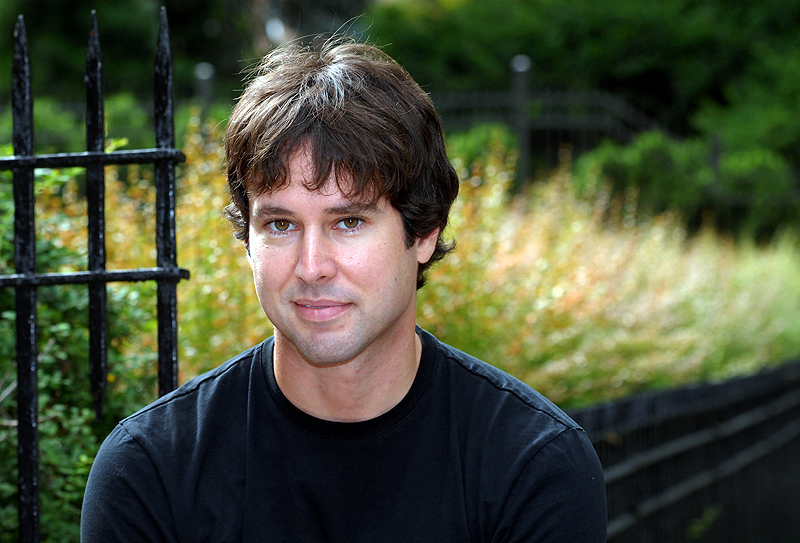
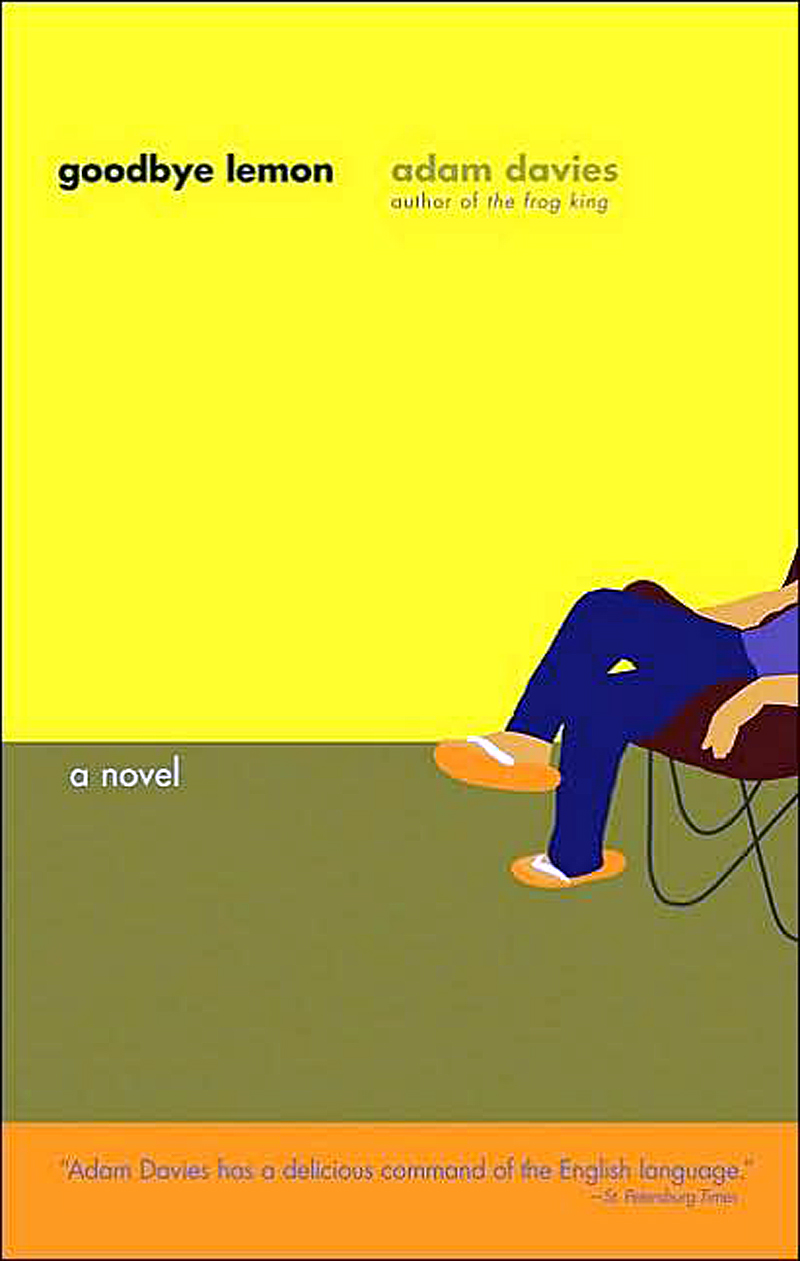
Writer Adam Davies' new novel, Goodbye
So, a few months ago, he bought an apartment in a cool Brooklyn neighborhood and hoped his girlfriend would end up at business school in New York. She didn’t: The two are suffering through a long distance relationship.
His apartment is starkly clean, filled with all the necessary metrosexual accouterments, including an iPod speaker, rows of Nick Hornby books and a soft, leather sofa.
He says it’s so clean because he scrubs when he can’t write, and he’s been suffering from a little writer’s angst lately. Before, when he needed to hunker down, he rented a dorm at Kenyon, channeling his inner-student.
“It just helped me write, to be in that chair, in that place, with no distractions,” he says.
Getting personal
“Frog King” was the thesis for his master’s degree, and indeed, the 2002 debut novel has a somewhat collegiate, lad-lit feel.
Hero Harry is a young dilettante toiling in publishing who mistreats a girl very badly and ends up learning a thing or two about himself.
Davies’ first job out of college was with Random House, and he, too, was in a relationship that ended badly, but he says there are no real similarities between the two.
“It was a love story, and I’m a young writer living in New York,” he says. “I could only write what I know. If I had worked in mushroom farming or microchipping, it would have taken place there.”
But when he sat down to write “Lemon,” at the Ohio college, he felt strangled, so he had to change, grow up a bit. “Maybe college was really over,” he says. “I just didn’t realize.”
The plot of “Lemon” is heavy: Anti-hero Jack Tenant, a would-be classical pianist and teacher, hasn’t seen his parents in 15 years, his relationship with his older brother is strained and his young brother drowned at age 6. Then his father has a debilitating stroke and is diagnosed with a rare disorder called locked-in syndrome that leaves him paralyzed; Jack goes home with his girlfriend to face the past.
Davies spent weeks researching the illness, and dug deep from his strained relationship with his father to make the character interaction feel more real.
“I was worried that my dad was going to hate it, that it would ruin our relationship,” he says.
The dead brother was based a bit on his strained relationship with his real-life brother, whom he doesn’t see much thanks to years of drug abuse.
Davies’ personal gamble has paid off. This time, USA Today called the book “a serious step forward.”
“‘Goodbye Lemon’ is mostly funny, evocative and emotionally true,” according to the review. “More important, there’s every indication that Davies will be just as successful when … he leaves lad lit behind for ambitious fare.”
Davies is working on another book about art theft, which hasn’t been sold to a publisher yet, but he’s confident he’ll get it published. And he’s not changing careers- or locations – anytime soon.
“I started writing because I had to find a way to live with myself,” he says. “I had all this personal anguish, and the only way I knew was to write about it.”
Arts and Entertainment

Watkins Museum to open special exhibit detailing how Douglas County celebrated America’s Bicentennial

Go, See, Do: Kaw River Roots Festival, markets and more

Soccer gear honoring Lawrence history’s all-star team is now on sale as part of city’s public art exhibition

Nominations, call for artists open for Lawrence’s 2026 Phoenix Awards
Go, See, Do: ‘Addams Family’, PRIDE parade and a host of library events among offerings