GOP leaders swept into scandal
Questions emerge in wake of congressman's resignation
Washington ? Republican leaders in Congress, including Speaker Dennis Hastert of Illinois, scrambled Saturday to distance themselves from a Florida congressman’s sex scandal as they disavowed responsibility for investigating the matter when it came to light months ago.
Aides to the speaker say he was not aware until last week of inappropriate behavior by Rep. Mark Foley, R-Fla., who resigned Friday after portions of racy e-mail exchanges between him and current and former underage congressional pages became public. But the aides conceded they could not be conclusive on the timing.
In the chaotic hours after news of the scandal broke, GOP leaders offered confusing versions of events about how much they knew, and when. One top House Republican said he relayed to Hastert his sketchy understanding of the situation months ago, and another said he “cannot say with certainty” whether he passed along the information or not.
Meanwhile, an aide to Rep. John Shimkus, R-Ill. – chairman of the board that oversees the page program – said Shimkus confronted Foley last year after learning of one e-mail message he sent to a former page. Shimkus declined to investigate when Foley assured him there was nothing to it, the aide said, and Shimkus declined comment Saturday, relying instead on his spokesman.
While House Republicans attempted to avoid blame, Democrats raised questions about why there wasn’t an official investigation after the first internal reports of impropriety.
“A 16-year-old kid was entrusted by his parents to the U.S. House of Representatives, and Congress has a responsibility,” said Rep. Rahm Emanuel, D-Ill., chairman of the Democratic Congressional Campaign Committee. “The most important questions are, ‘What did the Republican leadership know, when did they know it and, if they knew something, why didn’t they do anything to protect the child?”‘
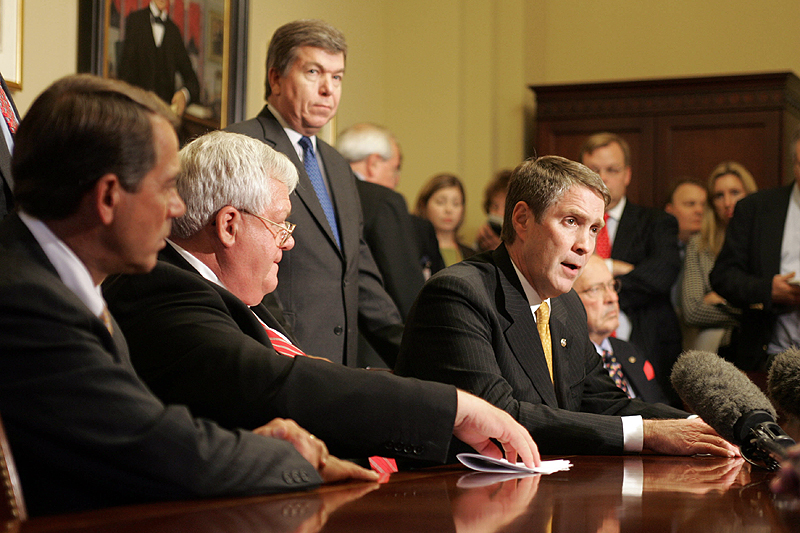
Senate Leader Bill Frist, right, makes a statement about the resignation of Rep. Mark Foley, R-Fla., in the wake of concerns about e-mails Foley wrote to a former teenage male page. Frist was joined Friday at the Capitol by Rep. John Boehner, far left, Speaker of the House Dennis Hastert, and Rep. Roy Blunt, R-Mo., standing. Questions have emerged as to when Frist and other GOP leaders became aware of concerns about Foley.
Foley’s resignation brings a new volatility to this fall’s midterm campaigns, in which Republicans are trying to fight off a Democratic insurgency to reclaim the House majority after 12 years of GOP rule. Democrats need to pick up 15 seats to take control of the chamber, and Foley’s heavily Republican district is now a surprise new opportunity for Democrats.
Party officials get to name a replacement candidate for Foley’s seat, but the ballots already have been printed with his name on them, and any votes cast for Foley will go to his stand-in.
Sure to get high-volume coverage on cable television, the latest revelations could affect the party’s appeal to its socially conservative base. Members of Congress left town last week with little to show on hot-button issues like immigration, and Congress’ ratings as an institution have sunk to levels not seen since 1994 when the GOP swamped Democrats to take control of the House.
The Foley story began to unfold Friday when ABC News reported that the congressman had exchanged explicit electronic messages with current and former male pages. Many of the messages were sexually suggestive.
But when the first reports of inappropriate e-mails began to percolate last year in Republican leadership offices, they centered on a milder message to an underage former page from Louisiana, Republican congressional aides say. In an e-mail to the 16-year-old, Foley asked him how he was doing in the wake of Hurricane Katrina and asked what he wanted for his birthday.
He also asked the boy to send a photo of himself, according to e-mail excerpts now widely available on the Internet. When Shimkus got news of that, he confronted Foley, according to Shimkus spokesman Steve Tomaszewski.
“Foley said he was trying to be a mentor,” Tomaszewski said. “The congressman (Shimkus) said, ‘For everybody’s well-being, you need to stop any contact with this former page.”‘
Shimkus did not know about the more explicit messages and didn’t take further action, Tomaszewski said.
“Obviously, there was more to this,” he said. “Foley basically lied to him.”
Officially, the matter is now in the hands of a House ethics panel charged with deciding whether there should be an investigation.
National
Lawyers for man accused of killing Charlie Kirk try to block death penalty

Trump’s name poised to come off Kennedy Center

Suspect in Texas shooting had fired at police days earlier, officials say
Man pleads guilty to killing a top Minnesota Democrat and her husband

New tornadoes outside Chicago as severe storms pummel the Midwest