Mild hurricane season called aberration
Fort Lauderdale, Fla. ? Not a single hurricane hit land. No systems were named under the Greek alphabet. And October and November were blissfully serene.
This hurricane season, which ends Wednesday, “was as different as day and night,” from last year’s, said Robert Murray, a Boca Raton, Fla., retiree who in 2005 had to evacuate his home a few times. “It was really great.”
Don’t get used to it.
The slower season, with five hurricanes compared to 15 in 2005, was an aberration, says Colorado State University professor William Gray, a noted hurricane forecaster. He warned next year likely will be busy again because the Atlantic and Caribbean still have abnormally warm waters, the main ingredient that fuels storm activity.
“As best we can read, this is a temporary pause in active seasons. I expect our forecast for next year will call for a fairly active year,” said Gray, who admits his initial forecast for the past season was over-inflated.
On the other hand, Stanley Goldenberg, a research meteorologist with the National Oceanic and Atmospheric Administration, said it’s possible this year was part of a lull that might continue for another year, or a “cycle within a cycle.”
He said there have been previous instances where two- to three-year lulls have occurred within active eras. For instance, in terms of landfalls, 2001 and 2002 were slow years during the current era, which started in 1995. During that two-year stretch, only Hurricane Lili hit the U.S. coast.
Two primary factors tempered this hurricane season, experts say: The unexpected emergence of El Niño, the atmospheric condition that shreds storms, and frequent Saharan air outbreaks.
The outbreaks essentially are Sahara dust storms that get picked up by tropical waves and are carried from North Africa across the Atlantic Ocean. They act to dry out the atmosphere and choke storms of moisture.
“We usually get one or two Saharan air outbreaks that reach South Florida in the summer. And we had four or five this year, so that was unusual,” said Jason Dunion, field program director of the Hurricane Research Division.
Further protecting the U.S. coast was a weakened Bermuda High, a high-pressure area in the western Atlantic; it allowed several storms to curve north and out to sea, including Hurricanes Florence, Gordon, Helene and Isaac.
Additionally, waters in the tropical Atlantic were about a half a degree cooler this year than last, said Phil Klotzbach, Gray’s associate. What caused the water temperatures to cool is unknown, he said, but they still remained warm enough to spawn two Category 3 hurricanes, Gordon and Helene.
The overall result: For only the 11th year since 1945, no hurricanes hit the United States.
Nine named storms formed during the 2006 season, with the last one being Hurricane Isaac in early October. The long-term average is 11 named storms, six of them hurricanes, with two of those intense.
Only two tropical storms made U.S. landfall, Alberto and Ernesto, both of which hit Florida but left little damage. Ernesto went on to cause flooding to North Carolina and Virginia.
In last year’s record-shattering season, 28 storms emerged. Five hurricanes pounded the U.S. coast, leaving about $150 billion in damage and almost 1,900 dead, most in New Orleans after Hurricane Katrina.
National
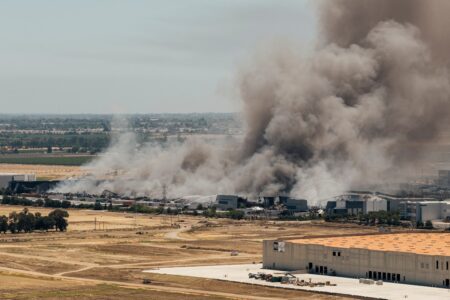
Unhealthy air quality in California city as huge warehouse fire burns for 3rd day

Judge orders Trump administration to restore National Park changes at sites that ‘disparaged’ US
Teens’ reading and math scores have stagnated, US test results show
WASHINGTON (AP) — Younger students have regained ground academically after the pandemic's disruptions while older ...

Lawyers for man accused of killing Charlie Kirk try to block death penalty

Trump’s name poised to come off Kennedy Center