Jail requests magazines to help pass time
For many, magazines are something to peruse while at the doctor’s office or waiting for an oil change.
But for inmates at the Douglas County Jail, they may be the difference between a calm stay and a violent one.
“Whether they’re here for a week or a month, when you’re locked in a white concrete room, you want something to look at,” said Michael Caron, program director at the jail.
Without magazines of interest to inmates, Caron said, “it makes it hell on the staff.”
The jail has been without appropriate reading material for inmates for more than a year now, Caron said, after subscriptions and donations from the community dried up.
The problem began when a limited county budget forced cancellations of the more popular reads, such as sports and news magazines.
For a time, Caron transferred his personal frequent flyer miles he’d accumulated into magazine subscriptions for the jail, but those ran out, too.
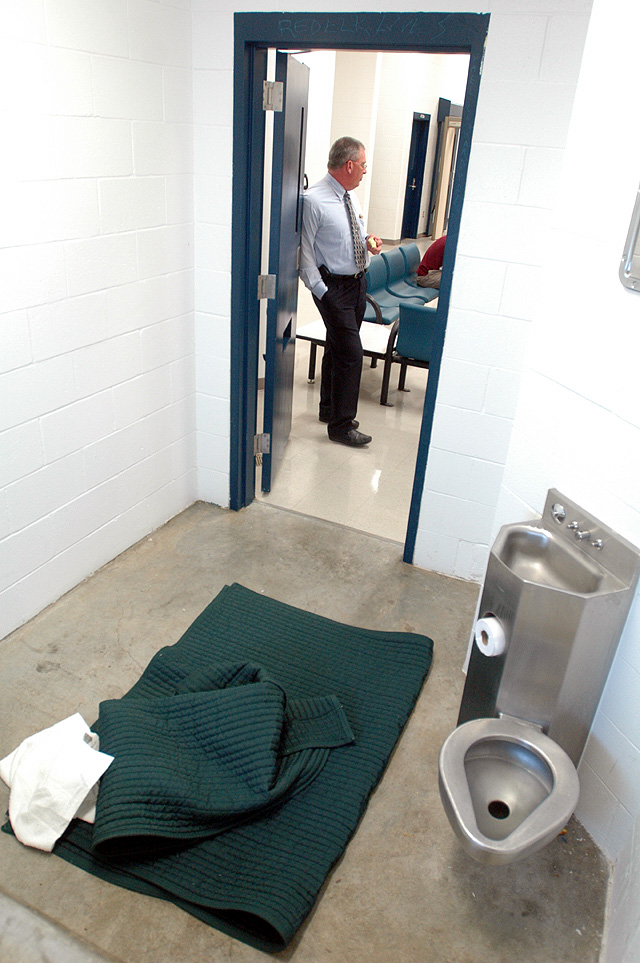
Douglas County Jail inmates are confined to a 10-by-10-foot cell, shown in this April photo. Administrators at the jail want to have more magazines available because they say they will help calm the inmates.
“That source dried up, anyway,” Caron said.
Community sources for reading material vanished as well, Caron said. The Kansas City-area based Heartland Book Bank used to send magazines, and the Lawrence Public Library would contribute cultural magazines for the jail’s minority population.
Not all magazines have disappeared from reading racks, Caron said. But the jail’s selection of Better Homes and Gardens and Country Living – fine periodicals though they may be – don’t exactly match the demographics of those behind the jail’s gray steel doors.
There was obviously a desire for other kinds of magazines, Caron said, especially back issues of the black-oriented periodicals Jet and Essence and Indian Country Today, which caters to American Indian readers. These types of magazines are donated even less than People or Sports Illustrated – already rare commodities in the jail library.
Caron said that at any given time, the jail’s population was between 8 percent and 10 percent American Indian, 24 percent black and about 5 percent Hispanic. The remainder, about 60 percent, are white, Caron said.
“By the time they came back,” Caron said of those magazines, “they were falling apart.”
More about the jail
Allison Parker, who studies confinement conditions for the advocacy group Human Rights Watch, said that having more culturally specific magazines helped prisoners stay connected to the communities they will return to – rather than strictly absorbing the culture behind bars.
“For many prisoners, the last refuge they have are in their reading materials,” Parker said. “It’s important to tailor the reading materials to who the prisoners are.”
How to help
To donate magazines or magazine subscriptions, contact Michael Caron, Douglas County Jail program director, at (785) 830-1000.
With a steady supply of materials to read and study, Parker said, inmates will be better adapted to life on the outside.
But it is difficult for some inmates to rely on books to read, Caron said. Reading levels for some inmates make digesting an entire novel difficult.
Magazines allow for more photos, shorter stories and passages, while still allowing inmates to do something besides staring at the TV.
Mental health issues also are a factor, Caron said. Without suitable reading material, people stuck in a mostly empty white room for months at a time can leave in worse shape than they entered – meaning they’ll be more likely to come back.
“It makes it more humane, more bearable,” Caron said.
The magazine search began last month at a volunteer fair at the library. While there, Caron contacted Leslie O’Neil from the Friends of Lawrence Public Library.
O’Neil said that she was recycling magazines already and that sending magazines to the jail instead is certainly a possibility.
But Caron seeks other sources, too. To get the kinds of magazines the jail needs, Caron said, he has tried finding volunteers to locate used issues at local businesses and churches.
That, he said, hasn’t been as successful.
“We haven’t had anyone,” Caron said. “At least not yet.”
City Government
Soccer gear honoring Lawrence history’s all-star team is now on sale as part of city’s public art exhibition
To honor public servants, Lawrence’s July 4 celebration will have a whole gallery of their photos on display; submissions open now

North Lawrence study consultants look at possibilities for a grocery store, food truck park, traffic calming and more
Algerian ambassador gives Lawrence a gift for supporting national team – a piece of art
Lawrence City Commission approves incentives for Alarm.com’s office project in downtown building