Bush cites progress in Iraq three years after speech
Washington ? Three years after delivering his “mission accomplished” speech on Iraq, President Bush on Monday declared another turning point had arrived with the establishment of a permanent government in Baghdad.
“We believe we’ve got partners to help the Iraqi people realize their dreams,” Bush said of the recent emergence of new Iraqi leadership. “They need to know that we stand with them.”
The president’s May 1, 2003, appearance on the USS Abraham Lincoln is one of his most indelible war-related images.
Clad in a flight suit, he emerged dramatically from a Navy jet that screamed in for a landing on the carrier’s deck.
Under a giant “Mission Accomplished” banner, Bush announced that “major combat operations in Iraq have ended.”
Though he was careful not to declare overall victory and warned of difficult work ahead, the speech was congratulatory in tone and aimed at marking a pivot from invasion to reconstruction.
“In the battle of Iraq, the United States and our allies have prevailed,” Bush said then. “The battle of Iraq is one victory in a war on terror that began on Sept. 11, 2001, and still goes on. … We do not know the day of final victory, but we have seen the turning of the tide.”
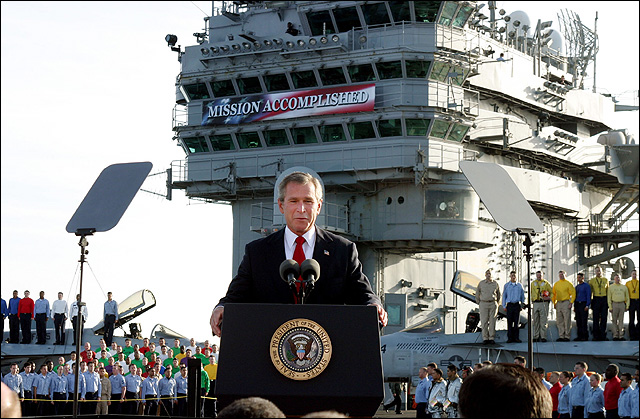
President Bush declares the end of major combat in Iraq as he speaks aboard the aircraft carrier USS Abraham Lincoln off the California coast, Thursday, May 1, 2003.
U.S. troops were trading fire with Iraqis almost daily, basic services were in a shambles and neither ousted leader Saddam Hussein nor weapons of mass destruction had been located. But the day seemed brilliantly staged.
Detractors dreaded what they thought was inevitable – seeing the images of Bush jubilantly greeting sailors resurface in the president’s 2004 re-election campaign and reinforce his wartime popularity. It didn’t turn out that way.
Violence in Iraq continued instead of ebbed. In the six weeks from the start of the invasion to Bush’s speech, 139 U.S. soldiers had died. In the three years since, as of Sunday, there have been another 2,258 U.S. military deaths in Iraq – an average of 63 each month.
There have been three democratic elections with voter participation increasing each time.
But it took four months of infighting to produce a slate of government leaders – expected to be finalized this month – representing all of Iraq’s major ethnic and political factions in a fragile unity.
Also, reliable electrical power is scarce, petty corruption is rampant and the government’s Interior ministry is blamed for harboring death squads that are helping to drive sectarian violence.
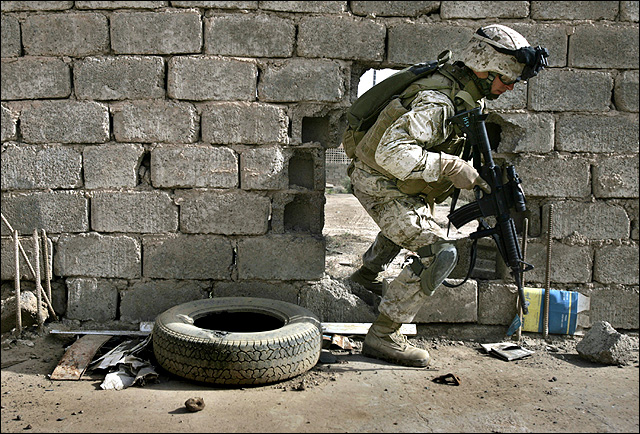
U.S. Navy Corpsman Paul Jardine, of Fair Haven, Vermont, climbs through a hole in a wall during a patrol in Fallujah, the site of the largest U.S. battle in Iraq, 65 kilometers (40 miles), west of Baghdad, Iraq, Monday, May 1, 2006. Three years ago today, President Bush stood aboard an aircraft carrier, the USS Lincoln, declaring the end of major military operations in Iraq, with a banner that read, Mission
Amid the difficulties, Bush’s overall approval rating has fallen to a new low.
Democrats cited the anniversary in criticizing the president.
Rep. Rahm Emanuel, D-Ill., chairman of House Democrats’ campaign arm, issued a reminder of some of the administration’s main prewar predictions that proved false: that Iraqi oil production would finance the reconstruction, that American troops would be greeted as liberators, that weapons of mass destruction would be found, and that a war that is now heading toward a $300 billion-plus price tag wouldn’t cost even a third of that.
Democratic leader Harry Reid stood on the Senate floor in front of a picture of Bush with the date May 1, 2003, and the phrase “Mission Accomplished” and read the names of the 16 troops from his home state of Nevada who had been killed.
Reid called it an “unfortunate anniversary” that marked “a public relations stunt gone horribly wrong.”
White House press secretary Scott McClellan said some Democrats are choosing to ignore the importance of the unity government’s establishment.
“There’s an effort simply to distract attention away from the real progress that is being made,” he said.
National
Lawyers for man accused of killing Charlie Kirk try to block death penalty
Trump’s name poised to come off Kennedy Center

Suspect in Texas shooting had fired at police days earlier, officials say
Man pleads guilty to killing a top Minnesota Democrat and her husband
New tornadoes outside Chicago as severe storms pummel the Midwest