

Award-winning historian well-versed on Bob Dylan, too
Princeton, N.J. ? Professor Sean Wilentz is a distinguished man, one of this year’s winners of the Bancroft Prize for history and chairman of the American studies department at Princeton University.
But in person he can remind you of the smart-aleck who sits in back of the class, with his playful eyes, crooked smile and signed photo of Bob Dylan in his office.
Wilentz won the Bancroft, voted on by fellow historians, for “The Rise of American Democracy,” an 800-page chronicle of American political and social movements during the first half of the 19th century. He also is a contributing editor to The New Republic and a Democrat who testified before Congress against the impeachment of President Clinton.
In still another life, he’s a music critic.
“I’ve always had a sense of multiple identities,” the author, half Irish and half Jewish, told The Associated Press during a recent interview at his office on a cold, rainy afternoon.
Wilentz, 55, holds the untenured position of “historian-in-residence” at bobdylan.com, which features various writings by the professor on the bard. He was a Grammy nominee for his liner notes to Dylan’s “Live 1964,” a Carnegie Hall performance released in 2004. His commentary for “Live 1964” also brought him a Deems Taylor award from the American Society of Composers, Authors & Publishers (ASCAP), a prize handed out for outstanding media coverage of music.
“I didn’t even know he was a historian. I know him as a Dylan writer,” says musician and ASCAP judge John Wesley Harding, who praised Wilentz’s writing for its balance of scholarship and passion.
Wilentz has spent more than 20 years at Princeton, but his roots aren’t so far from Dylan’s. A native New Yorker who grew up in a diverse Brooklyn neighborhood, the historian spent much of his childhood in Manhattan at the Eighth Street Bookshop, the Greenwich Village hangout run by his father and uncle and populated by Allen Ginsberg, Jack Kerouac and many others. (The store closed in the 1970s.)
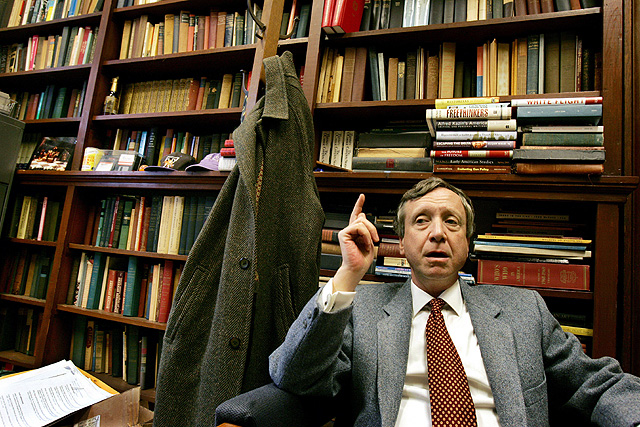
History professor Sean Wilentz gives an interview in his office at Princeton University in Princeton, N.J. Wilentz won the 2006 Bancroft Prize, voted by fellow historians, for Rise
Dylan, then a young folk singer, came by the store, too, although Wilentz has no memory of actually meeting him. He did catch on early to his music and at age 13, thanks to his father’s connections, got to see the Carnegie Hall concert he later wrote about.
“Like Bernstein striding to his podium, Dylan walked out of the wings, no announcement necessary, a fanfare of applause proclaiming who he was,” Wilentz wrote of the show, during which Dylan performed songs such as “It’s Alright Ma (I’m Only Bleeding)” that signaled his transition to rock ‘n’ roller.
“Two hours later, we would leave the premises and head back underground to the IRT, exhilarated, entertained and ratified, but also confused about the snatches of lines we’d gleaned from the strange new songs.”
In the spirit of Dylan, and the Beats, Wilentz says there were years when he “bumbled and stumbled,” although at the finest places: Columbia University, Oxford University and Yale University, where he received a Ph.D in history in 1980. In 1984, he debuted as an author with “Chants Democratic,” an acclaimed study of New York City’s working class before the Civil War.
“The Rise of American Democracy,” which includes blurbs from Pulitzer Prize-winning historian Arthur M. Schlesinger, Jr. and Pulitzer Prize-winning novelist Philip Roth, took 10 years to write and even longer to conceive. Emphasizing that his book is not a “great man” story, Wilentz regards political history as far more than leaders making speeches and signing bills, but of everyday people fighting, and sometimes winning.
Wilentz writes of how this country transformed from an old-world aristocracy to a democracy, however imperfect, with workers, women and minorities increasingly claiming rights for themselves.
“This is political history for the 21st century,” says historian Eric Foner, whose “Reconstruction” won the Bancroft in 1989. “He integrates a lot of levels of society into a unifying theme. He gives you a clear point of view, not just a bunch of facts thrown together. His book should become – at least for a while, because nothing is permanent in history – the standard interpretation for the long era he writes about.”
Arts and Entertainment
Photos: Lawrence begins World Cup festivities with downtown block party

Watkins Museum to open special exhibit detailing how Douglas County celebrated America’s Bicentennial

Go, See, Do: Kaw River Roots Festival, markets and more

Soccer gear honoring Lawrence history’s all-star team is now on sale as part of city’s public art exhibition

Nominations, call for artists open for Lawrence’s 2026 Phoenix Awards