Louisiana faces exodus from coast
Lafitte, La. ? Once the salt water is in your veins, Louisiana’s coastal folk say, it’s hard to give up the lifestyle of moonlit shrimping trips, the town “fais do-do” dances and afternoons spent on the bayous angling for catfish.
But since last year’s catastrophic hurricanes, this swampy land defined by Cajuns, cypress and tupelo gum forests, bayou-side saloons and, more recently, subdivisions may have become too vulnerable for that lifestyle to continue.
Even before the devastation caused by Katrina, Louisiana’s swampy coast had been sinking by as much as 2 inches a year. Along with that subsidence, the area is even more susceptible to flooding because last year’s hurricanes damaged vast tracts of wetlands – already shrinking because of man’s activities – that used to buffer the area from storms blowing in off the Gulf of Mexico.
All of those factors will be reflected in new Federal Emergency Management Agency flood-vulnerability maps due to be released soon that are the basis for flood insurance rates.
The maps will likely make the insurance more costly, force residents to spend heavily to raise homes out of flood plains to qualify for coverage, make many other homes uninsurable and make lenders less willing to loan money for construction in flood-prone areas.
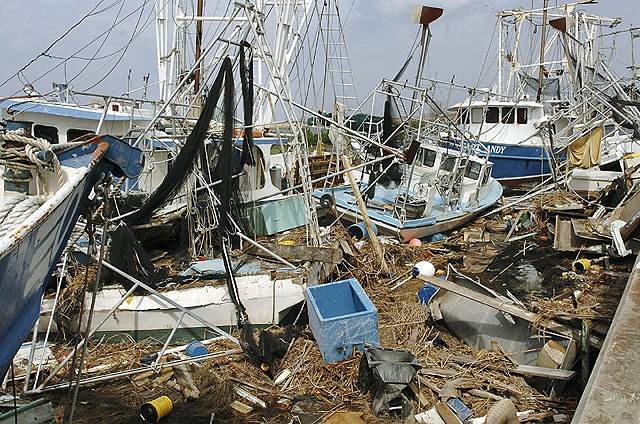
Six months after Hurricane Katrina, boats remain jammed up against the bridge at Empire, La. Coastal areas of Louisiana may become off-limits to human habitation when new flood maps are issued soon.
That new reality may threaten the state’s coastal population and its heritage of shrimp fishing, alligator hunting, fur trapping and oyster harvesting.
Some of the roughhewn people down here won’t leave willingly.
“You’ve got earthquakes, you’ve got fires, you’ve got volcanoes, you’ve got tornadoes in tornado alley,” said A.J. Fabre, an outspoken leader among shrimp fishermen in Lafitte, about 30 miles south of New Orleans. “Where are you going to have everybody? In Missouri?”
With no flood insurance, Fabre isn’t sure if he’ll be able to rebuild. He and his wife might have to demolish the place and buy a mobile home.
He insists he is not defeated and lashes out at politicians, importers, the federal government. “The fight has just begun,” he said.
But many of his neighbors and friends aren’t so sanguine. “We’re doomed,” said Jimmy Terrebonne, a 46-year-old boat builder. He tells his children to get an education and get out of the fishing trades.
As for himself, he said: “I can’t do anything else. I don’t have an education. I ain’t leaving until it’s gone. When the land’s gone, I’m leaving.”
Many coastal experts believe life along the coast is going to change dramatically with the new flood maps.
“Where we had subdivisions in the marshes, they will not come back,” said Shea Penland, a coastal scientist with the University of New Orleans. “I can’t believe they’re sustainable.”
“There are going to be some significant changes across the board,” said Butch Kinerney, a FEMA spokesman.
National
Unhealthy air quality in California city as huge warehouse fire burns for 3rd day

Judge orders Trump administration to restore National Park changes at sites that ‘disparaged’ US
Teens’ reading and math scores have stagnated, US test results show
WASHINGTON (AP) — Younger students have regained ground academically after the pandemic's disruptions while older ...

Lawyers for man accused of killing Charlie Kirk try to block death penalty

Trump’s name poised to come off Kennedy Center