Analysis: Predictions of a better Middle East have evaporated
Washington ? Three years after the United States invaded Iraq in pursuit of a freer, more stable Middle East, the country’s deepening ethnic conflict is spreading tension across Iraq’s borders, fueling terrorism and nurturing gloom about the future.
President Bush cited Saddam Hussein’s weapons of mass destruction and ties to international terrorism – neither of which turned out to exist – when he ordered a pre-emptive war that began March 19, 2003. He predicted payoffs for the wider Middle East: spreading democracy, deterred enemies, more secure oil flows, a less hostile environment for Israel.
None of that has happened, at least not yet.
Instead, said officials and analysts in the United States, Arab countries, Israel and Europe, the invasion has produced a vortex of unintended consequences.
Militancy is on the rise. Terrorists are using Iraq as a training base and potential launch pad for attacks elsewhere, according to U.S. officials and documents. Democratic reform remains largely stymied.
The U.S. Army and Marine Corps, and especially the Reserves and National Guard, are feeling the strain of repeated deployments. Public support for the war is declining in America and almost nonexistent elsewhere. The war has cost more than 2,300 American lives, and the Congressional Budget Office estimates that its total financial cost may exceed $500 billion.
“The region is pushed further toward extremism,” said Mohamed el Sayed Said, the deputy director of the Cairo-based Ahram Center for Political and Strategic Studies. “The Bush administration was warned that it’s moving into an area of shifting sand. … This is a very complex region with legacies of sectarian violence and religious strife.”
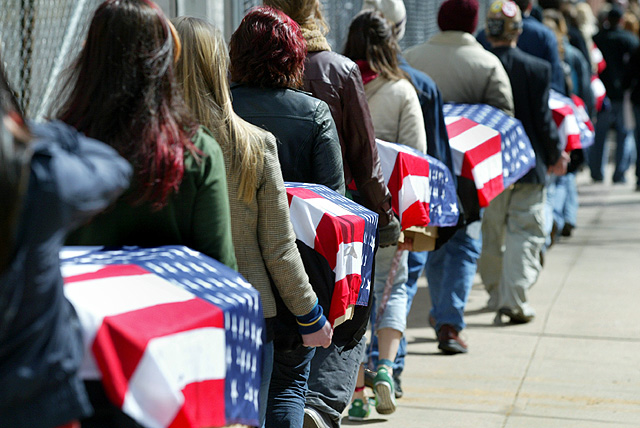
Protesters carry flag-covered caskets Saturday during a peace march in Lancaster, Pa. Anti-war protesters took to the streets around the world Saturday, a day before the third anniversary of the U.S.-led invasion of Iraq.
In Jordan to the west, Saudi Arabia to the south and Turkey to the north – even in Israel – U.S. allies are voicing growing concern that Iraq’s chaos could seep across their borders and infect them.
The president has said the Middle East was anything but stable before the invasion. Success in Iraq will leave the region better off and America safer, Bush said Monday in the first of three speeches to mark the anniversary.
“By helping Iraqis build a democracy, we will inspire reformers across the Middle East. And by helping Iraqis build a democracy, we’ll bring hope to a troubled region, and this will make America more secure in the long term,” he said.
Yet, so far at least, the reality in the Middle East is much different:
Regional stability
Shortly after last month’s bombing of a sacred Shiite Muslim mosque in Samarra, Iraq, Secretary of State Condoleezza Rice met with Persian Gulf leaders in the United Arab Emirates. Afterward, she said they’d told her they were worried that those who are provoking sectarian tension in Iraq “might try and stoke sectarian tensions in other parts of the region.”
In September, the Saudi foreign minister, Prince Saud al Faisal, warned that civil war in Iraq could drag in Iran, Turkey, the Kurds and Arabs.
Iraq’s Arab neighbors, dominated by Sunni Muslims, have watched in horror as Shiites gain political ascendancy in Iraq. So far they’ve supported Iraq’s unity, fearing that the country’s breakup could set off a regionwide scramble.
But a report last month by the private International Crisis Group warned that that could change if religious and ethnic tensions or Shiite power continues to grow.
“Increased sectarian polarization in Iraq will be viewed menacingly by neighboring states, and could draw them into Iraq and hasten its break-up, a development in which, ironically, they have no interest,” the report said.
Judith Yaphe, a Persian Gulf specialist at the National Defense University, said Iraq’s neighbors increasingly feared that the terrorism, drugs, crime and the weakening of central power in Iraq would spill across the country’s borders.
Terrorism
Counterterrorism experts and U.S. government documents seen by Knight Ridder say there are signs that terrorist-recruitment networks created to funnel foreign insurgents into Iraq are being “reversed,” with battle-trained militants flowing out of the country to try to destabilize other nations.
In November, suicide bombers apparently under orders from Iraq-based terrorist Abu Musab al Zarqawi killed at least 60 people in coordinated attacks on luxury hotels in Jordan’s capital, Amman.
Last month, would-be bombers were stopped during an attack on the world’s largest oil-processing plant, in Saudi Arabia.
How much regional terrorism is due to the invasion itself is open to debate. Some experts say Iraq is beginning to resemble Afghanistan in the 1980s – a place for jihadists to rally and confront a superpower.
Afghanistan “was the ultimate extremist-networking opportunity. I think Iraq is serving that same purpose,” said Paul Pillar, who retired last year as the U.S. intelligence community’s top analyst on the Middle East and South Asia.
Democracy
Few of Iraq’s neighbors see a model in its bloodshed and chaos.
“Who could possibly look at anything in Iraq and think, ‘I want some of that’?” said Yusuf Kanli, the editor of the Turkish Daily News.
The Bush administration has pushed Middle East dictators to open up, leading to small signs of political liberalization. Yet authoritarian regimes continue to hoard power, brutally quashing opponents and claiming that the only alternatives are an Islamic takeover or the kind of chaos seen in Iraq.
National

Lawyers for man accused of killing Charlie Kirk try to block death penalty
Trump’s name poised to come off Kennedy Center

Suspect in Texas shooting had fired at police days earlier, officials say

Man pleads guilty to killing a top Minnesota Democrat and her husband
New tornadoes outside Chicago as severe storms pummel the Midwest