U.S. troop drawdown in Iraq a precarious balancing act
On a 737 over Pakistan ? Gen. John Abizaid and his aides huddled around tables on his personal aircraft to discuss one of America’s pressing domestic issues: whether to bring some U.S. troops home from Iraq this summer.
Abizaid, commander of the U.S. military’s Central Command, was flying to Afghanistan after a two-day visit to Iraq. He is supposed to discuss the potential troop drawdown this week with President Bush and Gen. George Casey, the top commander in Iraq.
Abizaid and Casey are expected to help Bush decide: Can they back his desire for a cut in U.S. troops this summer? Or has Iraq’s frenzy of sectarian violence jolted them into canceling the drawdown and keeping troop levels near 132,000?
“It’s a tough balance,” Abizaid said Tuesday in Kabul, Afghanistan, moments before jetting off to Pakistan. Abizaid is expected to brief Congress in Washington this week on troop levels – a topic that’s become a hot political issue ahead of November’s midterm elections.
The Arab-American general who oversees U.S. operations in the region between Sudan and Pakistan declined to say directly what he and Casey would recommend. But he did say the decision is a tricky one. And U.S. military leaders say it has serious downsides no matter which way the decision goes.
“The Iraqis are a sovereign people and they are developing a sovereign government,” Abizaid told The Associated Press. “They don’t want to have foreign troops on their soil. They have to know you are ultimately going to leave. The only thing that’s in question is the rate.”
A drawdown, Abizaid said, requires confidence the Iraqi military will fight hard against insurgents without breaking the country apart.
“Let’s face it, these institutions are used to serving a dictator and they have to learn how to serve a freely elected government,” he said. “It will take some time for them to learn how to do that.”
Many factors to consider
The military is carrying out plans announced by Defense Secretary Donald H. Rumsfeld in December to cut troop levels this year by up to 7,000 soldiers by canceling the planned deployment of two Army brigades, but further cuts are still being debated.
Abizaid said his decision will be made after closely monitoring progress toward choosing an Iraqi government, and gauging whether the players have broad acceptability among Iraqis. The strength of resurgent sectarian militias are another factor, Abizaid said.
“Ultimately, the economic, the political and the security development needs to come together in a way that gives everybody confidence that you can use less foreign presence,” he said.
If U.S. troops are cut back, Iraq’s newborn army would take a larger role in defending the country. Some believe that a premature handover to the Shiite Muslim-dominated Iraqi forces could destabilize a nation already veering close to civil war. If ethnic conflict broke out, a smaller U.S. military contingent would be ill-prepared to stop it.
“You worry about sectarianism in all these countries where there are ethnic and sectarian differences,” Abizaid said. “The curse of the 21st century is undoubtedly going to be getting diverse people of diverse religions to live together.”
Drawbacks to staying
But prolonging the Americans’ stay also has its downsides. The Pentagon and U.S. commanders sorely want to reduce forces in Iraq, whose presence alone draws attacks by anti-American fighters from inside and outside the country.
Iraqis view American troops as occupiers. They resent Americans’ road-gouging tanks, their aggressive driving and their bunkered compounds. Many U.S. bases occupy Saddam Hussein’s most grandiose palaces, which remain stark symbols of oppression.
Staying in Iraq also prolongs the country’s dependence on American firepower and technology. U.S. commanders say Iraqi troops need to get used to fighting insurgents with more rudimentary weapons.
The drawdown was expected to go ahead until the Feb. 22 bombing of the Askariya shrine in Samarra, which shattered the Shiite mosque’s golden dome and sparked Shiite-Sunni slaughter that left more than 500 dead.
The specter of civil war and the resulting delay in Iraq’s process of choosing a government has forced commanders to reconsider the drawdown.
“I think we can look at the longer term view and say we’re satisfied that Iraqi armed forces are progressing along good lines and a responsible government will emerge,” Abizaid said.
National
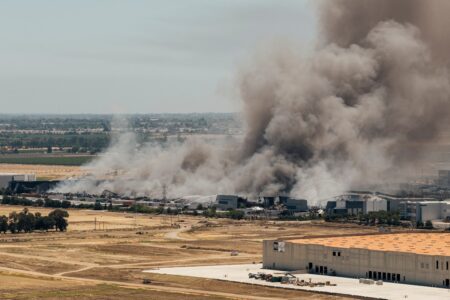
Unhealthy air quality in California city as huge warehouse fire burns for 3rd day
Judge orders Trump administration to restore National Park changes at sites that ‘disparaged’ US
Teens’ reading and math scores have stagnated, US test results show
WASHINGTON (AP) — Younger students have regained ground academically after the pandemic's disruptions while older ...
Lawyers for man accused of killing Charlie Kirk try to block death penalty

Trump’s name poised to come off Kennedy Center