U.S. general lauds Iraqi troops’ response
Armed forces can continue handling violence, he says
Baghdad, Iraq ? Iraq’s president said Saturday he had been assured that American troops will stay in his country as long as needed, while at least 14 people were killed in explosions and gunfire nationwide as vehicle restrictions were lifted in Baghdad.
A top U.S. general, meanwhile, said he was “very, very pleased” with the response of Iraqi armed forces in containing recent sectarian bloodshed, disputing critics who said too little was done to quell attacks that killed more than 500 people the past week.
Gen. John Abizaid, chief of U.S. Central Command, spent two days in Baghdad meeting with top Iraqi leaders after the Feb. 22 bombing of a golden-domed Shiite shrine in Samarra triggered reprisal attacks against Sunnis.
Iraqi security forces blunted the sectarian killing with an extraordinary daytime curfew in four flashpoint provinces a week ago, followed by a driving ban Friday in Baghdad.
But when the ban lifted Saturday, a bomb exploded at a bus terminal in southeastern Baghdad, killing seven people and wounding 25.
Abizaid said he was “very, very pleased with the reaction of the Iraqi armed forces during the aftermath of the bombing in Samarra.”
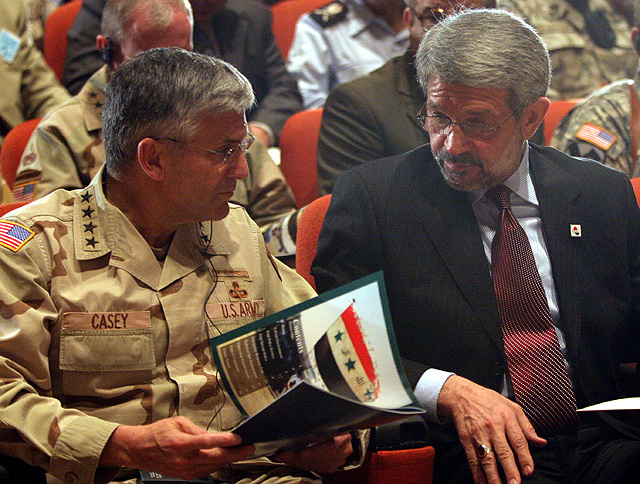
Gen. George Casey, left, the top U.S. military commander in Iraq, talks with Iraqi interior minister Bayan Jabr at a function Saturday in Baghdad, Iraq.
He warned that more such attacks were likely but added, “We believe that the Iraqi armed forces, in conjunction with the multinational force, can deal with any security problem that may arise.”
That was a more upbeat assessment than the one given Thursday by the U.S. commander in Iraq, Gen. George Casey, who said that Iraqi police and army units had performed “generally well, not uniformly well.”
U.S. officials have expressed concern about the role of private militias in the violence.
But Iraqi Interior Minister Bayan Jabr said Saturday the government was making progress integrating militiamen into its structures.
The question remained whether militiamen would comply and whether the government would get tough on enforcing the integration policy.
The surge of sectarian killing has complicated already tangled negotiations to form a broad-based government after the Dec. 15 parliamentary election. U.S. officials consider the broad-based government essential to stabilize the country so their troops can start pulling out this summer.
National
Lawyers for man accused of killing Charlie Kirk try to block death penalty
Trump’s name poised to come off Kennedy Center

Suspect in Texas shooting had fired at police days earlier, officials say
Man pleads guilty to killing a top Minnesota Democrat and her husband
New tornadoes outside Chicago as severe storms pummel the Midwest