

McCartneys seek end to seal hunt
Gulf of St. Lawrence, off Prince Edward Island ? Paul McCartney and his wife took to the frigid ice floes off the Atlantic Ocean on Thursday in a bid to halt Canada’s annual slaughter of weeks-old seal pups.
Animal rights advocates contend the killing of the doe-eyed baby seals – who often are clubbed to death, pierced with boat hooks or skinned alive – is cruel and unnecessary, but fishermen say they badly need the income.
The McCartneys, dressed in orange thermal jumpsuits, traveled in helicopters with members of the Humane Society of the United States and the British-based Respect for Animals, plus a dozen journalists.
Hundreds of seals and their fluffy white pups, only days old, were lolling on the ice in the Gulf of St. Lawrence, the mothers taking breaks from nursing to bob in the water to fish. The pups will shed their white fur within two weeks, when they become game for fishermen, who get up to $70 each for their pelts and blubber.
The former Beatle acknowledged residents have hunted seals for hundreds of years.
“Well, in our view, that doesn’t make it justifiable,” he said. “Plenty of things have been going on for a long time, like slavery. Just because it’s been going on for a long time doesn’t make it right.”
The McCartneys rolled on the ice with one pup, which gently nipped at Heather Mills McCartney and mewed for its mother. She expressed sadness it and others likely would be killed in a few weeks, their pelts going mostly to Norway, China and Russia.
“They sell the baby seal skins for fashions and fur – that’s what’s so horrific about it,” Mills McCartney said.
The former Beatle implored fishermen to turn instead to ecotourism like whale watching, as communities have done along the Atlantic Coast.
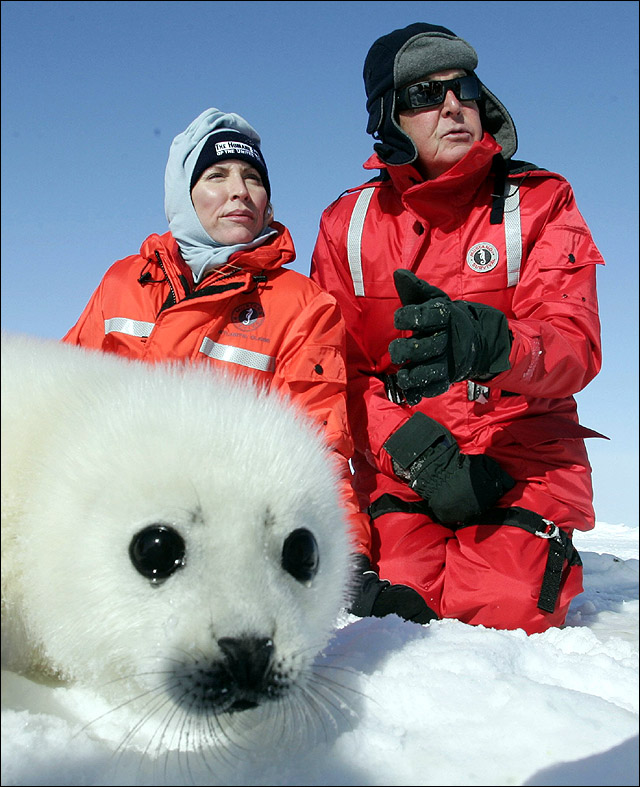
Paul McCartney and his wife Heather pose with a seal pup on the ice floes off Iles de la Madeleine in the Gulf of St.Lawrence, Thursday March 2, 2006, as part of a high-profile protest against Canadas annual seal hunt.
“This is one of the greatest wildlife spectacles on Earth,” he said. “It’s very rare that you can come to a beautiful, wild place like this. In our view, it would make more sense to look at ecotourism.”
Sealers say the hunt has kept their communities afloat for centuries.
“He’ll go out there and cuddle up to a whitecoat and they look beautiful, you can’t get away from that, and it is cruel, you can’t get away from that either, but it’s something we’ve done for 500 years,” said Jack Troake, a 70-year-old sealer. “It’s helped to sustain us. We go to bed with a full stomach, a tight roof over our head. It’s part of our culture, our history.”
The United States has banned Canadian seal products since 1972 and the European Union banned white baby seal pelts in 1983. The British government also is considering banning seal goods.
Canada’s Department of Fisheries and Oceans insists the seals are not killed before they shed their white fur – typically two to three weeks after they are born.
“All these animal rights groups take people out there to pose with these cute little ones. To suggest that they’re out there clubbing these little white furry ones is just wrong. That’s completely banned,” said Phil Jenkins, a department spokesman.
Arts and Entertainment

Photos: Lawrence begins World Cup festivities with downtown block party

Watkins Museum to open special exhibit detailing how Douglas County celebrated America’s Bicentennial

Go, See, Do: Kaw River Roots Festival, markets and more
Soccer gear honoring Lawrence history’s all-star team is now on sale as part of city’s public art exhibition

Nominations, call for artists open for Lawrence’s 2026 Phoenix Awards