Afghan visit recalls series of setbacks
Washington ? What should have been a triumphant moment for President Bush in Afghanistan also served as a vivid reminder of setbacks in his war against terrorism. His visit came at a time of increasing violence and drug trafficking in the country. And Osama bin Laden remains at large, more than four years after Bush demanded his capture, “dead or alive.”
Skeptics
Bush, who likes to salute Afghanistan as a beacon for emerging democracies, had to confront that reality at a news conference in Kabul on Wednesday when two of the four questions put to him and Afghan President Hamid Karzai dealt with the fugitive architect of the Sept. 11, 2001, terror attacks.
“I am confident he will be brought to justice,” Bush said with a bravado not shared by many military analysts. Bush suggested the issue was “not a matter of if … but when.”
Bin Laden is widely believed to be in hiding in rugged, remote areas along the Pakistan-Afghanistan border, most likely in Pakistan.
“The problem is, the longer this goes on, the harder it becomes,” said Kurt Campbell, former deputy assistant secretary of defense for Asia and the Pacific. “The worst truth is that bin Laden is welcomed in much of Pakistan, and can hide out and be protected by the local community with something close to impunity,” he said.
Cartoons built sympathy
Campbell said Islamic anger toward the West over cartoons published in Europe depicting the prophet Mohammad have helped to build even more sympathy in the region for bin Laden.
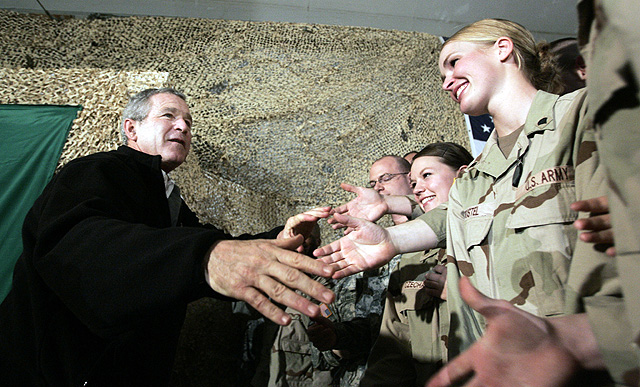
President George W. Bush greets U.S. troops at Bagram Air Base on Wednesday in Afghanistan, ahead of his trip to India and Pakistan.
Still, Bush’s visit was important, particularly at a time when conditions are worsening, because it “helps remind Americans that the job is not done, far from it, in Afghanistan,” said Campbell, now with the Center for Strategic and International Studies.
Bush’s surprise four-hour stopover on his way to India comes as the president is suffering at home from near-record-low approval ratings and fresh questions about his conduct of the war on terrorism, long his strongest issue in public opinion polls.
Violence linked to al-Qaida and other terror groups is increasing both in Iraq and Afghanistan. And the administration is coming under widespread bipartisan attack for its decision – now under review – to let a Dubai-owned company based in the United Arab Emirates take over management of some terminals at six of the nation’s largest ports.
Increasing violence
Analysts suggest that many of the destructive tactics used in Iraq, including suicide bombings and self-made roadside explosives, are being used with increasing frequency in Afghanistan.
More than two dozen suicide attacks in recent months have fueled Afghan suspicions that al-Qaida and Taliban militants are using Pakistan as base for launching terror strikes in Afghanistan.
The director of the Defense Intelligence Agency, Lt. Gen. Michael D. Maples, told a Senate Armed Services Committee hearing earlier this week that the insurgency was still growing and posed a greater threat to Afghanistan’s central government “than at any point since late 2001.”
Thriving drug trade
Despite progress on the political front, attacks within Afghanistan were up 20 percent in 2005 from the year before, Maples said. Meanwhile, a thriving narcotics trade is corroding government institutions and helping “the insurgency to operate in regions of southern and northeastern Afghanistan,” he said.
A State Department report issued Wednesday said drug trafficking “threatens regional stability” as well as the overall economy. It said production and trafficking of opium – the main ingredient of heroin – accounts for a full third of Afghanistan’s economy.
Long after a U.S.-led led military invasion overthrew the Taliban government for failing to surrender bin Laden, both bin Laden and former Taliban supreme ruler Mullah Mohammed Omar remain free. From time to time, bin Laden has taunted Bush and threatened America and its allies with taped messages.
In the most recent audio tape, broadcast Jan. 19 on the Al-Jazeera satellite channel, bin Laden vowed never to be captured alive and said the U.S. military had become as “barbaric” as Saddam Hussein. He offered the United States a long-term truce but also said his al-Qaida terror network would soon launch a fresh attack on American soil.
“I don’t think we’ll catch bin Laden anytime soon,” said Michael O’Hanlon, a foreign policy analyst at the Brookings Institution. “If we did, it would be great. But he’s likely to be in a part of Pakistan where government resources are quite limited, for both the U.S. and for Pakistan.”
“There’s at least a decent chance we’ll never catch him,” O’Hanlon said.
Bush, who seldom mentions bin Laden by name, mentioned him five times at Wednesday’s news conference in Kabul.
And the subject seems sure to come up again later this week when Bush meets in Islamabad with Pakistani President Gen. Pervez Musharraf.
National

Lawyers for man accused of killing Charlie Kirk try to block death penalty

Trump’s name poised to come off Kennedy Center

Suspect in Texas shooting had fired at police days earlier, officials say

Man pleads guilty to killing a top Minnesota Democrat and her husband

New tornadoes outside Chicago as severe storms pummel the Midwest