

Cattle rustlers a growing menace
Perry, Okla. ? The truck raced like a phantom down the lonesome dirt road, poking its headlights into the predawn darkness and spewing blinding clouds of dust. The deputy, who was watching nearby, smelled trouble.
Todd Culp saw the mysterious truck barrel through a stop sign at 80 mph and wondered where it was rushing to at 5 a.m. The off-duty deputy gunned the engine of his unmarked green pickup in pursuit.
Culp soon noticed the truck matched the description of one involved in a recent theft – and it was hauling an animal trailer. Fifteen miles later, the driver stopped on the ramp of the Cimarron Turnpike. He jumped out. The deputy was right behind him.
“Stop! Sheriff’s Department. Get on the ground!” Culp barked, drawing his .45-caliber pistol. But the man ran to open the back doors of the trailer, disappeared on the side and began whooping and hollering. Out stumbled a half-dozen cows and one calf.
It was, authorities say, an awkward – and belated – attempt to get rid of the evidence of a crime: cattle rustling.
The era of dusty stagecoaches and wagon trains is long gone but cattle thieves – the bad guys in a thousand Westerns – never quite rode off into the sunset. Rustlers are now a growing menace in some parts of rural America, striking in the dead of night and sometimes selling their haul before the rancher or farmer discovers the animals are gone.
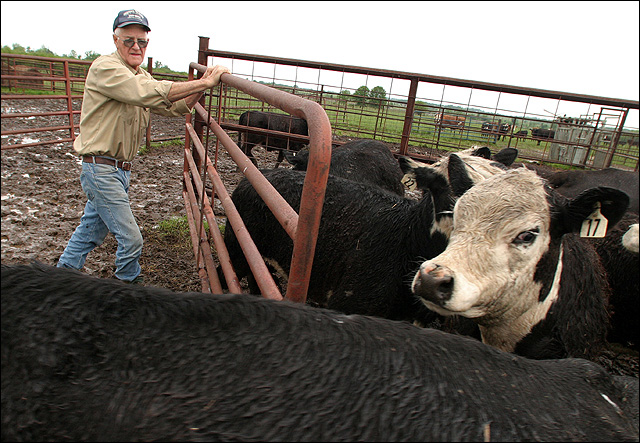
Farmer Bob Herndon lets calves out of a pen in a corral last month on his farm near Marionville, Mo. Herndon, who lost 25 cattle to thieves last fall, has begun branding his animals and patrolling with other local ranchers at night to watch for suspected cattle rustlers.
“It’s a low-risk, high-reward kind of crime and people figure that out very quickly,” says Joe Rector, an investigator who tools around the back roads of central Oklahoma, a Glock 9 mm pistol on his hip, caramel-colored ostrich-skin boots on his feet, a police scanner buzzing in his ear.
Millions of dollars of stolen cattle have been recovered in the past two years in Oklahoma and Texas. And in Missouri, a rash of thefts totaling more than $1 million – also since 2004 – recently led the governor to create a special task force as lawmakers have called for increased penalties for the culprits.
Cattle stolen in Oklahoma have shown up in Kansas, Missouri and Colorado.
Back in the days of the Wild West, cattle thieves sometimes paid for their crimes with a rope around the neck. Now, they’re more likely to get a slap on the wrist or prison if it’s a repeat offense or an especially large theft. Some say rustling is on the rise because of a 25 percent increase in beef prices in the past five years. Others, though, say thieves are oblivious to market fluctuations and tend to be common criminals – some of them methamphetamine users – looking for a fast buck.
“It’s financial problems. It’s greed. It’s to support a drug habit,” Rector says. “It’s just because they’re there.”
Cattle thieves are able to exploit a world of absentee owners, busy auction barns and a way of doing business that relies more on a handshake than paperwork. They usually prey on smaller ranches and farms and can pocket thousands of dollars in no time.
“It’s quick, it’s good money and it’s not hard if you know what you’re doing,” says John Bradshaw, a Texas cattle investigator. “If you steal one cow worth $1,000, that pays your house payment or a car. … It may take 20 minutes …. You’ve got the rest of the week to do your (legitimate) job. It’s a good racket.”
And unlike other crimes, Bradshaw says, rustlers collect full value. “If you steal a TV and sell it, you might get $30,” he says. “With cattle, you’re getting 100 percent what they’re worth.”
Bradshaw has seen thefts jump since last fall, and says he’s investigating cases involving about $2 million. He recently nabbed one brazen thief who’d drive around southeast Texas pastures, looking for cattle near the side of the road. The man would lure the animals into pens with feed, call the auction barn using a fake name, say he didn’t have a trailer and ask someone there to pick up the cattle.
Once they were sold, he’d have the check written out to a stranger he had approached in town – usually a drug user desperate for cash who was paid off with a small cut of the illicit profits. The man tried the scam nine times, Bradshaw says, and succeeded in four instances before he was caught.
Solving cattle thefts, like any other crime, takes good detective work. “You have to understand who, why, when and how,” Rector says. “Nine out of 10 times, we’ve got no suspects.”
While modern technology helps the sleuths, other advances – everything from cell phones to gooseneck trailers – aid the crooks in making a fast getaway.
“One hundred years ago, they had to herd cattle on horseback,” says Larry Gray, chief investigator for the Texas and Southwestern Cattle Raisers Assn. “Now with the interstate and good trucks, you can steal a load of cattle during the night in the Houston area and be in Baton Rouge the next morning.”
State Government
State legislators push back against federal energy regulators ending competitive bids
TOPEKA — Two Kansas legislators asked federal energy regulators to ensure competitive bidding occurs on ...
Senate confirms 1st of 3 Kansas nominees to U.S. District Court
Corporate income tax collections falling sharply in Kansas; Republican, Democratic leaders disagree on what it means
TOPEKA — Corporate income tax collections in Kansas have almost halved since last year, while other sources trend ...
Candidate’s campaign manager created website with documents used to attack rival
TOPEKA — Kansas U.S. Senate candidate Patrick Schmidt’s campaign manager left his digital footprint on ...

GOP secretary of state files to run for governor
