U.S. troops kill 7 insurgents in raid, but 2 children die
Baghdad, Iraq ? U.S. troops killed seven insurgents and captured three others in a Monday raid that also left two children dead not far from the safehouse where terrorist Abu Musab al-Zarqawi died in a U.S. bombing raid.
The military said the insurgents belonged to a terrorist cell with ties to senior al-Qaida leaders involved in helping foreign fighters come to Iraq.
More than 200 raids have been carried out since al-Zarqawi’s death Wednesday, some of them directly connected to what the U.S. military has described as a “treasure trove” of intelligence gleaned from his safehouse.
Iraqi National Security Adviser Mouwafak al-Rubaie said troops combing though the debris found al-Zarqawi’s diaries, telephone numbers, computers and a database in one computer.
“We’re cautiously optimistic that we have been very successful thus far,” Maj. Gen. William Caldwell, a U.S. military spokesman in Baghdad, said Monday. “We realize this is not going to end the insurgency and that it’s really going to take the people of Iraq making that decision.”
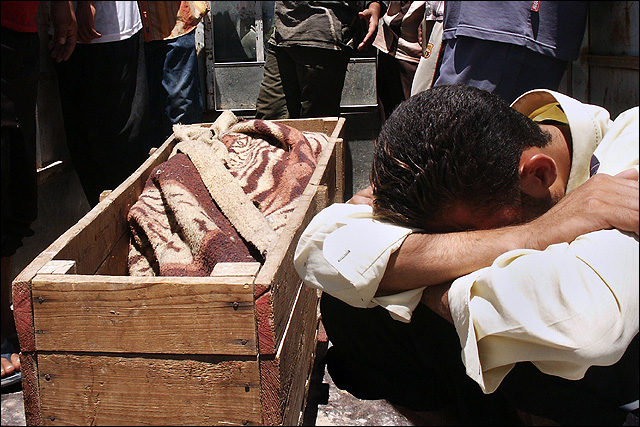
A brother grieves beside the coffin of a boy, who appeared to be 8- or 9-years-old at a hospital on Monday in Baqouba, Iraq. The boy was said to have died during a U.S.-led raid near Baqouba. According to the U.S. military, the raid was staged in the area where terror leader Abu Musab al-Zarqawi was killed and the targeted terrorists had ties to senior al-Qaida leaders across Iraq.
Caldwell also said a “high-value individual” with a $50,000 price on his head was detained. He did not name the suspect, but said he was picked up based on a tip.
The raid that killed the two children took place in Hashimiyat, a district of Hibhib, where al-Zarqawi was killed.
Residents in Hashimiyat, near Baqouba about 35 miles northeast of Baghdad, accused American troops of targeting civilians to find insurgents.
A man wearing a white dishdasha held the charred body of a child whose head had been blown in half. Other Iraqis screamed “Allahu akbar,” or “God is Great,” and raised their hands despairingly as they put the charred bodies of children – a 6-month-old and a 4-year-old – into wooden coffins and loaded them onto trucks.
AP Television News video showed burned-out vehicles and a devastated house with a large hole in the roof.
U.S. deaths
As of Monday, at least 2,499 members of the U.S. military have died since the beginning of the Iraq war in March 2003, according to an Associated Press count.
“That was an extremely unfortunate situation,” Caldwell said. “Any time we’re out conducting operations against terrorist elements and they mix themselves in with innocent young women and children and civilians, they in fact are asking for that possibility to occur.”
The military said in a statement that three terror suspects were wounded and detained in the raid. Coalition forces seized a rocket-propelled grenade launcher, five rockets, nine AK-47 assault rifles and 20 loaded ammunition magazines.
“Coalition aircraft supporting the ground force immediately suppressed the enemy fire, killing seven,” the military said in a statement. “Following the assault, coalition troops discovered two children had been killed. One child was wounded and evacuated for treatment.”
The raid came as insurgents escalated their attacks, killing more than 50 people across the country Monday in a bid to show they were not defeated after al-Zarqawi’s death.
In Baghdad, bombs in parked cars killed at least 11 people and wounded 54, police said. The first explosion in Sadr City, a sprawling Shiite district, killed six people.
A second bombing in an upscale western district killed five and wounded 13, said police Lt. Maitham Abdul-Razza.
In Tal Afar, 260 miles northwest of Baghdad, a suicide car bomber plowed into a gas station, killing four civilians and wounding more than 40, police Brig. Gen. Abdul-Hamid Khalaf said.
A roadside bomb struck a minivan in southern Baghdad, killing six people and wounding 10, police Capt. Jamil Hussein said.
Prime Minister Nouri al-Maliki’s new security team has moved ahead with a plan to restore peace in Baghdad, which has suffered most from suicide attackers, roadside bombs and sectarian death squads. He said the government will announce the plan this week.
But al-Maliki must also deal with political challenges.
Radical anti-U.S. cleric Muqtada al-Sadr called for the resignations of three Shiite Cabinet ministers, saying they lacked qualifications and experience to run their ministries.
Al-Sadr, a Shiite, accused at least one of them, Saad Tahir Abid, of having ties to Saddam Hussein’s Baathist regime, officials said.
Other developments Monday
¢ President Bush reassured Iraqis on Monday that the United States stands ready to help their new government, but said success in Iraq largely depends on Baghdad’s ability to secure the nation and care for its citizens.
Beginning a two-day strategy session on Iraq at Camp David, Bush also said Iraq’s neighbors should be doing more to help.
¢ Al-Qaida in Iraq leader Abu Musab al-Zarqawi survived catastrophic internal injuries and bone fractures for nearly an hour after his safe house was struck last week by two 500-pound bombs, according to autopsy results provided Monday by the U.S. military.
¢ In a statement posted on a Web site Monday, al-Qaida in Iraq said it had selected a new leader: a man who goes by the pseudonym Abu Hamza al-Muhajer. He is unknown by specialists who track militant movements and does not appear on U.S. lists of wanted militants with bounties on their heads.
¢ Guards dragged Saddam Hussein’s former intelligence chief out of court Monday for arguing with the judge, fueling defense protests that it is being treated unfairly.
The trial was further thrown into confusion when a judge read what were said to be confessions by four defense witnesses who admitted to committing perjury.
National
Lawyers for man accused of killing Charlie Kirk try to block death penalty
Trump’s name poised to come off Kennedy Center
Suspect in Texas shooting had fired at police days earlier, officials say
Man pleads guilty to killing a top Minnesota Democrat and her husband
New tornadoes outside Chicago as severe storms pummel the Midwest