Study finds Arctic once a lot like Miami
Washington ? Scientists have found something about the North Pole that could send a shiver down Santa’s spine: It used to be downright balmy.
In fact, 55 million years ago the Arctic was once a lot like Miami, with an average temperature of 74 degrees, alligator ancestors and palm trees, scientists say.
That conclusion, based on first-of-their-kind core samples extracted from more than 1,000 feet below the Arctic Ocean floor, is contained in three studies published in today’s issue of the journal Nature.
Scientists say the findings are both a glimpse backward at a region heated by naturally produced greenhouse gases run amok and a sneak peek at what manmade global warming could do someday.
Scientists believe a simple fern may have been responsible for cooling things back down by sucking up massive amounts of the carbon dioxide responsible for the warming. But this natural solution to global warming wasn’t exactly quick: It took about a million years.
The Earth went through an extended period of natural global warming, capped off by a supercharged spike of carbon dioxide that accelerated the greenhouse effect even more about 55 million years ago. Scientists already knew this “thermal event” happened, but figured that while the rest of the world got really hot, the polar regions were still comfortably cooler, maybe about 52 degrees on average.
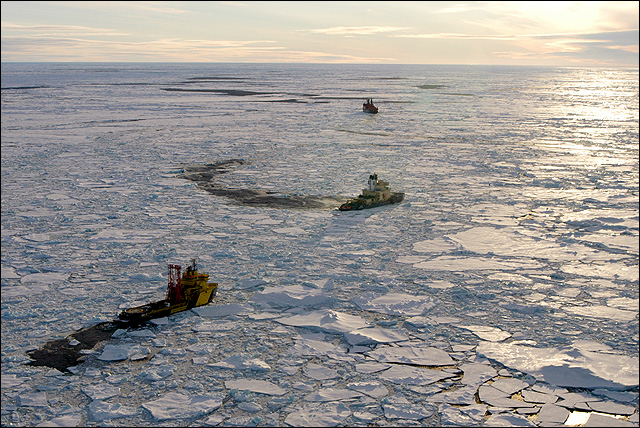
Three research ships break through Arctic ice a few miles from the North Pole as scientists drill deep below the surface in this August 2004 file photo provided by the University of Rhode Island. Their research found that this region was a subtropical paradise 55 million years ago.
But the new research from the multinational Arctic Coring Expedition found the polar average was closer to 74.
“It’s the first time we’ve looked at the Arctic, and man it was a big surprise to us,” said study co-author Kathryn Moran, an oceanographer at the University of Rhode Island. “It’s a new look to how the Earth can respond to these peaks in carbon dioxide.”
Researchers are not sure what caused the sudden boost of carbon dioxide that set the greenhouse effect on broil. Possible culprits could be huge releases of methane from the ocean, gigantic continent-sized burning of trees, or lots of volcanic eruptions.
What’s troubling is that this suggests that the current projections that say the Earth will grow warmer by several degrees over the next century may be on the low end, said the study’s lead author, Appy Sluijs of the Institute of Environmental Biology at Utrecht University in the Netherlands.
Also, the findings are proof that too much carbon dioxide – more than four times current levels – can cause global warming, said another co-author, Henk Brinkhuis of Utrecht University.
With all that heat and big freshwater lakes forming in the Arctic, a fern called Azolla started growing and growing. Azolla, the fastest-growing plant on Earth, eventually started sucking up carbon dioxide and helped cool the Arctic, Brinkhuis theorized.
Brinkhuis said the studies show tons upon tons of thick mats of Azolla covered the Arctic and moved south.
National

Lawyers for man accused of killing Charlie Kirk try to block death penalty

Trump’s name poised to come off Kennedy Center

Suspect in Texas shooting had fired at police days earlier, officials say

Man pleads guilty to killing a top Minnesota Democrat and her husband
New tornadoes outside Chicago as severe storms pummel the Midwest