

Mystery Man: Jess Walter enjoys acclaim of Edgar Award
Spokane, Wash. ? Jess Walter doesn’t write mysteries, so it is a bit of a mystery why he just won the prestigious Edgar Award for best mystery novel of the year.
His “Citizen Vince,” about a New York gangster who goes into the witness protection program and emerges as a doughnut maker in Spokane, is actually about voting in the 1980 presidential election.
Really.
Some stores have put Walter’s books in the mystery or crime section. Others in literature. At Powell’s Books in Portland, Ore., workers told Walter they were thinking of starting a separate category for him.
“That’s the greatest compliment,” he said during an interview at a sidewalk cafe in this Eastern Washington city that serves as the setting for his books.
Powell’s Kim Sutton said that Walter stopped by one day to thank a staff member who had written a favorable review of “Citizen Vince.” The review said the book has “characters that recall Richard Russo at his finest.”
“He proceeded to sign every copy of his books in the store’s inventory, including used copies,” Sutton said. “This gesture says a lot about his character.”
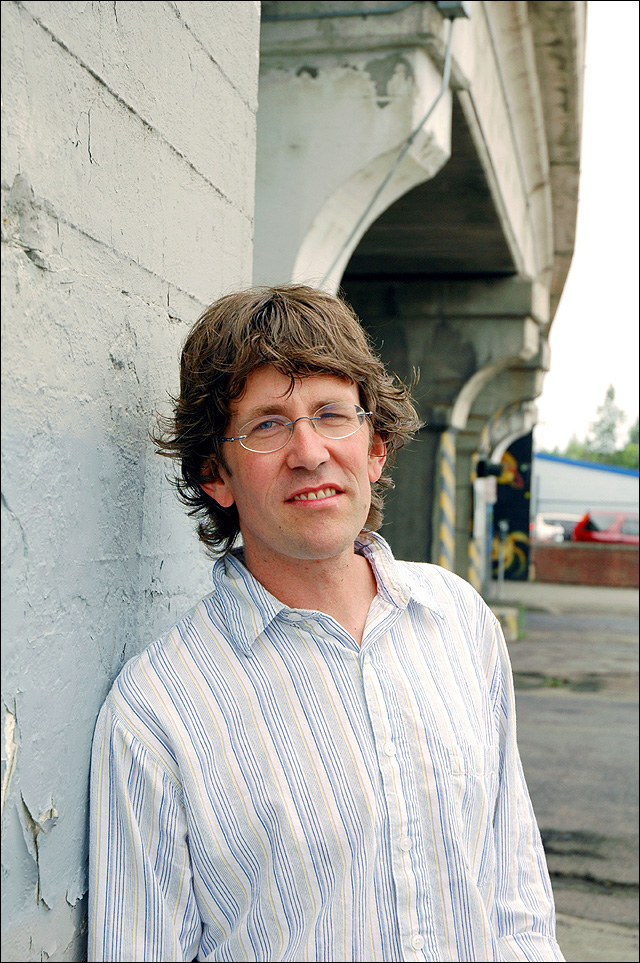
Author Jess Walter stands by a train overpass in downtown Spokane, Wash. Walter won the 2006 Edgar Award for best mystery novel of the year for his book Citizen
While Walter’s books are not whodunits, they are about cops, crooks and crimes, the same ground plowed by previous Edgar winners such as Raymond Chandler and Elmore Leonard.
“Citizen Vince” is a character-driven examination of a criminal’s complicated efforts to go straight. Vince, as a felon, has never been able to vote until the 1980 race between Jimmy Carter and Ronald Reagan. Both politicians are minor characters in the book, as is mobster John Gotti.
Walter set “Citizen Vince” during the closing days of the 1980 presidential race because he believes that election – which pitted the smart but wavering Carter against the resolute Reagan – set the stage for the politics of today. Vince wonders throughout the book which one deserves the first and possibly only presidential vote he will ever cast. Ultimately, the reader is not told and Walter claims he doesn’t really know.
“I get e-mails from all over” with theories based on the character’s journey toward respectability,” Walter said. “Some people sway me with their arguments.”
‘Darkly, darkly funny’
The book earned plenty of praise when it was released last year.
“Maybe if Aaron Copland had written the score for a film noir starring the Marx Brothers there would be some prototype for Walter’s fusion fiction, but he didn’t and there isn’t,” wrote critic Maureen Corrigan in The Washington Post.
Walter, 40, grew up in Spokane, went to college at nearby Eastern Washington University, where he studied under novelist Ursula Hegi, and then went to work as a reporter for The Spokesman-Review. He covered the federal government’s siege at Ruby Ridge, Idaho, and out of that wrote his first book. The nonfiction effort took him three years and numerous rejections to sell, but “Every Knee Shall Bow” was a critical success and was made into a TV movie.
Then he was hired to co-write the autobiography of O.J. Simpson prosecutor Christopher Darden, and the book spent weeks at the top of The New York Times list of best-sellers.
Since then he has published mostly fiction, including the novels “Land of the Blind” and “Over Tumbled Graves,” about a serial killer. He’s sold a couple of screenplays to movie studios, although none has been produced. HBO Pictures bought the rights to “Citizen Vince,” and Richard Russo wrote the screenplay.
“Citizen Vince,” which began as a screenplay, is Walter’s best-selling book, and just came out in paperback. Yet the book was already being returned by bookstores when it began winning acclaim and earned a surprise nomination for the Edgar, awarded by the Mystery Writers of America. Walter decided to attend the April ceremony in New York because he had other business in the city, and was surprised when he won. He was also shocked to discover how “obscure” he was. “People thought that I was a girl,” he said, because his name is Jess.
Other than a deal to publish “Citizen Vince” in China, the Edgar hasn’t changed his life much, Walter said.
His next book, “The Zero,” is a comic look at the aftermath of the terrorist attacks of Sept. 11, and their impact on the American psyche. Walter has spent plenty of time in New York City doing research for his writing, and first went to Ground Zero a week after the attacks.
“It’s darkly, darkly funny,” said Walter, whose literary influences include Kurt Vonnegut and Joseph Heller. “What they (the publisher) are hoping is it is ‘Catch 22’ about Sept. 11.”
Is the nation ready for that?
“We definitely need to laugh about this and scream about it,” Walter said. “I was amazed when we went back to business as usual.”
Plenty of material
Unlike many Western novelists, Walter is not interested in themes of the disappearing West, the loneliness of the vast landscape or stories where most characters wear cowboy boots.
“We think we’re supposed to write about cattle ranches and streams,” Walter said. “That’s not the West I grew up in.”
He prefers to write in the spirit of his friend, Sherman Alexie, plus Raymond Carver and Tom Robbins.
“He’s a literary writer who tells commercial stories. Those two don’t often go together,” said Alexie, who wrote such books as “Reservation Blues” and “Ten Little Indians.”
Walter lives with his wife, Anne, and three children in a lovely old home above the Spokane River near downtown. The place has an elevator and a carriage house. He likes to write in the mornings, get his kids off to school, spend time in the city’s many coffee shops. He writes an outdoors column for a local magazine and plays basketball with other writers.
Spokane has plenty of good writers, and is connected to big literary communities in the Seattle area, where Alexie lives, and nearby Montana, Walter said. And there is plenty of material.
“This is a real place,” he said.
Arts and Entertainment
Photos: Lawrence begins World Cup festivities with downtown block party
Watkins Museum to open special exhibit detailing how Douglas County celebrated America’s Bicentennial

Go, See, Do: Kaw River Roots Festival, markets and more
Soccer gear honoring Lawrence history’s all-star team is now on sale as part of city’s public art exhibition

Nominations, call for artists open for Lawrence’s 2026 Phoenix Awards