Marine leadership failed, slayings probe concludes
Washington ? The U.S. military officer overseeing the investigation into 24 civilian killings in Haditha, Iraq, has concluded that Marine leadership failed multiple times, including in pre-deployment training, in the tone set by commanders, and in how information was reported up the chain of command, defense officials said.
Army Lt. Gen. Peter Chiarelli, the No. 2 officer in Iraq, found that commanders and staff at the regimental and division levels were negligent in how they conveyed orders about how to deal with Iraqi civilians and also in how they responded to conflicting reports they received from units about the Haditha incident, the officials said.
Most of Chiarelli’s “Findings and Recommendations” endorse the conclusions of an investigation led by Army Maj. Gen. Eldon Bargewell, the officials said. Bargewell concluded that Marine commanders should have asked more questions about how and why 15 Iraqi civilians – the number first reported – were killed, especially after a discrepancy emerged between the first report, that they had been killed by a roadside bomb, and a later report, that they all had died of gunshot wounds. Chiarelli told colleagues that he was stunned to learn that no investigation of the incident had been conducted even after it was evident that the facts of the matter were in dispute, an official said.
Bargewell’s report also criticizes the Marine Corps for letting stand a statement, released in November by one of its public affairs officer, that the Iraqis had been killed by a roadside bomb, instead of correcting the record when it was clear the statement was incorrect.
Chiarelli long has been concerned that the U.S. military was inadequately prepared to conduct an effective counterinsurgency campaign in Iraq. He also included thoughts about how better to prepare troops and commanders, the official added.
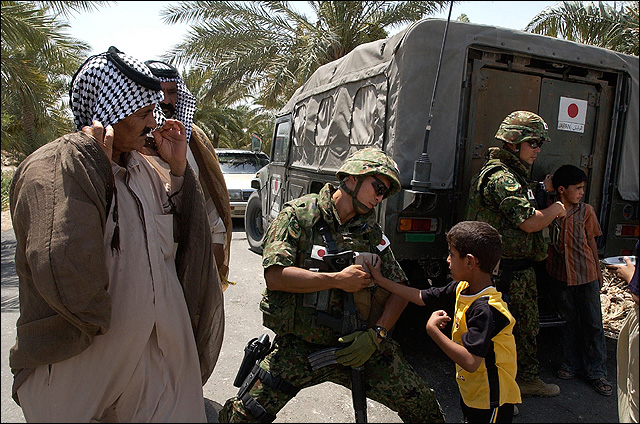
Japanese troops say their goodbyes to young Iraqis Saturday in Samawah, southern Iraq. On Friday, Japan began withdrawing its 600-member military contingent from Iraq. The first group of about 30 soldiers left Samawah and flew to Kuwait, Japanese media said. Their departure marked the beginning of the end of Japan's biggest overseas military mission since World War II.
“You’ve got to prepare for the fight you’re in today,” said a second defense official, summarizing Chiarelli’s findings on the military’s inadequate training for counterinsurgency operations. “It’s totally different” than fighting in Iraq two or three years ago, he said.
The Army, for example, tends in its training to emphasize using heavy firepower against the enemy, while classic counterinsurgency doctrine teaches that soldiers should use the minimal amount of force necessary to accomplish the mission.
Also, the Army early in Iraq tended to focus on killing or capturing insurgents, while counterinsurgency doctrine teaches that the best way to deal with an insurgent is to persuade him to change sides or to desert. Also, in contrast to a spate of cases of the abuse of detainees, counterinsurgency theorists recommend treating captured fighters well, to encourage them to desert and to persuade others to give themselves up. Above all, people are seen as the prize in the war, not as its playing field.
When stacked up, Bargewell’s exhaustive investigation stands more than four feet high. His report won’t be released, but, later this week, Chiarelli is expected to release a redacted version of his 30-page report. On Friday, Chiarelli gave his report to Army Gen. George W. Casey Jr., the top U.S. commander in Iraq, but Casey isn’t expected to ask for major changes, an official said.
The two generals’ inquiry into the role of the Marine Corps chain of command in the incident is different from a criminal investigation being conducted by the Naval Criminal Investigative Service (NCIS). That investigation involves more than 45 agents and is expected to conclude this summer, Pentagon officials have said.
No charges have been filed, but people familiar with the case say they expect charges of homicide, making a false statement and dereliction of duty, among others.
National
Teens’ reading and math scores have stagnated, US test results show
WASHINGTON (AP) — Younger students have regained ground academically after the pandemic's disruptions while older ...
Lawyers for man accused of killing Charlie Kirk try to block death penalty

Trump’s name poised to come off Kennedy Center

Suspect in Texas shooting had fired at police days earlier, officials say
Man pleads guilty to killing a top Minnesota Democrat and her husband