

Post-surgery Pavarotti on the mend
Tenor cancels tour dates after pancreatic cancer diagnosis
New York ? The tenor of his times to opera buffs and a celebrity whose personality captivated even casual fans, Luciano Pavarotti was recovering Friday from surgery for pancreatic cancer – a kind of cancer often considered a death sentence.
His manager said he’s recovering well, and two cancer experts said surgery offered improved odds for survival.
The 70-year-old Pavarotti, recognizable around the world with his smiling bearded face and heavy bulk, became the most popular opera tenor since Enrico Caruso during a career that began 45 years ago in his native Italy.
In his heyday, he was known as the “King of the High C’s” for the ease with which he tossed off difficult top notes, and he turned “Nessun dorma,” an aria from Puccini’s “Turandot,” into a universally recognized signature piece.
Pavarotti was preparing to leave New York last week to resume a farewell tour when doctors discovered a malignant pancreatic mass, manager Terri Robson said from her London office. All his remaining 2006 concerts have been canceled.
“Fortunately, the mass was able to be completely removed at surgery,” she said, adding that “his physicians are encouraged by the physical and emotional resilience of their patient.”
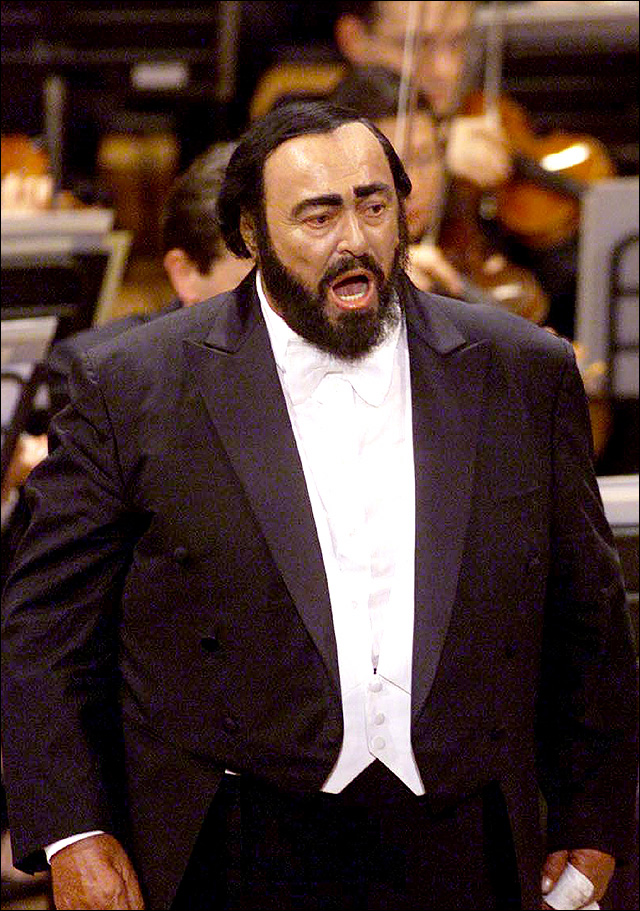
Tenor Luciano Pavarotti sings during a concert marking the 40th anniversary of his debut on April 29, 2001, in his native town of Modena, central Italy. Pavarotti made his debut in 1961 as Rodolfo in Puccini's La
She said he underwent surgery within the past week at a New York hospital that she declined to identify. He remained hospitalized Friday.
Because pancreatic cancer usually is diagnosed at an advanced stage, it has one of the worst prognoses of all types of malignancies. Fewer than 4 percent of patients are still alive five years after diagnosis, and the majority die within a year.
But when the cancer is contained and can be surgically removed – as was Pavarotti’s – “that means he has a chance for long-term survival,” said Dr. Dan Laheru, an oncologist at the Johns Hopkins Kimmel Cancer Center in Baltimore, one of the world’s leading institutions for pancreatic cancer.
Current studies show that 15 percent to 20 percent of patients with pancreatic cancer who have had surgery are still alive five years after being diagnosed, Laheru said. Of such patients, 63 percent survive one year and 42 percent two years.
Dr. Len Lichtenfeld of the American Cancer Society said, “The fact that he had surgery suggests his disease was localized, and the outlook is more optimistic.”
The pancreas, a 6-inch-long organ that lies behind the stomach, serves two main functions: It produces insulin that controls the body’s use of sugar, and it secretes enzymes needed to digest food. The cause of pancreatic cancer isn’t known, but risk factors include age, cigarette smoking, excess weight and a fatty diet.
At an age when most tenors are long retired, Pavarotti’s infrequent performances in recent years capped a four-decade career at the pinnacle of the music industry.
He took advantage of the television age to become a widely marketed artist – especially as one of the Three Tenors, including Placido Domingo and Jose Carreras, who sang together at four World Cup soccer finals.
Domingo’s eyes welled with tears at the beginning and the end of a concert he participated in Friday night in Berlin for this year’s World Cup final.
“When I was singing the last aria, I couldn’t help being quite sad, thinking that Luciano is in this moment suffering,” Domingo said. “It was very, very emotional.”
Domingo said he last saw Pavarotti in May, when he visited him in the New York hospital where Pavarotti was recovering from back treatment. “His innate strength seemed to have conquered those troubles and I hope that the same inner fortitude will make him overcome his current troubles. In the meantime, I’m sending from Europe to New York the most positive thoughts and much affection through space to him.”
The Three Tenors gave their first concert exactly 16 years ago Friday, in Rome, after Carreras overcame leukemia, and Domingo said Pavarotti’s illness might spark a reunion.
Arts and Entertainment
Photos: Lawrence begins World Cup festivities with downtown block party

Watkins Museum to open special exhibit detailing how Douglas County celebrated America’s Bicentennial

Go, See, Do: Kaw River Roots Festival, markets and more

Soccer gear honoring Lawrence history’s all-star team is now on sale as part of city’s public art exhibition

Nominations, call for artists open for Lawrence’s 2026 Phoenix Awards