Advocates see area as health care destination
Kansas, Missouri officials consider joining efforts
Topeka ? Officials in Kansas and Missouri are calling for an end to the Border War – at least when it comes to health care.
They want to join forces for what they say is an exciting, regional good – the advancement of life sciences work in the Kansas City metropolitan area.
They think that it’s possible and necessary to bridge the best parts of the Kansas University Medical Center and KU Hospital in Kansas with Children’s Mercy Hospital and Clinics, St. Luke’s Health System and the Stowers Institute for Medical Research in Missouri.
The result, they say, would be a nationally recognized center that produces cures for diseases and fuels a growing economy.
Think something like M.D. Anderson Cancer Center in Houston, and that is what these officials are dreaming about.
“We will have to align our resources to compete nationally,” said David Adkins, executive vice chancellor of external affairs at KU Medical Center.
Concerns raised
But some have worries.
State Sen. Jim Barnett, R-Emporia, a physician, graduate of the KU medical school and candidate for governor, said he was concerned Kansas tax dollars would benefit Missouri, and other lawmakers have said KU’s partnership discussions need to be more fully aired and analyzed.
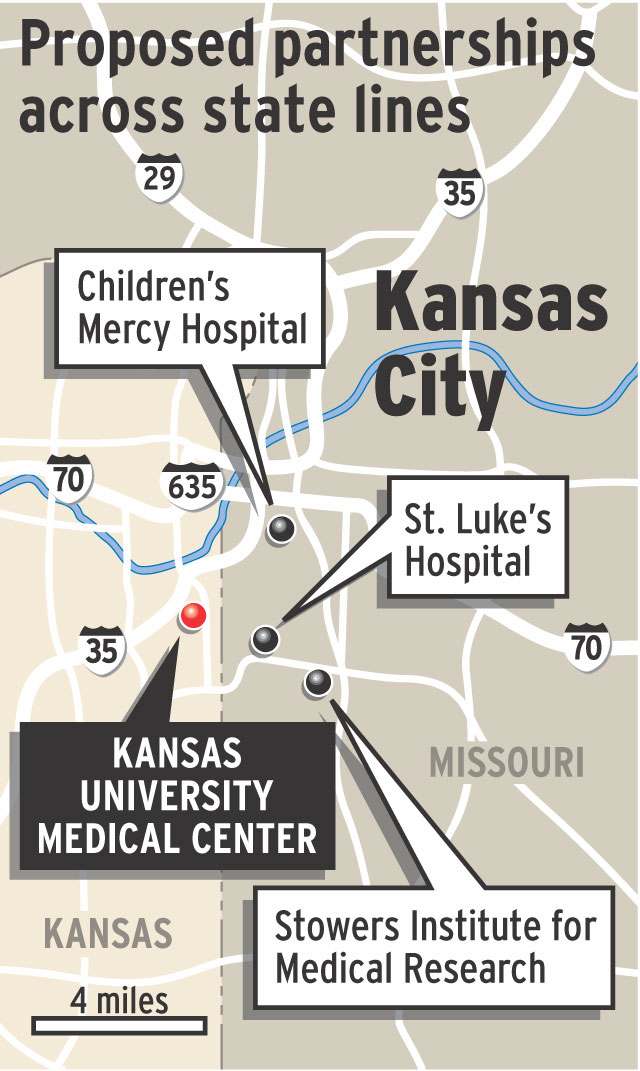
Kansas taxpayers support the KU Medical Center by about $110 million annually.
After visiting with KU officials last week, Barnett said he felt that his concerns, specifically that the KU Hospital was being left out of the discussions, were being addressed.
Richard Brown, co-chairman of the board of directors for the Stowers Institute for Medical Research, said KU was an integral part of the recipe for a regional life sciences initiative.
“There is only one research university in the Kansas City region that can serve as the academic axis around which a vibrant life sciences strategy can revolve, and that is the University of Kansas,” Brown said.
“But the axis is really an important concept. It implies that there are a number of orbiting resources that strengthen that axis, one of which has to be the University of Kansas Hospital,” he said.
Payoff for KU
The goal for KU would be to build affiliations that would lead to better access to clinical trials and improve educational opportunities for future doctors and other health care professionals, Adkins said.
“Ideally, you want the best environment possible to train your students,” Adkins said. “You want the most robust number of clinical cases for them to learn on.”
Brown also noted that further development of Stowers would benefit KU and Kansas. He said most Stowers researchers live in Kansas, and the institute supports KU faculty research.
In 2005, Stowers financed 18 scientists who have faculty positions at KU. The institute spent $16.1 million last year for those scientists’ research, he said.
When those scientists make important discoveries, KU shares in the prestige and ability to recruit more top-flight scientists, he said.
The Stowers engine
The driving force behind the pursuit of a regional life sciences initiative is the Stowers Institute, a state-of-the-art research facility with a $2 billion endowment and scores of research associates and graduate students.
Kansas University key to plan
The Kansas University Medical Center is in Kansas City, Kan. It was established in 1905. It includes the School of Medicine, the School of Nursing, the School of Allied Health, the Office of Graduate Studies and the University of Kansas Hospital. It also has a campus in Wichita, which includes a unit of the School of Medicine and provides clinical training for third- and fourth-year medical students.
The University of Kansas Hospital is governed by a 14-member board of directors instead of the Kansas Board of Regents.
Last year, a task force of national education leaders issued a report called “Time to Get it Right: A Strategy for Higher Education in Kansas City.”
“The promise of Stowers for Kansas City, for the nation and for humanity is enormous,” the report said.
But the report stated Stowers, located in Kansas City, Mo., “must be augmented by world-class higher education research capacity” that will require a two-state strategy. The report continued that the KU Medical Center and University of Missouri-Kansas City will require “substantial enhancement.”
Kansas bioscience funds
Some concerns have been raised that any partnerships with Missouri interests could result in Kansas bioscience funds being used across the state line.
In 2004, Kansas elected officials approved reinvesting growth in tax dollars in state bioscience companies back into the industry. The Kansas Bioscience Authority has started to award grants under the legislation.
But KU officials say there has been no decision made to seek bioscience funding, and if there were, any use of Kansas bioscience funds would be vigorously reviewed by the Bioscience Authority, which is made up of politicians, business leaders, higher education administrators and others.
“We will assume that we will have to compete for and merit the right to those investments,” Adkins said.
What is next?
Health care consultants are studying partnership possibilities in the region and models across the country that could be used as examples to follow.
Barbara Atkinson, executive vice chancellor of KU Med Center and executive dean of the KU medical school, is chairwoman of a steering committee that will receive the consultant report on Aug. 15.
Brown said he hoped citizens in both states could check any gut-level opposition at the suggestion of cooperation between Missouri and Kansas.
“It is an easy set of expressions to recognize, and it’s almost instinctive. Hopefully, once we get past that instinctive response, a thoughtful assessment can be made,” Brown said.
“What we now have emerging is a real-life example of an opportunity, where one could combine the best strengths. And the good news is, it isn’t the case of one side having all the marbles,” he said.
City Government

City of Lawrence seeking public feedback on its bike infrastructure plan

City to keep Community Building open through end of 2026; leaders want more data before deciding on 2027
City leaders approve incentive for 131-unit housing development near Wakarusa and Queens

Developer seeks incentive from City of Lawrence to build 131 units of housing near Wakarusa and Queens

Lawrence city leaders will consider whether to keep Community Building open, make 2 other rec centers free to access