Chinese scholar once welcomed by U.S. now facing deportation
Alexandria, Va. ? Nearly five years ago, the U.S. government exerted high-profile diplomatic pressure on China to secure the return of scholar Gao Zhan, a researcher at American University whom Beijing believed was a spy for Taiwan.
Now, the Department of Homeland Security is pushing with equal vigor to have her deported back to China.
Gao’s case, set for a hearing today on the latest twist, became international news in February 2001 when she and her family were arrested by the Chinese on suspicion of espionage. Her husband, Xue Donghua, and the couple’s 5-year-old son were released after a month in custody, but the Chinese government charged Gao with espionage.
The State Department protested and worked hard to secure her release. Sen. George Allen, R-Va., was one of many elected officials who took up her cause and introduced legislation, which ultimately failed, to grant her U.S. citizenship in absentia.
The Chinese government put Gao on trial in July 2001, convicted her and sentenced her to prison.
But then it decided to deport her to the United States instead. Gao received a hero’s welcome when she returned to the U.S. a month later.
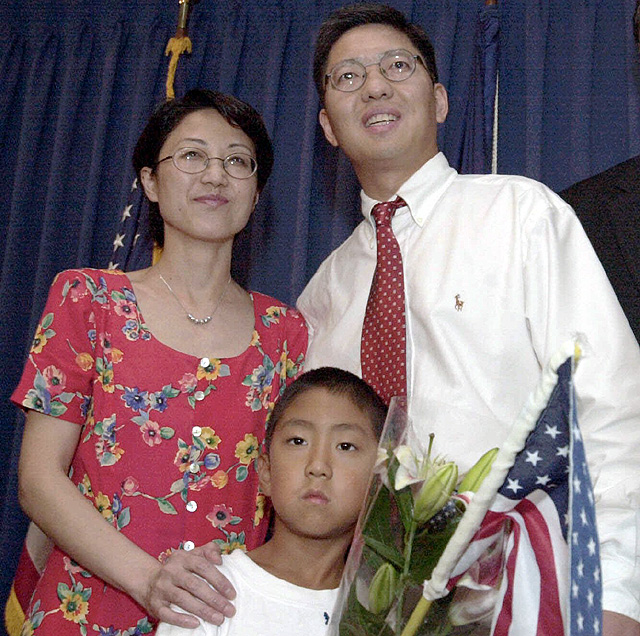
American University scholar Gao Zhan, left, attends a news conference with her husband, Xue Donghua, and son, Andrew, age 6, in this July 26, 2001, file photo. A hearing is scheduled today in immigration court to determine whether Gao poses a risk to national security.
Gao, who was born in China but has been a U.S. resident living in McLean, Va., spoke out frequently against human-rights abuses in China. A naturalization ceremony was scheduled for her, but was abruptly canceled.
In 2003, in a move that shocked supporters, Gao pleaded guilty to illegally exporting more than $1 million in military-grade computer microprocessors to a Chinese government agency. Court documents indicate that the scheme preceded her 2001 arrest in China and that Gao knew the microprocessors could be used by the Chinese military.
She struck a plea bargain that resulted in a seven-month jail sentence, plus eight months in a halfway house. Her jail time was sharply reduced because prosecutors believed Gao had cooperated and provided useful information.
As part of the plea bargain, the Justice Department recommended to the Department of Homeland Security that it not deport Gao after she served her sentence. Normally, such recommendations carry great weight, but in this case Homeland Security and U.S. Immigration and Customs Enforcement are ignoring the recommendation and pushing for deportation.
A hearing is scheduled today to determine whether Gao is a national security risk, which would mean she would almost certainly be deported. If no threat is found, a hearing in February would determine if Gao should be granted asylum.
Earlier this month, U.S. District Judge T.S. Ellis III, who sentenced Gao, said he was surprised by the effort to deport her. If Gao were truly a national security risk, he said, prosecutors would have brought more serious charges.
“I certainly never contemplated that she would face this situation,” Ellis said at a post-trial hearing for Gao’s husband, who was convicted along with Gao of tax evasion for failing to report profits from the microprocessor sales on their joint tax return. “Only the most serious proof should change that.”
National

Unhealthy air quality in California city as huge warehouse fire burns for 3rd day

Judge orders Trump administration to restore National Park changes at sites that ‘disparaged’ US
Teens’ reading and math scores have stagnated, US test results show
WASHINGTON (AP) — Younger students have regained ground academically after the pandemic's disruptions while older ...

Lawyers for man accused of killing Charlie Kirk try to block death penalty

Trump’s name poised to come off Kennedy Center