Iraqi leaders attend emergency meeting as violence increases
Baghdad, Iraq ? With sectarian violence surging after a day of relative calm, Prime Minister Ibrahim al-Jaafari met in emergency session Saturday night with Shiite, Sunni and Kurdish political leaders, and a daytime curfew in Baghdad was extended as defense ministry officials threatened to send tanks into the streets to prevent further bloodletting and attacks on mosques.
U.S.-led troops, meanwhile, stepped up their patrols in the capital and President Bush, in an unusual diplomatic gesture, called seven Iraqi political leaders and encouraged them to work together to defuse the violence that began when a venerated Shiite shrine in Samarra was bombed by unknown assailants Wednesday.
The Iraqi leaders emerged together from their three-hour meeting in a show of unity that was carried live on state television. Al-Jaafari, a Shiite, was flanked by Shiite politicians but also by Sunnis, who had threatened to boycott the political process following a series of killings and attacks on Sunnis mosques after the explosion at Samarra’s Golden Mosque. The officials announced the establishment of a national security committee that would include Sunnis who are not in the Shiite-dominated Iraqi government.
“By the end of meeting, all were standing together behind a common sense of principles,” said a Western diplomat, present at the session. “People have found a way not only back to the table but to the decision-making room, and they have agreed on a plan.”
With many Iraqis still fearing that the nation is on the verge of a sectarian civil war, the Iraqi government canceled all leave for government security forces, announced a continued state of emergency and extended the curfew in Baghdad for 34 hours.
At the same time, both American and Iraqi government officials sought to play down the continuing violence and disputed what they called exaggerated accounts in the media.
On Saturday, the violence continued at a brisk pace, with at least 50 more people killed in various attacks around the country
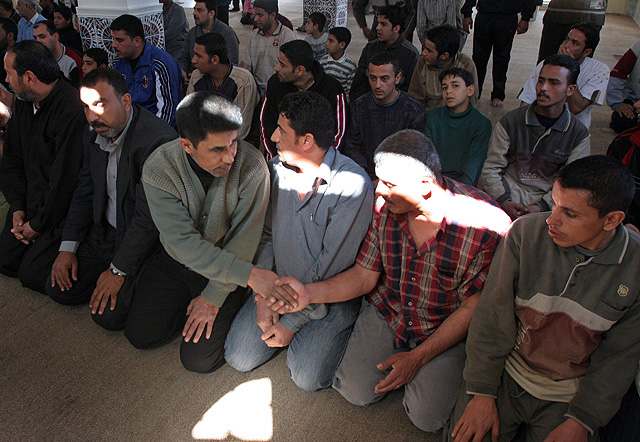
An Iraqi Sunni Muslim, in red shirt, shakes hands with a Shiite Muslim after a joint afternoon prayer Saturday, in Shiite district of Sadr City, in Baghdad, Iraq. Sunni and Shiite clerics agreed Saturday to prohibit killing members of the two sects and banning attacks on each other's mosques.
In the Shiite holy city of Karbala, home to the two of the faith’s most important shrines, a car bomb killed at least seven people, according to local hospital officials. The explosives-packed vehicle was detonated using a wireless device, according to police who said three Iraqi officers were killed in the blast.
Northeast of Baghdad in a village near Baqouba, gunmen broke into a house and shot an entire Shiite family of twelve dead, Iraqi officials said.
The funeral procession of Atawar Bahjat, the popular female TV anchor from the Al-Arabia station who was killed with two colleagues after covering the mosque bombing in Samarra Wednesday, was attacked on Saturday as it passed through the city of Abu Ghraib. Two police officers were shot dead, and five wounded, officials said. Nearby in Baghdad, mortars rained down on various neighborhoods beginning at 8 a.m., killing three people in the impoverished Shiite neighborhood of Sadr City . Eight others were wounded in three separate attacks.
Just west of the capital, a roadside bomb exploded in Khan Dari, killing one police commando, and injuring three others.
Police reported the discovery of 28 additional bodies Saturday morning, 15 in Baghdad and the other 13 in neighboring Diyala province, a mixed Sunni and Shiite area.
Late Saturday evening, calls for help could be heard from a Sunni mosque in the Western Baghdad neighborhood of Ameriah. “Help us, help us,” a cleric called through the mosque loudspeakers as gunfire raged outside. “People of Ameriah, come and help.”
Seeking to quell the ongoing disturbances, Defense Minister Sadoon al-Duleimi said the government was ready to send tanks into the streets if necessary. “There are armored brigades that are waiting for sign to go at any time,” al-Duleimi said. Interior Ministry officials, meanwhile, announced security forces would also seek to enforce a weapons ban.
Media reports have cited a death toll of more than 150 since the bombing in Samarra, with a relative lull in the bloodletting Friday after two days of rioting and rampages.
Al-Duleimi contended that the death toll has been exaggerated and that as of Saturday afternoon, it stood at 118.
Representatives from Shiite cleric Muqtada al-Sadr’s office participated in a televised event in front Abu Hanifa mosque — the largest Sunni mosque in Baghdad — during which Sunni and Shiite clerics and political leaders announced a “charter of honor.”
The text of the charter condemned mosque attacks and called for an investigation.
The government has already begun an investigation, officials said, and on Saturday, al-Jaafari reiterated the government’s plan to reconstruct destroyed mosques.
“Our country is passing through a crucial stage and stands in front of hard choice,” President Talabani said in a statement. “In order to cross to the peaceful shore, we must renounce the sectarianism and unify (our) ranks.”
National
Unhealthy air quality in California city as huge warehouse fire burns for 3rd day
Judge orders Trump administration to restore National Park changes at sites that ‘disparaged’ US
Teens’ reading and math scores have stagnated, US test results show
WASHINGTON (AP) — Younger students have regained ground academically after the pandemic's disruptions while older ...
Lawyers for man accused of killing Charlie Kirk try to block death penalty
Trump’s name poised to come off Kennedy Center