States seek more flexibility under No Child Left Behind
SALEM, ORE. ? About 15 states are vying to be chosen as one of the few that will be allowed some leeway in how student progress is measured under the No Child Left Behind Act, the federal education law criticized by some as overly rigid.
Applications are due Friday, three months after Education Secretary Margaret Spellings announced that states would be allowed to seek some flexibility.
Under the current law, schools are expected to show year-to-year improvement in test scores – for example, this year’s third-grade scores are compared to last year’s. Under the pilot program, however, schools will be allowed to chart how individual students are doing on standardized tests from one year to the next.
The idea is the latest move by the Bush administration to allow more breathing room in the No Child Left Behind law.
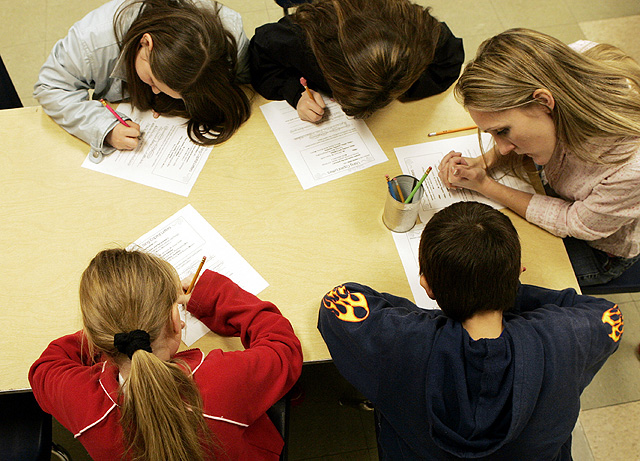
Lincoln Elementary School teacher Bethany Sherrill, right, works on a lesson with third-graders, clockwise from top left, Alyson Simpson, Tula Belle Faith, Jason Lamb and Shania Jolley in Coquille, Ore. About 15 states are vying to be chosen as one of the few that will be allowed some leeway in how student progress is measured under the No Child Left Behind Act, the federal education law criticized by some as overly rigid.
The 2001 law is set for a tough reauthorization battle in Congress next year, and even some Republicans are calling for more flexibility. The results of the experimental program could affect the debate.
The applications are coming from states urban and rural, red and blue, including Florida, Ohio, Arizona, Alaska, Hawaii and Oregon. A maximum of 10 states will be chosen by this spring.
Under No Child Left Behind’s current incarnation, schools must bring all students up to grade level in reading and math by the year 2014. Schools that fail to get increasing percentages of students up to par face a series of consequences, from having to pay for after-school tutoring to a state takeover.
Because of the tough standards, thousands of schools across the country has been listed as “needing improvement.”
Some activists are afraid states will use the new approach to shirk their obligation to raise the test scores of minorities and immigrants.
National

Unhealthy air quality in California city as huge warehouse fire burns for 3rd day

Judge orders Trump administration to restore National Park changes at sites that ‘disparaged’ US
Teens’ reading and math scores have stagnated, US test results show
WASHINGTON (AP) — Younger students have regained ground academically after the pandemic's disruptions while older ...
Lawyers for man accused of killing Charlie Kirk try to block death penalty

Trump’s name poised to come off Kennedy Center