Alito takes seat on Supreme Court
Washington ? After the most partisan Supreme Court battle in more than a decade, Samuel Alito was sworn in Tuesday as the 110th justice on the nation’s highest court, where he is expected to usher in a new era of judicial conservatism.
Alito took the oath minutes after the Senate voted 58-42 to confirm him to replace Justice Sandra Day O’Connor – a Republican nominee who became the court’s pivotal swing vote on divisive issues such as abortion and gay rights.
Alito, 55, is the second justice to be confirmed in five months and is perhaps the linchpin of President Bush’s plans to put a conservative imprint on the court. Alito by most accounts is politically to the right of O’Connor, while Chief Justice John Roberts, who succeeded former Chief Justice William Rehnquist in September, replaced a fellow conservative.
Bush, who watched the vote with Alito from the White House, hailed the newly minted justice as meeting the criteria he promised during both presidential campaigns – to name conservative justices in the mold of Justices Antonin Scalia and Clarence Thomas.
“Sam Alito is a brilliant and fair-minded judge who strictly interprets the Constitution and laws and does not legislate from the bench,” Bush said in a statement. “He is a man of deep character and integrity, and he will make all Americans proud as a justice on our highest court.”
Partisan battle
The vote for Alito – who as a lawyer in the Reagan administration had championed his own political conservatism – was one of the most partisan since the Constitution gave the Senate the job of providing “advice and consent” to the appointment of federal judges. Just four Democrats voted for Alito and just one Republican voted against him.
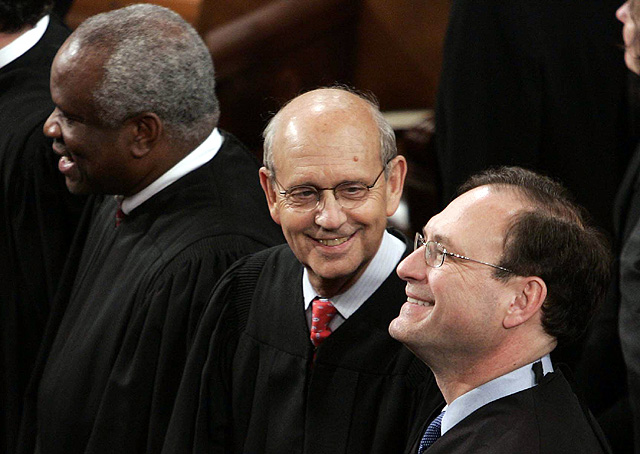
Newly sworn in Supreme Court Justice Samuel Alito, right, shares a laugh with fellow Justice Stephen Breyer, center, and Clarence Thomas on Tuesday at Capitol Hill before President Bush's State of the Union address.
Since the founding of the nation, only Thomas received more votes against his confirmation than Alito – Thomas was confirmed by a 52-48 vote, the closest in history. Democrats said their vote was driven by Alito’s 15 years on the 3rd U.S. Circuit Court of Appeals, where, they say, he compiled a record of ruling against individual rights and civil liberties in deference to executive authority, whether the police or the president.
“In replacing Justice Sandra Day O’Connor, President Bush had an opportunity to bring the country together. But sadly, by nominating Samuel Alito, he chose not to do so,” said Sen. Edward Kennedy, D-Mass, who led an 11th-hour filibuster drive to block the confirmation. “As today’s vote makes clear, there is no consensus in the Senate or the country that Alito, a strong believer in unrestrained presidential power, is the right person for the court at a time when it will clearly be facing major issues of abuse of executive power.”
They expressed particular concern over a 1985 job application to the Reagan Justice Department in which Alito vouched for his political conservatism and expressed pride in his efforts to abolish racial quotas in hiring and to overturn the Roe v. Wade Supreme Court decision that established a woman’s right to an abortion.
“It is my belief that this nominee’s legal philosophy and views will essentially swing the Court far out of the mainstream, toward legal philosophy and views that do not reflect the majority views of this country,” said Sen. Dianne Feinstein, D-Calif., the only woman on the Senate Judiciary committee. “I am very concerned about the impact Judge Alito could have on women’s rights, including a woman’s right to make certain reproductive choices as limited by State regulation.”
Republicans described the Democrats’ opposition as motivated primarily by politics and the increasingly hostile relationship between the parties in Congress. They repeatedly noted that in 1993 and 1994, most Republicans voted overwhelmingly to confirm President Clinton’s more liberal nominees, Stephen Breyer and Ruth Bader Ginsburg, to the Supreme Court.
“There are some of my colleagues, I’m sure, who voted their conscience. But a lot of it is over politics,” said Sen. Orrin Hatch, R-Utah, a former Judiciary committee chairman. “I have found that the confirmation of judges probably is at the root of this very bitter partisanship that is going on in the Senate.” Democrats countered that the president has deliberately fomented partisan strife on Capitol Hill.
“His campaign promise was to be a uniter, not a divider,” said Sen. Patrick Leahy of Vermont, the top Democrat on the Judiciary committee. “This was a chance for the president to be a uniter – he failed in that and the country is worse for it.”
Politics of justice
Some Democrats acknowledged that politics was part of the equation, at least in the sense that they never had enough votes to stop the confirmation. Sen. Barack Obama, D-Ill., said Alito’s confirmation was a direct result of Democrats’ failure to win the presidency or a majority in the Senate.
“Sooner or later, politics catches up with the Supreme Court,” Obama said. “If Democrats are consistently losing elections, then our views and our values will be less represented on the court.”
The confirmation capped a year of deep contention in the Senate over judicial nominations, with Democrats repeatedly threatening to use the only tool at the minority’s disposal to block controversial nominees – the filibuster.
But in the end, only about half the chamber’s 44 Democrats supported the filibuster, deciding that the political costs of blocking Alito would be too high, especially in an election year with a number of Democratic senators trying to hold on to seats in Republican-leaning states.
The four Democrats who voted for Alito are all from so-called “red states” who voted for the president in 2004: Sen. Robert Byrd of West Virginia, Sen. Kent Conrad of North Dakota, Sen. Ben Nelson of Nebraska and Sen. Tim Johnson of South Dakota. All except for Johnson face re-election in the fall.
The only Republican to vote against Alito faced a similar electoral calculation from the other side: Sen. Lincoln Chafee of Rhode Island faces a tough re-election battle this year in the Democratic-leaning state of Rhode Island.
“I am a pro-choice, pro-environment, pro-Bill of Rights Republican and I will be voting against this nomination,” Chafee said before the vote.
At 55, Alito will be one of the youngest members of the Supreme Court, joining 51-year-old Roberts and 57-year-old Thomas on the court’s conservative wing. The other conservative stalwart, Justice Antonin Scalia, is 69.
By contrast, the more liberal justices are all over 60: Justice John Paul Stevens, at 85, is the oldest member of the court, followed by Ginsburg, 72, Justice Anthony Kennedy, 69, Justice Stephen Breyer, 67, and Souter, 66.
National

Unhealthy air quality in California city as huge warehouse fire burns for 3rd day

Judge orders Trump administration to restore National Park changes at sites that ‘disparaged’ US
Teens’ reading and math scores have stagnated, US test results show
WASHINGTON (AP) — Younger students have regained ground academically after the pandemic's disruptions while older ...
Lawyers for man accused of killing Charlie Kirk try to block death penalty

Trump’s name poised to come off Kennedy Center