It’s time to talk trafficway
Eastern route: 32nd or 42nd Street?
It was show-and-tell day for the controversial South Lawrence Trafficway.
Federal regulators had an open house Thursday that attracted 140 people to look at placards and ask questions about two proposed routes for the uncompleted eastern leg of the trafficway.
“At this point, we’re trying to get as much input as we can on the two alternatives,” said Wendall Meyer, assistant division administrator for the Federal Highway Administration, which must approve a route for the project before it can become eligible for federal funding.
Getting input on the project that has been lingering in the Lawrence lexicon for more than a decade shouldn’t be a problem. Regulators on Thursday heard from supporters of both routes that federal regulators have deemed to be possible:
¢ A 32nd Street route that would run through the Baker Wetlands.
¢ A 42nd Street route that would avoid the wetlands by building the road south of the Wakarusa River.
“I’m just seeking more details so I can get an informed opinion,” said Lawrence resident Jeff Anderson, who said he was most concerned about selecting a route that did the least to impose on the environment and historical sites.
Those two concerns have been cited frequently by opponents of the Baker Wetlands route, which would go through ground that historically is linked to Haskell Indian Nations University.
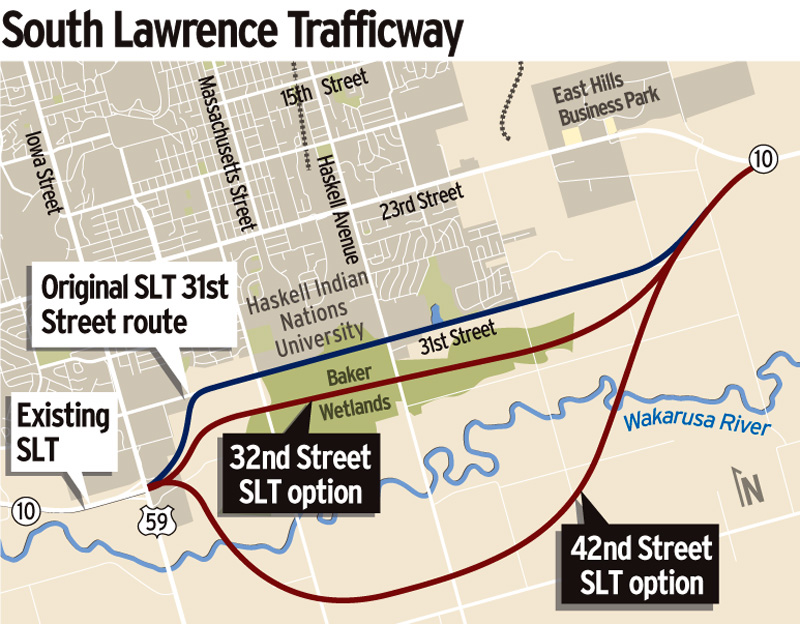
But supporters of the 32nd Street route contend that the large amount of mitigation – including the creation of approximately 300 acres of wetlands, woodlands and tallgrass prairie – makes it the best environmental option.
“It does surprise me to see the amount of mitigation that they are proposing,” Anderson said. “It is good to see the details.”
Most folks weren’t so undecided on the future of the road, which is designed to connect the Kansas Turnpike west of Lawrence with Kansas Highway 10 east of Lawrence. It currently ends at Iowa Street on the southern edge of Lawrence.
Several supporters of the 32nd Street route said they were uncertain of the environmental significance of the Baker Wetlands because they had been used as farmland as late as the early 20th century.
“That is a man-made lake,” Lawrence resident George Lauppe said of the wetlands. “They altered it once, so we should be able to alter it again.”
Supporters of a 42nd Street route, though, said the wetlands route wasn’t farsighted enough to serve as a true bypass because the city already is slated to grow south of the Wakarusa River. They also said supporters of a 32nd Street route do not adequately understand the importance of the wetlands, especially to the American Indian community.
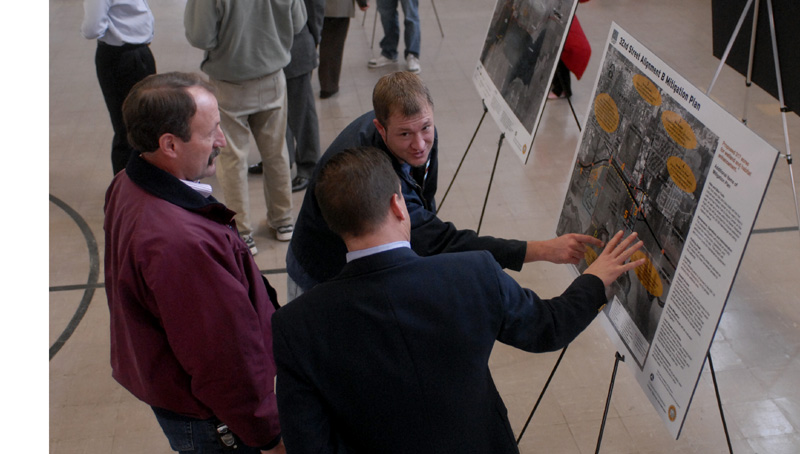
An open house to gather comments on the eastern leg of the South Lawrence Trafficway attracted 140 people Thursday to the National Guard Armory, 200 Iowa. Among them were property owners Mike Koehler, left, and his son, Dan Koehler, who talked with Kris Norton of the Kansas Department of Transportation. The Koehlers, who own 6.5 acres south of the Wakarusa River, favor the 32nd Street route.
“As a community, I think we really need to show more respect for Native Americans, and their land and their history,” said Saunny Scott of Lawrence.
Federal and state transportation officials were on hand to answer questions at the open house, which also gave people an opportunity to submit written comments on the project. Regulators said they hoped the event provided participants with clear side-by-side comparisons of the two routes.
The Federal Highway Administration is taking public comment on the routes as part of a required study to examine the road’s possible effects on historical sites in the area. The agency previously accepted comments on a study regarding possible environmental impacts. The agency expects to make a decision on a route in June or July.
The U.S. Army Corps of Engineers already approved the 32nd Street route, but the Federal Highway Administration also must approve it in order for federal funds to be used. Federal funds likely will be needed because the project currently is not on the list of state projects to be funded.
The South Lawrence Trafficway
- 6News Video: Lawrence residents turn out by the dozens to discuss S.L.T.
- 6News video: Residents given chance to see South Lawrence Trafficway proposals(12-13-06)
- Information placards from the open house meeting (.pdf)
- A new round for the SLT (11-14-06)
- Traffic forecasting study considered (11-07-06)
- New city manager reveals his plans (10-16-06)
- SLT referendum won’t be on ballot (09-21-06)
- Group wants public vote on trafficway (09-08-06)
- The Federal Highway Administration Report
City Government
Developer seeks incentive from City of Lawrence to build 131 units of housing near Wakarusa and Queens

Lawrence city leaders will consider whether to keep Community Building open, make 2 other rec centers free to access
A STAR Bond application raises questions for city leaders about Costco and housing west of the SLT
Soccer gear honoring Lawrence history’s all-star team is now on sale as part of city’s public art exhibition
To honor public servants, Lawrence’s July 4 celebration will have a whole gallery of their photos on display; submissions open now