

Memoir shows human side of Presley
MEMPHIS ? When he was 12, Jerry Schilling couldn’t believe the voice he heard on the radio singing “That’s All Right” belonged to a teenager from his own north Memphis neighborhood.
A few days after hearing the song, he was playing a pickup football game, and the quarterback on his team was the same kid from the neighborhood, 19-year-old Elvis Presley.
“We went into a huddle, and I said, ‘Wow, that’s the guy with a song on the radio!”‘ Schilling told The Associated Press.
Schilling has written a new memoir about his 23-year friendship with Presley, but he didn’t use the book to convince anyone that his childhood friend was a great performer or a rock ‘n’ roll legend.
Instead, “Me and a Guy Named Elvis,” written with Chuck Crisafulli, shows Presley’s more human side, the intelligent and passionate man who struggled with drug abuse and was frustrated with his mediocre Hollywood movies.
After Presley’s death in 1977, Schilling, who still lives in the Hollywood Hills, Calif., home that Elvis bought for him, worked for Elvis Presley Enterprises and produced documentaries and TV specials about the performer.
But Schilling had always said he wasn’t interested in writing an Elvis book, as other members of the inner circle had done. He changed his mind when Schilling’s wife, Cindy, urged him to tell the story.
Schilling worked with Crisafulli, an entertainment journalist who has written several books. Publisher Gotham, an imprint of the Penguin Group, said that the pair wrote the book side by side over the course of three years, and it was a very successful collaboration. There are about 30,000 copies in print of the book, which already has been sent back for a second printing since its release Thursday.
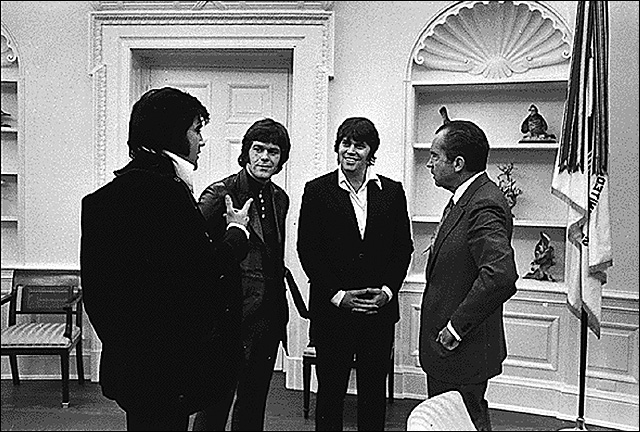
From left, Elvis Presley, Jerry Schilling and Sonny West meet President Richard Nixon on Dec. 21, 1970, at the White House. Schilling first met Presley in 1954 at the age of 12 and later went to work for Presley, starting out as a gofer and working his way up to the producer of several of Presley's movies. Schilling has co-written the book Me
“It’s a fun, complicated book about a simple friendship in a complicated world,” Schilling said in a recent interview while in town to promote his new book. “(His death) was the biggest loss of my life, ever. I still miss him.”
The memoir received the blessing of Presley’s wife, Priscilla, and his daughter, Lisa Marie.
Schilling started working for Presley in 1964, doing whatever was needed as Elvis moved from concerts to movie sets to the studio.
Those who worked for Presley – the so-called Memphis Mafia – became his friends and confidants. Presley even allowed Schilling and the others to live in his Memphis home at Graceland.
Even when Presley started seeing Priscilla, the Memphis Mafia was always around. Presley’s manager, “Colonel” Tom Parker, shut his buddies out of their 1967 wedding in Las Vegas, but Presley managed to invite them along on the honeymoon.
“When he carried Priscilla across the threshold of their new Palm Springs home – the so-called Honeymoon House – the first thing Priscilla saw on the other side was us,” Schilling writes.
Presley wanted his buddies around, but he wanted them to keep their distance from Priscilla, Schilling said, even though they were all living under the same roof.
Schilling once saw Priscilla in the kitchen of Graceland looking flushed and asked her if she was feeling OK – not realizing she and Elvis had been arguing. Priscilla later told Elvis that Schilling cared about her feelings, and it drove Elvis crazy. Schilling said Presley stormed into a room where his friends were watching TV and announced, “I don’t need anybody else taking care of Priscilla and checking how she is.” Schilling said he didn’t talk to Priscilla for almost a year.
Drugs have long been the suspected cause of Presley’s death, and Schilling said he took pills to escape the disappointment he felt about the direction of his career. Elvis wanted to produce his own film about karate, but Parker refused to allow it. Elvis tried to make the movie himself with Schilling’s help, but it was shelved as Elvis spent more time in the hospital to combat fatigue and drug usage.
“It was the creative disappointment that killed Elvis,” Schilling said. “The drugs were just a Band-Aid.”
Arts and Entertainment

Photos: Lawrence begins World Cup festivities with downtown block party
Watkins Museum to open special exhibit detailing how Douglas County celebrated America’s Bicentennial

Go, See, Do: Kaw River Roots Festival, markets and more

Soccer gear honoring Lawrence history’s all-star team is now on sale as part of city’s public art exhibition

Nominations, call for artists open for Lawrence’s 2026 Phoenix Awards