Defiant Saddam begins second trial
Baghdad, Iraq ? Defiant and alert, Saddam Hussein bickered with the judge, challenged prosecutors and vented outrage Monday on the opening day of his second trial.
This time around, Saddam faces charges of genocide, war crimes and crimes against humanity linked to his regime’s scorched-earth “Anfal” campaign against rebellious Kurds almost two decades ago.
He is in the dock of the special Iraqi tribunal with six other ex-aides, the most notorious being his cousin, Ali Hassan al-Majid, who earned the nickname “Chemical Ali” because of his purported sanctioning of the use of internationally banned chemical weapons.
Both Saddam and al-Majid could face the hangman if convicted for responsibility in the death of as many as 100,000 Kurds during a 1988 military campaign in Iraqi Kurdistan.
Not-guilty pleas were entered for the seven defendants, who are expected to argue that the regime used appropriate force to put down pro-Iranian Kurdish rebels during a critical stage of the bloody 1980s Iraq-Iran war.
Although five years younger than the 69-year-old Saddam, al-Majid appeared much frailer, trudging into court on cream-colored sandals and using a cane to steady himself. Al-Majid donned a red-checked tribal head covering and Arab robe, while Saddam opted for a black suit and open-necked white shirt.
Asked his name, Saddam’s once-ferocious commander replied, “The fighting comrade Staff Maj. General pilot Ali Hassan al-Majid.” He gave his occupation as “detainee.”
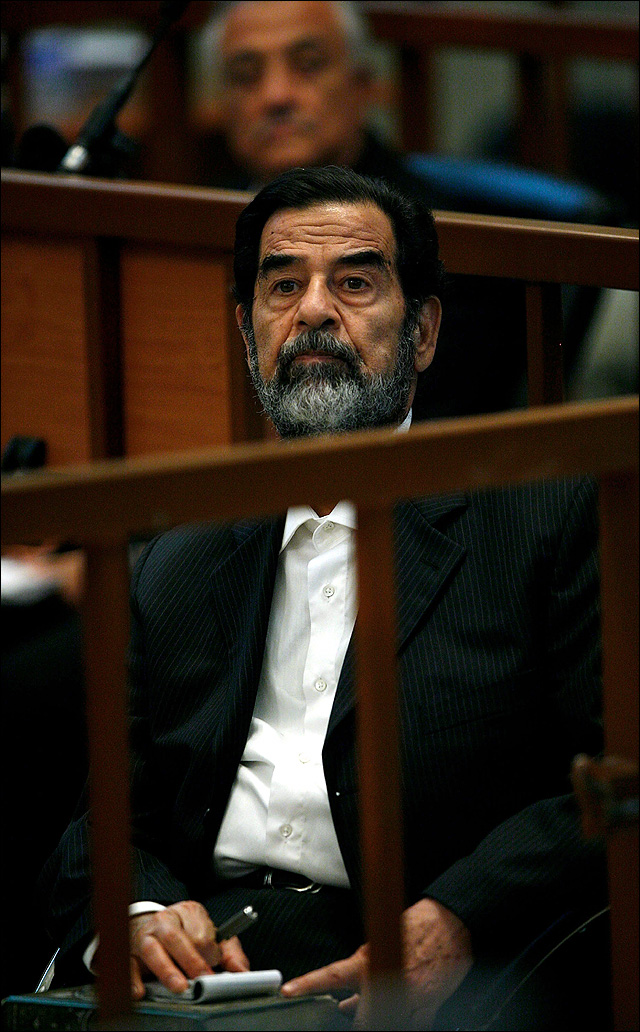
Iraq's former President Saddam Hussein looks on Mon-day during the first day of the Anfal trial in Baghdad's heavily fortified Green Zone. Saddam opened his second trial with a show of defiance, refusing to enter a plea on charges of genocide and war crimes connected to his scorched-earth offensive against Kurds nearly two decades ago.
Saddam often parried the judge’s questions, refusing to respond when queried if he was innocent or guilty. “That would require volumes of books,” Saddam finally explained.
Saddam chided presiding judge Abdullah al-Amiri for silencing two defense attorneys, an Egyptian and a Jordanian, because they are not Iraqi.
The ex-Iraqi strongman never wavered during the almost five-hour court proceeding, occasionally taking a green-covered Quran in hand as he rose to challenge a point.
Saddam, sporting his now-trademark, close-trimmed, salt-and-pepper beard, looked gaunt but appeared focused. He projected a sense of coiled power as he listened to the proceedings and frequently expressed indignation — especially at suggestions his soldiers had raped Kurdish women during the Anfal campaign.
“To say a … woman was raped and Saddam is president, this is intolerable,” said Saddam, wagging his fingers in disgust. “Who ever says this is my personal enemy. … Where is Saddam’s honor?”
He recalled a purported incident in “liberated” Kuwait – following the Iraqi invasion of the oil-rich kingdom in 1990 – when an Iraqi officer was found to have raped a woman. Hussein said the officer was court-martialed and, at Saddam’s orders, publicly hanged at the site of the alleged assault, where his body was left to hang for several days as an example.
Saddam also disputed the prosecutor’s interpretation of the word “anfal,” said to mean “spoils of war.” Saddam hinted at a more benign meaning, though he never spelled out an alternative definition.
The judge rejected a plea from Saddam and defense attorneys to throw the charges out because the tribunal was formed during the U.S. “occupation” government. A similar defense tactic failed in the first case against Saddam.
National
Lawyers for man accused of killing Charlie Kirk try to block death penalty

Trump’s name poised to come off Kennedy Center

Suspect in Texas shooting had fired at police days earlier, officials say
Man pleads guilty to killing a top Minnesota Democrat and her husband
New tornadoes outside Chicago as severe storms pummel the Midwest