AOL makes more services free in attempt to maintain relevance
New York ? AOL just gave its customers more reasons to stop paying.
In a strategy shift likely to accelerate the decline in its core Internet access business, AOL said Wednesday it would give away e-mail accounts and software previously available only to customers who paid as much as $26 a month.
AOL hopes to chase additional online advertising dollars instead. Encouraged by such trends as its 40 percent jump in ad revenue in the second quarter, AOL figures that by making services free, it can prevent users from defecting to Yahoo Inc., Google Inc. and Microsoft Corp., which have offered free, ad-supported e-mail for years.
Rob Enderle, an analyst with the Enderle Group, said the restructuring brings Time Warner Inc.’s online unit in line with “this decade as opposed to the last decade” and lets the company “hold on to the customers they had left.”
“Had they done nothing, by the end of the decade, they would have been gone,” Enderle said.
The move marks the end of an era for a company that grew rapidly in the 1990s by making it easy to connect online, giving millions of Americans their first taste of e-mail, the Web and instant messaging through discs that continually arrived unsolicited in mailboxes.
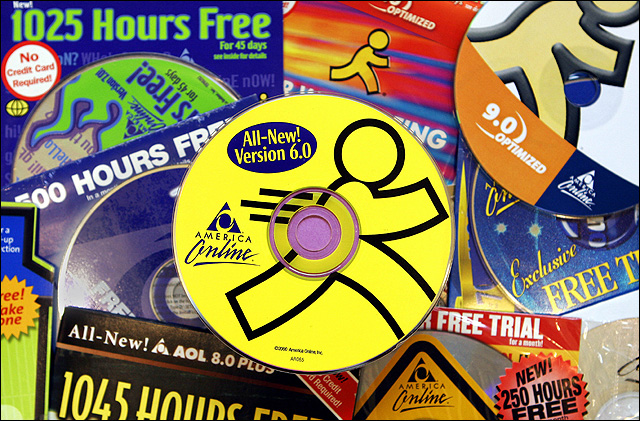
A collection of CDs containing promotional software for AOL's Internet service is shown in New York. AOL announced Wednesday that it will give away free e-mail accounts and software, removing the few remaining reasons for AOL subscribers to keep paying when they already have high-speed Internet access through a cable or phone company.
America Online, as it was then known, became the undisputed leader of dial-up Internet access when many people still used that method to get online. The greeting users got when signing on – “You’ve got mail!” – became so ensconced in pop culture that it was the title of a movie. AOL’s shares flew so high in the Internet bubble that the company bought the Time Warner media giant in 2000.
But many promises of synergy from that deal evaporated. The company’s stock plunged, key AOL executives left under pressure and now Time Warner management is firmly in charge.
AOL kept losing subscribers as more Americans got high-speed service through a cable or phone provider.
“This is the final goodbye to the days when AOL was the king of the Internet,” said Jeff Lanctot, general manager of aQuantive Inc.’s Avenue A/Razorfish, an agency that places some ads on AOL sites. “They now know they are the underdog.”
The company expects to save more than $1 billion by the end of 2007 by cutting marketing, network and overhead costs. That’s also roughly the amount AOL could lose annually if all 6.2 million of its subscribers with broadband stop paying extra – generally $15 a month – for access to AOL’s content.
“Any guesses or speculation that this plan requires a ‘hit’ to AOL earnings is not right,” said Jeff Bewkes, president and chief operating officer of Time Warner.
However, AOL will continue losing dial-up subscribers, perhaps at a faster rate as the company scales back its notoriously aggressive retention efforts and no longer actively markets the service to obtain replacements.
“But we have to remember that we’re changing the nature of this game,” Jonathan Miller, AOL’s chairman and chief executive officer, told The Associated Press. “Before, when someone left us, that was not good for our company. They probably went to one of our competitors.”
Now they can stay with AOL for free and view its ads.
“They were leaving us over price,” he said. “They weren’t leaving us because they were unhappy.”
National

Unhealthy air quality in California city as huge warehouse fire burns for 3rd day
Judge orders Trump administration to restore National Park changes at sites that ‘disparaged’ US
Teens’ reading and math scores have stagnated, US test results show
WASHINGTON (AP) — Younger students have regained ground academically after the pandemic's disruptions while older ...
Lawyers for man accused of killing Charlie Kirk try to block death penalty

Trump’s name poised to come off Kennedy Center