Katrina coverage wins Pulitzers
New York ? The staffs of The Times-Picayune of New Orleans and The Sun Herald of south Mississippi captured Pulitzer Prizes for public service on Monday for chronicling the catastrophic aftermath of Hurricane Katrina despite life-changing damage to their own homes and workplaces.
Tears flowed rather than champagne in the Times-Picayune newsroom, which the staff had to evacuate just eight months earlier for about six weeks. At The Sun Herald, staff members cheered and fought back tears.
The Sun Herald won for its “valorous and comprehensive coverage … providing a lifeline for devastated readers” and The Times-Picayune for its “heroic, multi-faceted coverage” to “serve an inundated city even after evacuation of the newspaper plant,” the Pulitzer citation said.
The Washington Post won four Pulitzers, The New York Times three and The Times-Picayune and the Rocky Mountain News each won two.
The Times-Picayune staff was awarded a second Pulitzer, for breaking news, for Katrina, and The Dallas Morning News was honored “for its vivid photographs depicting the chaos and pain” of the disaster.
Like their communities, The Sun Herald and The Times-Picayune took a beating from Katrina. Their buildings were damaged, advertisers and subscribers were displaced, and circulation dropped.
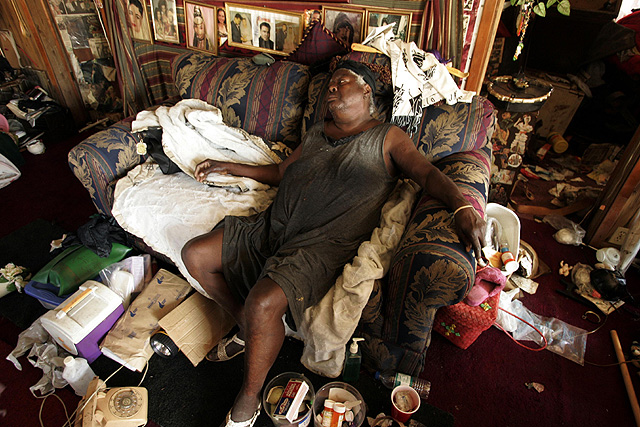
Eddie Mae Smith, 75, collapses on her sofa inside her mold infested home in Biloxi, Miss., where she has been living Sept. 11, 2006, following Hurricane Katrina. She had been living inside the home and fending for herself since the storm. This photo was included in a portfolio of images that was awarded the 2006 Pulitzer Prize for Breaking News Photography.
The Times-Picayune evacuated about 240 employees in the back of newspaper delivery trucks as water from a levee breach rose around its plant. Many staffers saw the disaster unfold in their own neighborhoods.
The newsroom erupted in applause at the news of the Pulitzers, but there was no champagne.
“It was a national tragedy,” said Peter Kovacs, the Times-Picayune’s managing editor for news. “It would not be appropriate to have champagne because of the nature of the event.”
‘Watchdog journalism’
At The Washington Post, Susan Schmidt, James V. Grimaldi and R. Jeffrey Smith won the investigative reporting Pulitzer for stories on the Jack Abramoff scandal; David Finkel won for explanatory reporting on the U.S. government’s attempt to bring democracy to Yemen; Dana Priest won the beat reporting category for stories on secret prisons and the government’s counterterrorism campaign; and Robin Givhan won for “her witty, closely observed essays that transform fashion criticism into cultural criticism.”
James Risen and Eric Lichtblau of the Times and the staffs of the San Diego Union-Tribune and Copley News Service won for national reporting – the Times for stories on the Bush administration’s domestic eavesdropping, the Union-Tribune and Copley for disclosing the bribe-taking that sent former Rep. Randy “Duke” Cunningham to prison.
Joseph Kahn and Jim Yardley of the Times won the award for international reporting for coverage of China’s legal system.
The Pulitzer for commentary went to Nicholas D. Kristof of the Times for focusing attention on genocide in Darfur.
“The Pulitzer judges have put a premium on watchdog journalism – on journalism that demonstrated the press standing up to power, often with substantial consequences,” Times Executive Editor Bill Keller said in a newsroom speech.
Other awards
Jim Sheeler of the Rocky Mountain News was honored for feature writing for his story on a Marine major who helps families of comrades killed in Iraq cope with their loss. The newspaper’s Todd Heisler received the prize for feature photography for his accompanying pictures in a package called “Final Salute.”
Rick Attig and Doug Bates of The Oregonian of Portland won for editorial writing focused on abuse inside a mental hospital. Bates wrote the 1991 book “The Pulitzer Prize: The Inside Story of America’s Most Prestigious Award.”
The prize for editorial cartooning went to Mike Luckovich of The Atlanta Journal-Constitution.
For the first time, applicants in all categories were allowed to include material published online as part of their entries.
The Pulitzer for public service carries a prize of a gold medal. The other prizes come with cash awards of $10,000.
National

Lawyers for man accused of killing Charlie Kirk try to block death penalty

Trump’s name poised to come off Kennedy Center

Suspect in Texas shooting had fired at police days earlier, officials say

Man pleads guilty to killing a top Minnesota Democrat and her husband

New tornadoes outside Chicago as severe storms pummel the Midwest