Court rules against LAPD’s arrests of homeless people
A federal appeals court ruled Friday that the Los Angeles Police Department cannot arrest people for sitting, lying or sleeping on public sidewalks on Skid Row, saying such enforcement amounts to cruel and unusual punishment because there are not enough shelter beds for the city’s huge homeless population.
The long-awaited decision effectively kills Los Angeles Police Chief William J. Bratton’s original blueprint for cleaning up Skid Row by removing homeless encampments that rise each evening around the 50-block downtown district.
That plan has been on hold for three years, and city leaders have recently backed a less aggressive policy.
The ruling also has implications for police agencies around the nation that have grappled with how they deal with the homeless.
While Los Angeles’ policy was considered one of the most restrictive in the nation, other communities have tried milder variations of the same approach. Las Vegas and Portland, Ore., for example, bar sleeping or standing in a sidewalk or other public space only if it obstructs pedestrians or cars, and Seattle, Tucson, Ariz., and Houston limit the hours of enforcement, the opinion said.
City officials said Friday that the ruling makes it likely that the LAPD will move forward with a more moderate Skid Row policing plan, one that would crack down on crime while allowing cardboard cities.
The city’s crackdown will be centered “on the predators who are preying on the homeless, whether they are selling drugs, prostitution, whatever it is,” Mayor Antonio Villaraigosa, who has promised a major push to fix Skid Row, said Friday.
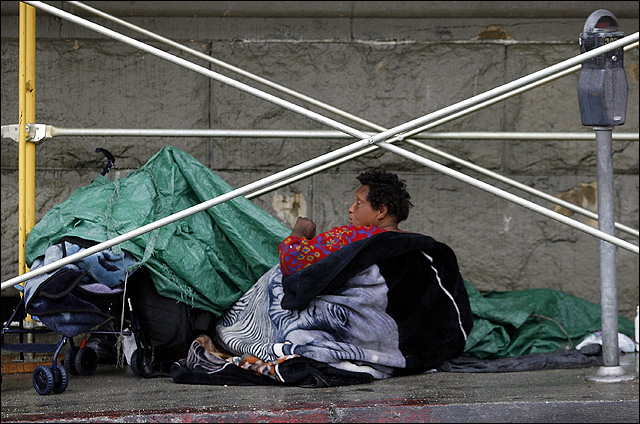
A woman lies under construction scaffolding for shelter from the rain in the Skid Rown area of downtown Los Angeles, Friday, April 14, 2006. The city of Los Angeles cannot arrest homeless people for sleeping on sidewalks until it provides enough beds for the thousands who lack shelter each night, a federal appeals court ruled Friday.
The mayor said he hoped the court’s decision would allow the city to finally move forward with a humane approach that targets crime without making criminals out of transients who have nowhere else to live.
Although the City Attorney’s office would not say if it would appeal, the suit was filed two years before Villaraigosa’s election in 2005. The mayor has said he wants a less contentious approach on the homeless issue, and recently appointed Ramona Ripston, executive director of the American Civil Liberties Union’s Southern California affiliate, to the city and county Homeless Services Authority. Only the city, as the defendant, can file an appeal.
The decision was issued by the U.S. 9th Court of Appeals in San Francisco, the most liberal federal appeals court in the nation.
Mark Rosenbaum, legal director of the American Civil Liberties Union of Southern California and the lead attorney on the case, said the ruling “stands for the proposition that in America homelessness is not a crime.”
Bratton called for the removal of the tent cities when he arrived in Los Angeles in 2002, but the department scaled back its plans after the lawsuit was filed. Friday’s decision overturned a December 2004 ruling by U.S. District Judge Edward Rafeedie, who held the city’s enforcement was constitutional.
The suit was brought on behalf of six homeless people.
The court ruling comes as Los Angeles leaders are making a new push to fix Skid Row. Los Angeles County has proposed establishing suburban homeless centers to reduce the concentration of drug abuse centers and shelters in Skid Row. The mayor is expected to unveil his homeless plan soon.
The ruling won’t have an immediate impact because the city right now allows homeless people to sleep on the streets as long as they pack up their camps by morning.
National
Unhealthy air quality in California city as huge warehouse fire burns for 3rd day
Judge orders Trump administration to restore National Park changes at sites that ‘disparaged’ US
Teens’ reading and math scores have stagnated, US test results show
WASHINGTON (AP) — Younger students have regained ground academically after the pandemic's disruptions while older ...
Lawyers for man accused of killing Charlie Kirk try to block death penalty

Trump’s name poised to come off Kennedy Center