

News of the Weird
Lead story
Researchers at Massachusetts Institute of Technology are working on a high-tech device with seemingly a multitude of uses in lessening our crushing overload of banality: a boredom detector. A talker, via a wearable camera and software that measures facial expressions and movements, could know whether he has lost touch with a listener (via signals from eyebrows, lips, nose, etc.). The device was designed for the autistic (who are typically oblivious of other people’s reactions), but would be useful to anyone underskilled at being interesting. So far, the software is said to be accurate 64 percent of the time, according to a March report in New Scientist.
The entrepreneurial spirit
Bold Marketing: (1) Among men’s colognes recently launched: the Elizabeth Arden-NASCAR “Daytona 500” fragrance and the Ecuadorean Football Federation’s set of three soccer-motif scents, ranging from a “sporting” aroma to “an intense smell ideal for after work.” (2) Butte, Mont., has long been unhappy with the presence of the Berkeley Pit, a huge, putrid, toxic lake filled by runoff from arsenic, copper, cadmium, cobalt, iron and zinc mines. Last year, however, the town began to figure out that tourists would actually pay to see the 500-acre, 900-foot-deep, foul, wretched mess. Attendance was so good that the admission price was recently increased.
¢ Specialty Products: The apparently successful Iraq Insurance Co. (a state-owned firm with 50 salespeople nationwide) is thought to be the only company in the world to offer “off-the-shelf” terrorism life insurance (paying a bodyguard’s beneficiary, for example, the equivalent of about $3,500, which is a policeman’s yearly salary, for a $90 premium, according to a New York Times dispatch). As of mid-March, no policyholder had been killed.
Science on the cutting edge
In work by various labs in the United States, the Netherlands and Australia (reported by Toronto’s Globe and Mail in March), meat was grown in test tubes, and such dishes may yet be a staple in progressive kitchens. “Before bed, throw starter cells and a package of growth medium into the (coffee maker-sized) meat maker and wake up to harvest-fresh sausage for breakfast,” wrote the Globe and Mail. Engineered meat would taste like beef or pork, but could be created to be as healthful as salmon. One private group told researchers it was interested in growing human meat, but funding for any of the work will be difficult, said a Medical University of South Carolina scientist.
¢ A family has been found in Kurdish Turkey whose members walk on all fours, use the palms of their hands for balance, and stand upright only with difficulty, according to researchers who filmed the family for a March British television show. According to Professor Nicholas Humphrey of the London School of Economics, scientists’ best guess for the family’s condition is that their inbreeding caused the reprise of genetic traits long thought to have been evolutionarily passed over.
Least competent criminals
Inexplicable: Phillip Williams, 47, for some reason approached two uniformed police officers in Tampa, Fla., in March to ask their opinions of whether the substance he had just purchased for the crack pipe he was holding was indeed cocaine. After examining the pipe, the officers suspended their then-current investigation of a burglary and put the cuffs on Williams. The month before, in Orlando, Michael Garibay, 34, approached a sheriff’s deputy in a marked patrol car and asked him if he was “straight,” which, as Garibay proceeded to explain to the befuddled officer, meant, “Do you want to buy cocaine?” After Garibay pulled out a baggie of white rocks, he was arrested.
Arts and Entertainment
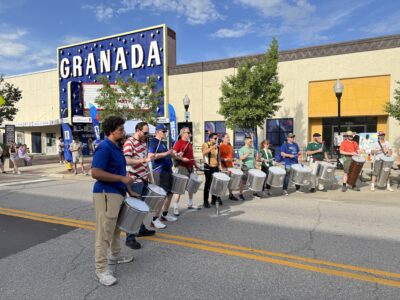
Photos: Lawrence begins World Cup festivities with downtown block party
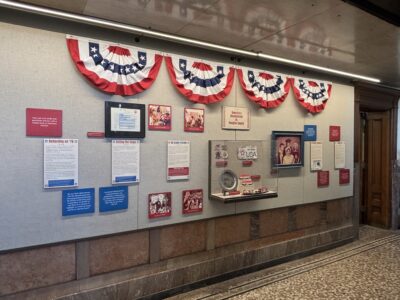
Watkins Museum to open special exhibit detailing how Douglas County celebrated America’s Bicentennial

Go, See, Do: Kaw River Roots Festival, markets and more
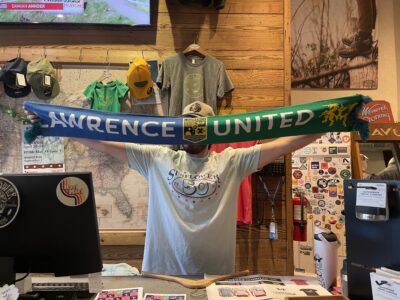
Soccer gear honoring Lawrence history’s all-star team is now on sale as part of city’s public art exhibition

Nominations, call for artists open for Lawrence’s 2026 Phoenix Awards