West Nile tracking flawed, prof says
Questions remain concerning number of Douglas County cases
State health officials have made a “serious error” by not more extensively tracking the West Nile virus in Kansas, a Kansas University scientist said Wednesday.
A day after Douglas County’s second and third human cases in 2005 were announced, Townsend Peterson said state procedures made it impossible to know if the Lawrence area was particularly vulnerable to the virus. No other county has seen more than one case this year.
Early testing of birds in 2002 showed where West Nile had spread, Peterson said, but officials didn’t look into how prevalent it was in any location.
“My argument was, and still would be, is that is a very dangerous attitude,” said Peterson, an associate professor of ecology and evolutionary biology at Kansas University. “Because it leads to the question you’re asking, which is whether Lawrence is particularly prone (to West Nile). And the answer is, I have no idea.”
Officials with the Kansas Department of Health and Environment, though, said the agency had shifted its focus to preventing infections. Once the virus has appeared in a county, they said, officials must assume the population is vulnerable.
“Our perspective is to try to keep people from getting West Nile virus,” said Dr. Gail Hansen, the state epidemiologist. “We know once it has come here, it isn’t going away … so what we’re trying to focus on is the human public health aspect.”
Severe symptoms
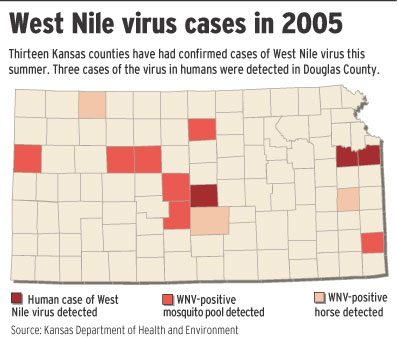
KDHE announced Tuesday that two Douglas Countians – a 61-year-old and an 82-year-old – were diagnosed with the virus in late August. That followed an earlier announcement, in June, that the county was home to the nation’s first human case in 2005, contracted by a 51-year-old. Only two other cases have been identified across Kansas this year.
“The cases that are reported to KDHE are the cases where there are more severe symptoms,” said Sharon Watson, KDHE spokeswoman.

At its worst, West Nile symptoms can include high fever, disorientation, numbness and paralysis resulting in death. The disease is usually passed through mosquito bites.
When the virus first appeared in Kansas in 2002, Peterson was part of a team at the KU Natural History Museum that tested birds from counties across the state to see if they had contracted the virus. Once officials determined the virus had spread to a new county, they stopped further testing of birds from that location – letting scientists know where the virus was, but not the level of danger.
That makes it difficult to know if Douglas County is more or less safe from the virus than other parts of Kansas, he said.
“I think the situation is so cloudy, it’s impossible to say,” Peterson said.
“To me, it’s a very serious error that KDHE has committed in this.”
But Watson countered that a variety of factors are at play in West Nile infections. Just because Douglas County leads the state in diagnoses, she said, doesn’t mean it’s a hotbed for the virus. And bird testing doesn’t show where people will get the virus, she said. The agency still actively tracks mosquito pools.
“It could be considered a coincidence that one particular area has more cases than another,” she said. “It comes down to who’s being bitten … and how they respond to being infected by the virus.”
Prevention
There have been five human cases of West Nile virus in Kansas this year, among more than 1,300 nationwide – mostly in California, Illinois and South Dakota. There have been 29 deaths, nationally, from the virus in 2005.
Among the ways to prevent the spread of West Nile:
¢ When outdoors, use insect repellent.
¢ Mosquitoes are most active at dusk and dawn; in addition to repellent, long sleeves and pants can prevent bites – so can staying inside.
¢ Good screens on windows and doors can keep the mosquitoes outside.
¢ Mosquito-breeding sites should be eradicated by emptying standing water from flower pots, buckets, barrels, water dishes and bird baths. Tire swings and children’s wading pools should also be emptied regularly.
Source: Centers for Disease Control, www.cdc.gov/westnile
Other cases
Christine Pearson, a spokeswoman for the Centers for Disease Control in Atlanta, said only one percent of victims developed West Nile’s most serious symptoms. Infants, people with immune deficiencies and adults over age 50 are the most vulnerable, but 80 percent of people who contract the virus never get sick.
“Anytime there’s West Nile in an area, people should be concerned,” Pearson said.
That makes it difficult to determine if Douglas County is vulnerable, Watson said. The three identified cases here were all in adults older than 50; other counties could have higher infection rates – but if people don’t get sick, authorities will never know.
“There are other cases of West Nile virus than what we know,” she said.
But Hansen said Douglas County’s high number of cases was just a “quirk.”
“You’ll get clusters, but they don’t necessarily mean anything,” she said. “If you throw a hundred M&Ms on a map of Kansas, they aren’t going to spread out evenly.”
Kim Ens, disease control program coordinator for the Lawrence-Douglas County Health Department, said her agency has also taken a prevention-first approach, urging residents to use mosquito repellent and to eradicate standing pools of water where mosquitoes congregate.
“Just because we’ve had the two (recent) cases, we’re not worried we have any more mosquitoes than any other place,” Ens said.
The CDC’s Pearson, though, warned that this year’s outbreak might not be over.
“We often see cases peaking in September and October,” she said. “It’s still out there.”
City Government

Opinion: Don’t give up on trying to use Costco to take tens of millions of dollars from the state of Kansas
Abandoned housing pilot program, data center rules, funding clawback for Bert Nash project on City Commission’s agenda

KU professors, middle school band director, radio personality among this year’s Phoenix Award honorees: ‘It’s a cool mix’
Housing Stabilization Collaborative’s request for city trust fund aid won’t be considered because it was filed late

On sister city visit, delegates from Hiratsuka, Japan, see Lawrence’s friendship firsthand