Fundraising for 9-11 memorials put on back burner during disasters
Washington ? With the nation’s attention and charitable giving focused on Hurricane Katrina and other disasters, it could be more difficult for fundraisers to collect the half-billion dollars needed to build memorials at each 9-11 crash site.
Fundraisers for the memorials planned at the World Trade Center site in New York City, the Pentagon and near Shanksville, Pa., say they are optimistic they will succeed, but it might take a little longer than planned.
Out of respect for Katrina victims, efforts to raise money for the World Trade Center and Pentagon memorials were held up on the fourth anniversary of the 9-11 terrorist attacks, even though it was a good time to get people to donate.
So far, more than $100 million of the $500 million for the World Trade Center site has been raised, along with $9 million of the $18 million needed for the Pentagon memorial. Fundraising for the Flight 93 memorial in Pennsylvania is in its infancy.
Long term, the memorial organizers could have a tough sell competing against Katrina and other disasters, said Daniel Borochoff, president of the American Institute of Philanthropy.
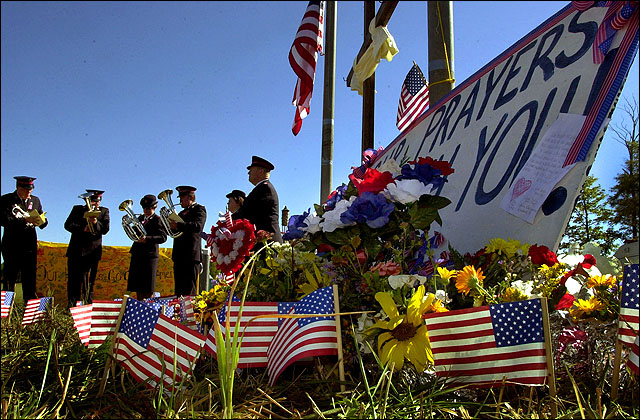
A Salvation Army band plays during a worship service Sept. 16, 2001, near the site where United Airlines Flight 93 crashed Sept. 11, 2001, in Shanksville, Pa. With the nation's attention and charitable giving focused on Hurricane Katrina and other disasters, it could be more difficult for fundraisers to collect the half-billion dollars needed to build memorials at each 9-11 crash site.
“When there are people suffering and people in need right now, it’s a harder argument to give money to a memorial, to a capital campaign, or an endowment,” Borochoff said.
In recent years, however, Americans have shown a willingness to give.
The Red Cross has received $1.2 billion of the $2 billion it has sought for hurricane relief.
After the 9-11 attacks, more than $2.2 billion was given to charities by Americans, and more than $1 billion was donated for victims of the Asian tsunami.
Even after those events, people continued to give at the same level to traditional charities, and some gave more, said Bob Ottenhoff, president of GuideStar.org, which tracks the finances of nonprofit organizations.
But the close timing of Hurricanes Katrina and Rita, the mudslides in Guatemala and the catastrophic earthquake in Pakistan, is unprecedented, and victims’ needs are ongoing, Ottenhoff said.
The test for nonprofits will come during the upcoming holiday period, when most charitable donations are given, Ottenhoff said.
National
Teens’ reading and math scores have stagnated, US test results show
WASHINGTON (AP) — Younger students have regained ground academically after the pandemic's disruptions while older ...
Lawyers for man accused of killing Charlie Kirk try to block death penalty

Trump’s name poised to come off Kennedy Center

Suspect in Texas shooting had fired at police days earlier, officials say

Man pleads guilty to killing a top Minnesota Democrat and her husband