Bush adviser acknowledges lack of preparation
Washington ? White House Homeland Security adviser Frances Fragos Townsend acknowledged Friday that the government failed to prepare adequately for the consequences of Hurricane Katrina, noting studies of New Orleans’s vulnerability to flooding and lessons from flawed U.S. responses to past natural and terrorist disasters.
Discussing the administration’s internal inquiry into the response to the Aug. 29 hurricane at length for the first time, Townsend told reporters that the broad review she is leading is incomplete but that some initial findings are clear. U.S. officials thought before Katrina’s arrival that “we were appropriately positioned and we had the right mechanisms in place,” but the long-feared rupture of the New Orleans levee system and the inundation of the sub-sea-level city belied such confidence, she said.
“It turned out we were all wrong,” Townsend said. “We had not adequately anticipated.”
The admission came after weeks of embarrassing disclosures of confusion of roles within the Federal Emergency Management Agency under a new national disaster plan. It also came amid intramural sniping within an administration that prizes loyalty, underscoring how criticism of its handling of the domestic disaster that killed more than 1,200 people and wiped out 250,000 homes in the Gulf Coast has engulfed FEMA and its parent, the Department of Homeland Security.
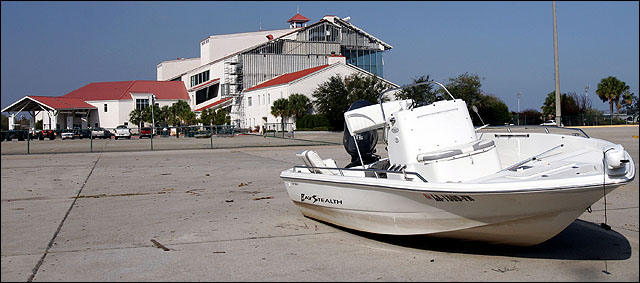
A boat rests Friday in the parking lot of the New Orleans Fairgrounds. A White House adviser acknowledged Friday the government failed to adequately prepare for the consequences of Hurricane Katrina as studies of New Orleans' vulnerability to flooding and lessons from past flawed responses were unheeded.
Townsend delivered a sharp message in President Bush’s name to tamp down internal criticism amid a swirl of House and Senate investigations, saying: “It’s clear we want to quickly identify and fix problems and not play a blame game. … Lessons are what the president wants, not finger-pointing,” she said. “He is less interested in last time. … His concern is with the next time.”
Even before she spoke Friday, however, Homeland Security Secretary Michael Chertoff responded to Senate testimony this week that ousted FEMA director Michael Brown and other top officials ignored a staffer’s eyewitness report about the collapse of the 17th Avenue Canal levee on the Monday the storm hit. The dismissal of accounts of catastrophic flooding by FEMA’s only person in New Orleans, Marty Bahamonde, delayed federal supplies and efforts to move 50,000 people out of harm’s way for nearly a day, senators said.
According to Bahamonde, Brown said he would call the White House after Bahamonde reported to him on the night of Aug. 29 that he had observed a massive break on the Lake Pontchartrain levee and flooding over 80 percent of the city. Chertoff said Brown told him no such thing that day.
Asked what Brown told the White House, Townsend said: “I have to tell you I am unaware of those specific communications. But obviously … if there is some significant fact in there that we need to understand to make sure that we fix the information flow, we’re going to do that.” Bush was briefed by 5 a.m. Tuesday about the city’s rising waters.
Meanwhile, another federal agency involved in disaster response, the U.S. Army Corps of Engineers, said Friday that its official timeline had discounted eyewitness reports by its top official in New Orleans, Col. Richard Wagenaar, confirming a levee breach Monday night. Instead, the Corps said the break was confirmed at 8 a.m. Tuesday.
Townsend said Friday that she expects her 12-person staff’s final report around the end of the year – in time for action by Congress, if necessary, before next year’s hurricane season.
National
Unhealthy air quality in California city as huge warehouse fire burns for 3rd day
Judge orders Trump administration to restore National Park changes at sites that ‘disparaged’ US
Teens’ reading and math scores have stagnated, US test results show
WASHINGTON (AP) — Younger students have regained ground academically after the pandemic's disruptions while older ...
Lawyers for man accused of killing Charlie Kirk try to block death penalty
Trump’s name poised to come off Kennedy Center