Bush’s video teleconference with soldiers draws criticism
Exchange blasted as 'highly scripted'
Washington ? President Bush touched off a new round of controversy over his policies in Iraq on Thursday when he conducted a videoconference interview about this weekend’s constitutional referendum with a small group of hand-picked troops stationed in Iraq who reinforced his upbeat view of the conflict.
The closely coordinated exchange drew disapproval from Democratic war critics as well as some Pentagon military leaders.
The soldiers were coached. Before the session began, a Pentagon communications official, Allison Barber, was heard asking one of them, “Who are we going to give that (question) to?”
Barber later told reporters the soldiers were told only about broad themes Bush wanted to discuss, not specific questions.
With Iraqi troop readiness at the center of the war debate, Bush’s discussion with the troops was questioned by war critics including Senate Minority Leader Harry Reid, D-Nev., who complained that it was “highly scripted,” and by military officers.
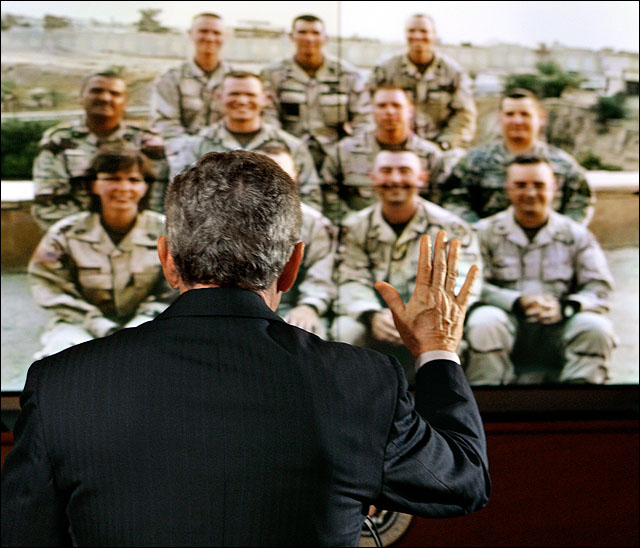
President Bush waves goodbye Thursday as he finishes speaking from the White House to American troops from the 42nd Infantry Division on duty in Tikrit, Iraq, via video teleconference.
White House Press Secretary Scott McClellan said he did not think the soldiers had been told what they could or could not say.
“The troops can ask the president whatever they want,” he said. “They’ve always been free to do that.”
The president did not invite the soldiers to ask any questions, however, and none chose to do so.
Pentagon spokesman Lawrence Di Rita later issued a statement saying, “On behalf of these fine young men and women, we certainly regret any perception that they were told what to say. It is not the case.”
Meanwhile, the Pentagon released its second quarterly report to Congress on the war, saying that although the number of Iraqi battalions capable of fighting alongside U.S. units has increased, infiltration of the Iraqi police by insurgents remains a significant problem.
National
Unhealthy air quality in California city as huge warehouse fire burns for 3rd day
Judge orders Trump administration to restore National Park changes at sites that ‘disparaged’ US
Teens’ reading and math scores have stagnated, US test results show
WASHINGTON (AP) — Younger students have regained ground academically after the pandemic's disruptions while older ...
Lawyers for man accused of killing Charlie Kirk try to block death penalty

Trump’s name poised to come off Kennedy Center