Saddam’s hometown among cities beginning to catch election fever
Tikrit, Iraq ? On the streets of Saddam Hussein’s hometown, young men were hanging campaign posters Thursday, some even reaching out to members of the jailed dictator’s banned political party.
Dozens of political groups in this city of 200,000 are competing in next month’s national election, and turnout throughout the heavily Sunni Arab province is expected to be high.
The activity in Tikrit is a marked contrast to the Jan. 30 parliamentary elections, which most Sunni Arabs boycotted. Their absence from the polls enabled Shiites and Kurds to win an overwhelming majority in the National Assembly, worsening sectarian tensions.
The United States hopes a big turnout will encourage Sunni Arabs to abandon the insurgency in favor of politics, hastening the day the U.S. and other international troops can go home.
But local politicians complain the province that includes Tikrit got shortchanged on the number of parliamentary seats up for grabs. They fear that will reduce the voice of the Sunnis in the new legislature.
“We would like to confirm that we intend, with God’s help, to get involved in the political process to the widest extent that achieves the best representation for the people” of the province, Gov. Hamad Hammoud Shightay told dozens of politicians gathered at his office Thursday.
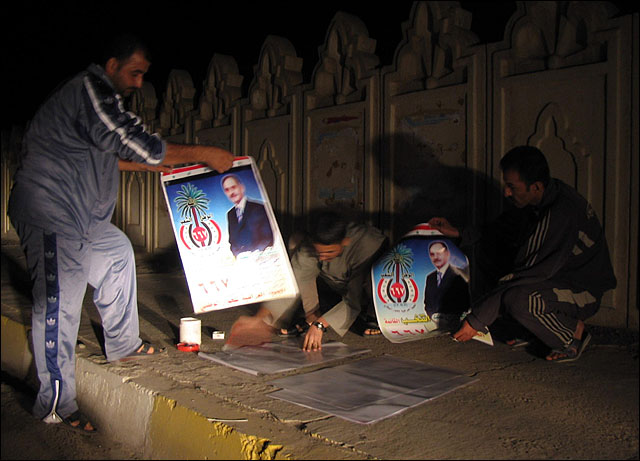
People attach posters of politician Saleh al-Mutlaq, one of the Sunni Arabs who helped draft the new constitution, Thursday in Tikrit, Iraq.
Hours later, posters promoting the candidacy of Saleh al-Mutlaq – one of the Sunni Arabs who helped draft the new constitution – were popping up on the streets of Tikrit, about 80 miles north of Baghdad.
Many Sunni Arabs now agree the January boycott was a mistake. This time, Sunni politicians are complaining that Shiite-led security services are trying to prevent them from voting through a campaign of arrests and intimidation amid allegations of torture and maltreatment at an Interior Ministry detention center in Baghdad.
On Thursday, however, the talk was not of voter intimidation or torture allegations. The main complaint from local politicians was that the province’s 1.1 million people – the vast majority of them Sunni Arabs – are going to get swindled out of their fair share of National Assembly seats under the current election law.
In the last election, the whole of the country was considered a single constituency in which voters from the Turkish border in the north to the frontiers with Saudi Arabia and Kuwait in the south all voted for the same candidates.
That system – along with the Sunni boycott – limited the number of Sunni Arabs elected to the assembly. Shiites make up about 60 percent of Iraq’s 27 million people.
To redress the imbalance, parliament amended the law so that each of the 18 provinces will have a specific number of seats depending on the number of eligible voters.
The total number of seats to be selected nationwide under this formula is 230, with the remaining 45 seats allocated according to how many votes a party gets across the country.
Under the provincial formula, voters in Salahuddin – the province that includes Saddam’s hometown, Tikrit – will directly elect eight members. But politicians at the meeting Thursday pointed to the religiously mixed southern province of Wasit, which has fewer people but gets the same number of representatives.
“We should have a minimum of 12 seats in Salahuddin. They took four seats from us. Most of those 45 seats (for minorities) were taken from predominantly Sunni provinces,” said Abdul-Hadi Jamil, of the National Dialogue Front.
Election officials tried to explain that seat allocation is not based on overall population but the number of eligible voters. The officials presented figures showing 563,000 eligible voters in Salahuddin and 495,000 in Wasit.
National
Unhealthy air quality in California city as huge warehouse fire burns for 3rd day
Judge orders Trump administration to restore National Park changes at sites that ‘disparaged’ US
Teens’ reading and math scores have stagnated, US test results show
WASHINGTON (AP) — Younger students have regained ground academically after the pandemic's disruptions while older ...
Lawyers for man accused of killing Charlie Kirk try to block death penalty
Trump’s name poised to come off Kennedy Center