

A journey to cleanse the heart
'Buffalo Soldiers' play asks whether a fraction can define a whole person
What is the essence of who we are?
Are we defined by family? By our genetic makeup? By our society?
These are the questions asked by William S. Yellow Robe Jr. in his play “Grandchildren of the Buffalo Soldiers,” staged Thursday and Friday at the Lied Center. Commissioned by Trinity Repertory Company through the National Theatre Artist Residency Program, the play premiered at Penumbra Theatre in St. Paul, Minn., in September. Yellow Robe and director Lou Bellamy have been participating in lectures and master classes in the Lawrence and Leavenworth area, discussing Yellow Robe’s vision of an American Indian family torn apart by its own history.
Anchored by a strong and experienced cast, “Grandchildren” tells the story of the Robe family, who are members of the Assiniboine tribe and descended from a buffalo soldier – the name given to members of black military units. The Robe grandchildren find themselves faced with the realities of their mixed heritage: prejudice, confusion, sometimes even hatred. Older brother Craig (James Craven) is driven from the reservation by his own anger toward himself and his brother Brent (Jake Hart), who refuses to acknowledge their half-black father, choosing instead to declare himself a “full-blooded Indian.”
Their brother, Elmo (Freedome Bradley), and sister, Sugar (George A. Keller), remain on the reservation, trying to find peace with themselves and each other until Craig returns for Sugar’s daughter’s naming ceremony. There he must confront his brother’s prejudices and his family’s anger. Hoping to calm the anger in himself, he plans to participate with his brothers in the naming ceremony by playing their father’s drum. Sugar hopes that if the brothers come together in their music, they will be joined as a family again in acceptance of one another and their past.
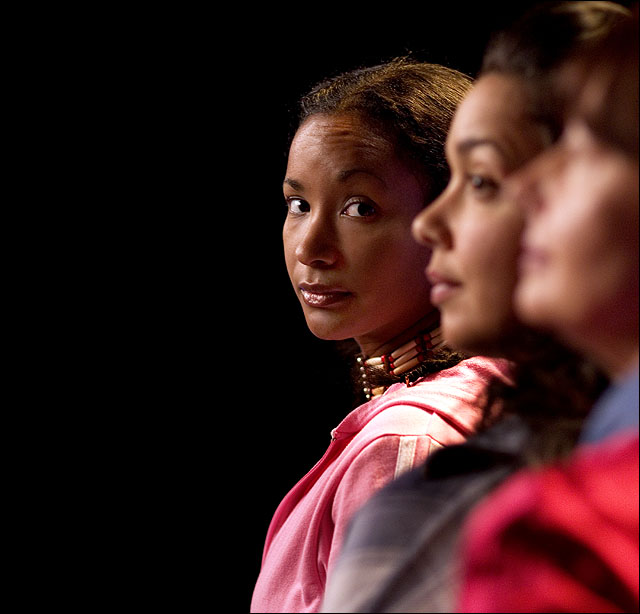
From left to right, Maya Washington (August Jackson), George A. Keller (Carol Sugar Robe) and Donna Brooks (Juanita Jones) star in Grandchildren
While the events surround the girl’s traditional coming-of-age ceremony, the play is about names on many different levels. The show raised many questions: What is your name? Is it too “white” or too “Indian”? Are you Indian or black? Is that enough to define who you are? Yellow Robe asks, “Does the word ‘breed’ or ‘mixed blood’ describe the very essence of a person?” Should one be defined as “half” of anything? Or should one ignore an essential element of oneself by choosing one “side” over the other?
Americans of all races have long been prone to describing themselves “one-half” or “one-quarter” of many different ethnicities and heritages, and American Indians codify this process with papers asserting their genetic makeup, thus “(quantifying their) blood into a representational numerical fraction.” Yellow Robe wishes everyone would consider whether a “person’s identity, humanity and spirit can be as easily measured.”
Craig Robe’s return to the reservation signals his desire to return to his Native heritage, but he realizes that his heritage must be an understanding and acceptance of himself as a whole rather than the denial of any part.
– Sarah Young is a lecturer in Kansas University’s English department. She can be reached at youngsl@ku.edu.
Arts and Entertainment

Photos: Lawrence begins World Cup festivities with downtown block party

Watkins Museum to open special exhibit detailing how Douglas County celebrated America’s Bicentennial

Go, See, Do: Kaw River Roots Festival, markets and more
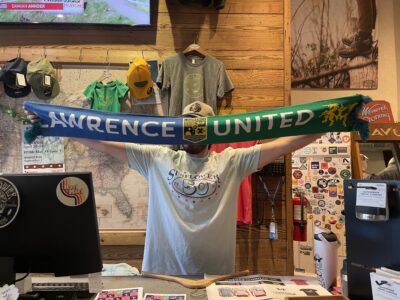
Soccer gear honoring Lawrence history’s all-star team is now on sale as part of city’s public art exhibition

Nominations, call for artists open for Lawrence’s 2026 Phoenix Awards