

Marines offer mixed opinions on ‘Jarhead’
It is hard to imagine more attentive audiences for the opening weekend of “Jarhead” than the active-duty and retired Marines who flocked to the theater just outside Camp Pendleton, Calif., where the movie, adapted from ex-Marine Anthony Swofford’s book about the Persian Gulf War, was showing on three screens.
In large measure, what the Marines saw conformed to their sense of themselves and the Corps: the tough training, the forever use of the F-word, the camaraderie, the “first-to-fight” spirit, even small details – the common belief that the Army gets better equipment and that your girlfriend back home is cheating on you with that infamous snake “Jody.”
Jamie Foxx as the kick-butt staff sergeant and Chris Cooper as the charismatic battalion commander received high marks for realism. But in two fundamental ways, “Jarhead” was seen by many in attendance at the multiplex in downtown Oceanside, Calif., with first-hand experience of the war in Iraq, as a relic from a world that no longer exists.
The Gulf War took place in a world before Sept. 11, before young men enlisted in the Marine Corps not with the vague hope of combat but with the full promise of it.
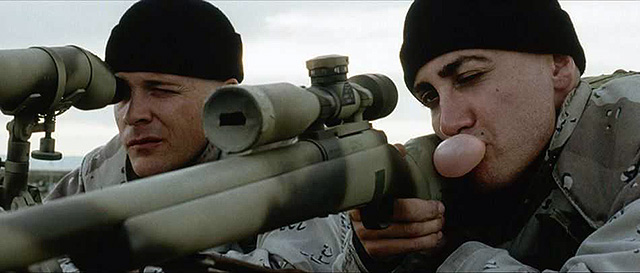
Jake Gyllenhaal, right, portrays a marine who does not quite know why he has been sent to Saudi Arabia during the first Persian Gulf War. The reactions of many characters in the movie is somewhat outdated now that the reality of combat is a certainty for anyone entering military service after Sept. 11.
And it was a world before the Marine Corps and other U.S. forces were mired in a war of attrition with a relentless and lethal insurgency that kills by stealth and remote control and where enemy fighters are often indistinguishable from civilians.
In “Jarhead,” as in that earlier war it depicts, opposing forces mass at opposite ends of an open plain and then collide in great, albeit brief, fury. In such a contest, the U.S. enjoyed the enormous advantage of superior technology and firepower, with the result never truly in doubt.
Jake Gyllenhaal’s Swofford is unsure of why he has been sent to Saudi Arabia to help oust Saddam Hussein’s army from Kuwait. Swofford had joined the Marines in the twilight between the end of the Cold War and the full explosion of the U.S. war on terrorism.
The world that gave rise to Swofford’s ambivalence ended “when we watched those two towers come down,” said retired Master Gunnery Sgt. Steven Schweitzer, 46, who served 27 years, including during the 2003 assault on Baghdad.
As film critics have noted, it helped that Swofford’s book was published shortly before the assault on Baghdad, but that might not help the movie because of the differences between the Iraq war and the one Swofford fought in 1991.
“That was the last classic force-on-force war,” said retired Gunnery Sgt. Robert Kane, 41, who served for 22 years, including stints in the Gulf War, Afghanistan and the assault to topple Saddam. The current conflict “has changed the entire nature of warfare.”
As Marines from Camp Pendleton prepare for their fourth deployment to Iraq, the enemy that awaits them is not an opposing army but insurgents from multiple countries planting roadside explosives and using suicide bombers.
This war has also seen a change in perspective for many of those fighting in it. During the Gulf War, service personnel fought to liberate a country that some had never even heard of. For many in today’s military, the terrorist attack on the United States made this fight more personal.
Swofford “doesn’t seem to know the reason he’s being sent to fight,” said Pvt. Matthew Donnelly, 18, of Salem, Ore., who is being deployed to Iraq soon. “I know exactly why: to serve my country and protect my brothers in arms.”
As the U.S. attempts to help a fledgling Iraqi government, Marines are engaged not solely in head-on combat but in what the Corps calls a “three-block war”: fighting a gun battle on one block, providing humanitarian assistance on another and acting as peacekeepers on a third.
“It’s a different war,” said Donald F. Armento, 48, a colonel in the Marine Corps Reserves with 23 years’ experience. “We went after the symptoms (in Kuwait). Now we’re going after the causes.”
Arts and Entertainment

Photos: Lawrence begins World Cup festivities with downtown block party

Watkins Museum to open special exhibit detailing how Douglas County celebrated America’s Bicentennial

Go, See, Do: Kaw River Roots Festival, markets and more
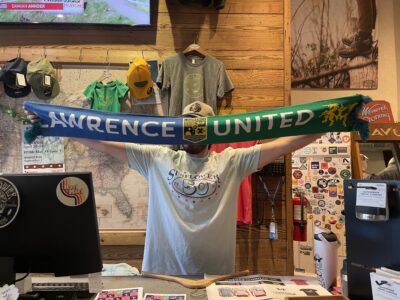
Soccer gear honoring Lawrence history’s all-star team is now on sale as part of city’s public art exhibition

Nominations, call for artists open for Lawrence’s 2026 Phoenix Awards