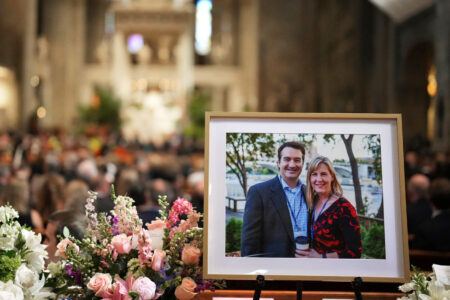
U.S. troops withdraw from Saddam’s compound
Tikrit, Iraq ? Under a cloudless autumn sky in the heart of Saddam Hussein’s home region, commanders of the U.S. Army’s 42nd Infantry Division withdrew Tuesday from a sprawling 18-palace compound that has been a U.S. base since 2003.
They called the move a step toward reducing the visibility of U.S. troops and eventually withdrawing them altogether.
The scenic, hilly campus straddling the Tigris River, an enduring symbol of Hussein’s rule and largesse, stands just a few miles from the village where the former dictator was born and the earthen pit where U.S. forces captured him last year. By Monday morning, the cold stone halls were eerily empty, a command center that once buzzed with computer screens and communications equipment reduced to some plywood tables and sleeping bags for the few remaining troops.
Known to the Americans as Forward Operating Base Danger, it will be formally turned over to the provincial government on Nov. 22 after three weeks of logistical preparations, said Maj. Gen. Joseph Taluto, commander of the 42nd Infantry, which is leaving Iraq this month. For now, an American artillery battalion is all that remains.
“Soon this place that was once for only an elite few will be a place for the Iraqi people,” Taluto told a crowd of Iraqi politicians and tribal leaders and fellow generals gathered for a ceremony transferring control of the region north of Baghdad to the Army’s 101st Airborne Division, which recently arrived for its second tour in Iraq and will be headquartered at a U.S. base a few miles outside Tikrit.
“Instead of representing how one man used Iraq’s wealth, it will represent how Iraq’s wealth can be used for its people,” Taluto said.
Grandiose even by Hussein’s notably gaudy standards – its 134 buildings are adorned with inlaid brass and kitschy chandeliers, their walls covered in a veneer of marble – the complex was built after the 1991 Persian Gulf War for Hussein’s relatives and political patrons. One of its palaces has a waterfall running through it. A tributary of the Tigris, teeming with three-foot-long carp, flows underneath another.
The palace complex will be the 30th U.S. base turned over to Iraqis this year, said Brig. Gen. Donald Alston, a top U.S. spokesman in Iraq, who joined generals George Casey, commander of U.S. forces in Iraq, and John Vines, commander of the multinational corps, at Tuesday’s ceremony.
The purpose of such transfers is to reduce the footprint of the U.S. presence in Iraq, both to discourage attacks and to pave the way for eventual reduction of American troops, Taluto said. He gave no timetable for when such withdrawals might occur.
The United States has already begun scaling back operations in some places, Taluto said, and would continue to do so. “We used to go into Tikrit quite a bit. We don’t go into Tikrit much anymore,” he said. “Iraqi army units are getting more proficient. I think we should be making them do more and more. That means we’re going to be doing less and less. And we’re going to be less exposed.
Gov. Hamid Hamoud Qaisi, the top political leader in Salahuddin province, whose capital is Tikrit, said he intended to move his office into the palace complex temporarily, along with the provincial council and police department.
“It will be a fortune for all the people here,” said Qaisi, who said 3,000 police and soldiers would initially be assigned to protect the compound. The province remains a hub for Hussein loyalists and voted overwhelmingly against the Iraq’s draft constitution in the referendum held Oct. 15.
National
Lawyers for man accused of killing Charlie Kirk try to block death penalty
Trump’s name poised to come off Kennedy Center

Suspect in Texas shooting had fired at police days earlier, officials say

Man pleads guilty to killing a top Minnesota Democrat and her husband
New tornadoes outside Chicago as severe storms pummel the Midwest